Distance to the Horizon The distance that a person can see to the horizon on a clear day from a point above the surface of Earth varies directly as the square root of the height at that point. If a person 144 m above the surface of Earth can see 18 km to the horizon, how far can a person see to the horizon from a point 64 m above the surface?
Ch. 3 - Polynomial and Rational Functions

4장, 문제 31
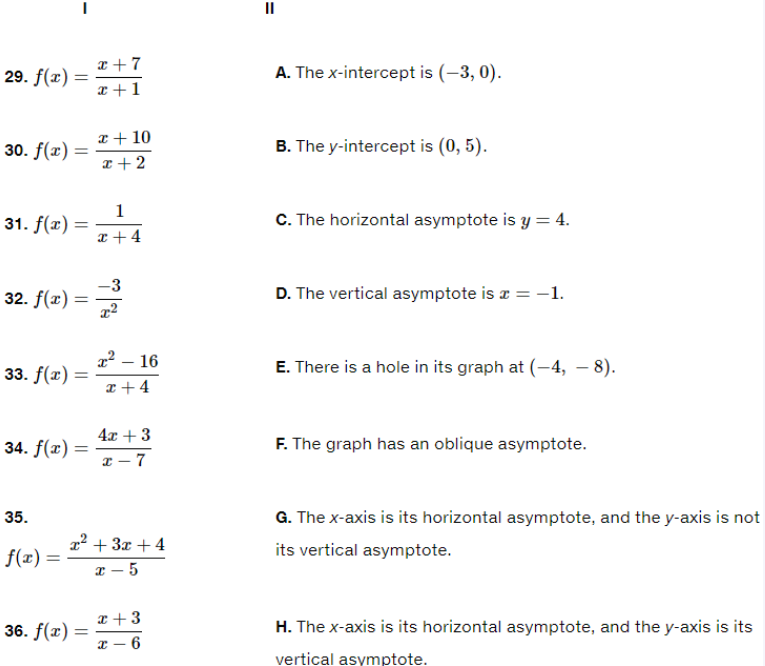
Match the rational function in Column I with the appropriate description in Column II. Choices in Column II can be used only once. ƒ(x)=1/(x+4)

검증된 단계별 안내1
Identify the given rational function: \(f(x) = \frac{1}{x+4}\).
Recognize that the function is a transformation of the parent function \(f(x) = \frac{1}{x}\), shifted horizontally.
Determine the vertical asymptote by setting the denominator equal to zero: \(x + 4 = 0\), which gives \(x = -4\).
Note that the horizontal asymptote of the function remains \(y = 0\) because the degree of the numerator is less than the degree of the denominator.
Match the function to the description that mentions a vertical asymptote at \(x = -4\) and a horizontal asymptote at \(y = 0\), indicating a horizontal shift of the parent function.

비슷한 문제에 대한 검증된 영상 답변:
이 영상 해법은 위 문제에 도움이 된다고 튜터들이 추천한 것입니다.
영상 길이:
1m주요 개념
질문에 올바르게 답하기 위해 반드시 이해해야 하는 핵심 개념들은 다음과 같습니다.
Rational Functions
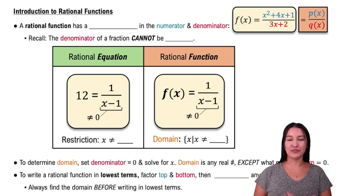
A rational function is a ratio of two polynomials, expressed as f(x) = P(x)/Q(x), where Q(x) ≠ 0. Understanding the form and behavior of rational functions helps in identifying their key features such as asymptotes and domain restrictions.
추천 영상:
Intro to Rational Functions
Domain of Rational Functions
The domain of a rational function includes all real numbers except where the denominator equals zero. For f(x) = 1/(x+4), the domain excludes x = -4, since division by zero is undefined, which is critical for matching the function to its description.
추천 영상:
Intro to Rational Functions
Vertical and Horizontal Asymptotes
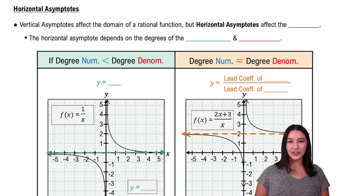
Vertical asymptotes occur where the denominator is zero, indicating values the function cannot take. Horizontal asymptotes describe the end behavior of the function as x approaches infinity or negative infinity. For f(x) = 1/(x+4), x = -4 is a vertical asymptote, and y = 0 is a horizontal asymptote.
추천 영상:
Determining Horizontal Asymptotes
관련 실천
교과서 질문
511
views
교과서 질문
Factor into linear factors given that k is a zero. (multiplicity )
1010
views
교과서 질문
Show that each polynomial function has a real zero as described in parts (a) and (b). In Exercises 31 and 32, also work part (c). ƒ(x)=3x^3-8x^2+x+2 Find the zero in part (b) to three decimal places.
365
views
교과서 질문
Show that each polynomial function has a real zero as described in parts (a) and (b). In Exercises 31 and 32, also work part (c). ƒ(x)=3x^3-8x^2+x+2 between 2 and 3
369
views
교과서 질문
Solve each polynomial inequality. Give the solution set in interval notation. -(x - 3)(x - 4)2 (x - 5) > 0
475
views
교과서 질문
Show that each polynomial function has a real zero as described in parts (a) and (b). In Exercises 31 and 32, also work part (c). ƒ(x)=3x^3-8x^2+x+2 between -1 and 0
275
views
