Use synthetic division to divide ƒ(x) by x-k for the given value of k. Then express ƒ(x) in the form ƒ(x) = (x-k) q(x) + r. ƒ(x) = 3x4 + 4x3 - 10x2 + 15; k = -1
Ch. 3 - Polynomial and Rational Functions

4장, 문제 31
Distance to the Horizon The distance that a person can see to the horizon on a clear day from a point above the surface of Earth varies directly as the square root of the height at that point. If a person 144 m above the surface of Earth can see 18 km to the horizon, how far can a person see to the horizon from a point 64 m above the surface?
검증된 단계별 안내1
Identify the variables and the direct variation relationship: Let \(d\) represent the distance to the horizon (in km) and \(h\) represent the height above the Earth's surface (in meters). The problem states that \(d\) varies directly as the square root of \(h\), so we write the equation as \(d = k \sqrt{h}\), where \(k\) is the constant of proportionality.
Use the given information to find the constant \(k\): Substitute \(d = 18\) km and \(h = 144\) m into the equation \(d = k \sqrt{h}\) to get \(18 = k \sqrt{144}\). Since \(\sqrt{144} = 12\), this simplifies to \(18 = 12k\).
Solve for \(k\): Divide both sides of the equation \(18 = 12k\) by 12 to isolate \(k\), giving \(k = \frac{18}{12}\).
Use the constant \(k\) to find the distance for the new height: Substitute \(k\) and the new height \(h = 64\) m into the original equation \(d = k \sqrt{h}\) to get \(d = k \sqrt{64}\). Since \(\sqrt{64} = 8\), this becomes \(d = 8k\).
Calculate the distance \(d\) by multiplying \(8\) by the value of \(k\) found in step 3. This will give the distance to the horizon from a point 64 m above the surface.

비슷한 문제에 대한 검증된 영상 답변:
이 영상 해법은 위 문제에 도움이 된다고 튜터들이 추천한 것입니다.
영상 길이:
3m도움이 되었나요?
주요 개념
질문에 올바르게 답하기 위해 반드시 이해해야 하는 핵심 개념들은 다음과 같습니다.
Direct Variation
Direct variation describes a relationship where one quantity changes proportionally with another. In this problem, the distance to the horizon varies directly as the square root of the height, meaning if height changes, the distance changes by a constant multiple of the square root of that height.
추천 영상:
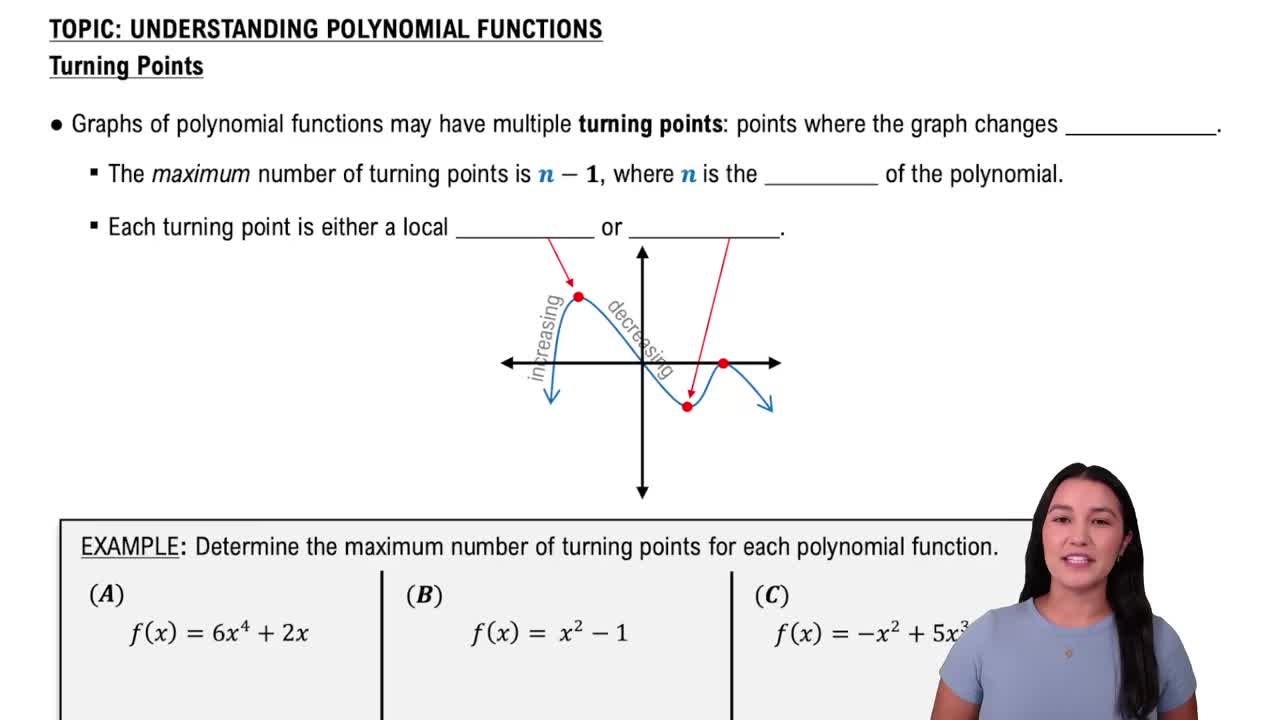
Maximum Turning Points of a Polynomial Function
Square Root Function
The square root function involves taking the root of a number, which is the inverse of squaring. Here, the distance depends on the square root of the height, so understanding how to compute and manipulate square roots is essential to relate height and distance.
추천 영상:
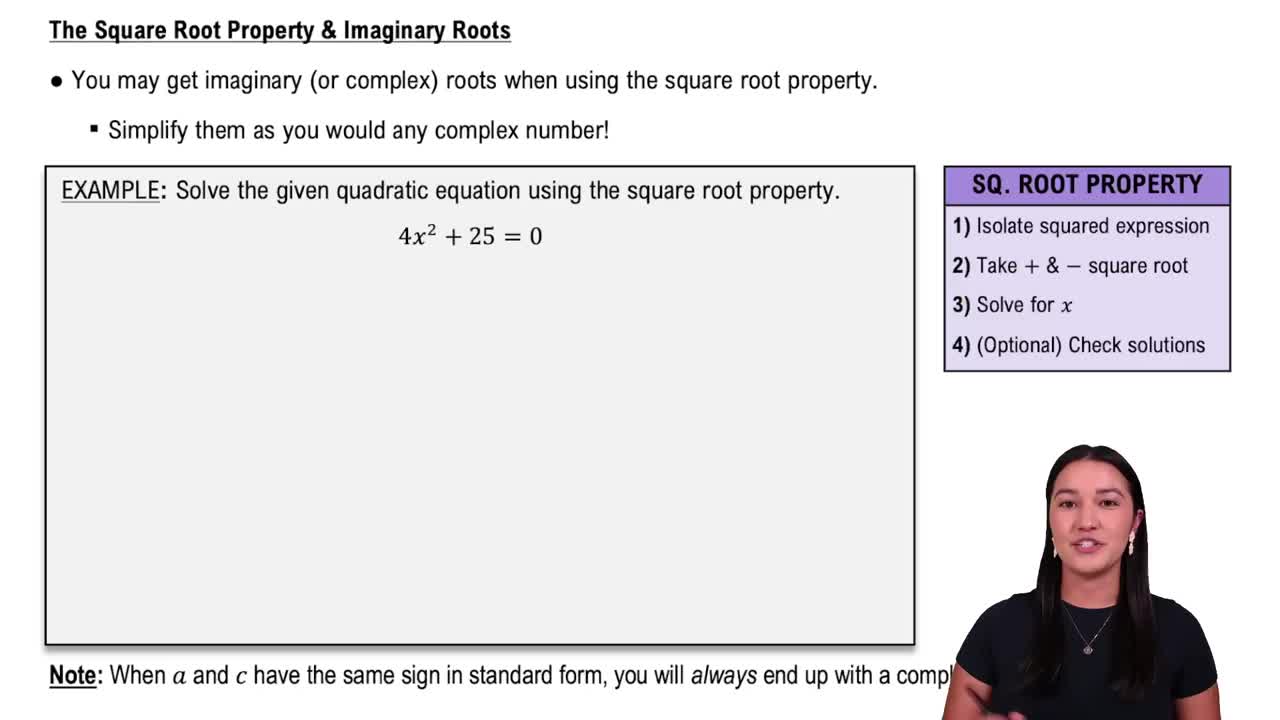
Imaginary Roots with the Square Root Property
Solving Proportions
Solving proportions involves setting two ratios equal to each other to find an unknown value. Since the problem gives a known height-distance pair, you can set up a proportion using the square roots of heights to find the unknown distance for a different height.
추천 영상:
Solving Logarithmic Equations
관련 실천
교과서 질문
679
views
1
rank
교과서 질문
Factor into linear factors given that k is a zero. (multiplicity )
1010
views
교과서 질문
Match the rational function in Column I with the appropriate description in Column II. Choices in Column II can be used only once. ƒ(x)=1/(x+4)
871
views
교과서 질문
Show that each polynomial function has a real zero as described in parts (a) and (b). In Exercises 31 and 32, also work part (c). ƒ(x)=3x^3-8x^2+x+2 between 2 and 3
369
views
교과서 질문
Solve each polynomial inequality. Give the solution set in interval notation. -(x - 3)(x - 4)2 (x - 5) > 0
475
views
교과서 질문
Show that each polynomial function has a real zero as described in parts (a) and (b). In Exercises 31 and 32, also work part (c). ƒ(x)=3x^3-8x^2+x+2 between -1 and 0
275
views