Ch. 3 - Polynomial and Rational Functions
Lial - College Algebra 13th Edition
Lial13th EditionCollege AlgebraISBN: 9780136881063당신이 사용하는 게 아니라요?교과서 변경
4장, 문제 50d

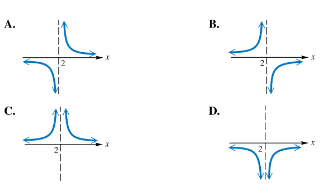
Work each problem. Choices A–D below show the four ways in which the graph of a rational function can approach the vertical line x=2 as an asymptote. Identify the graph of each rational function defined in parts (a) – (d). ƒ(x)=1/(x2)2ƒ(x)=-1/(x-2)^2

검증된 단계별 안내
1
Identify the vertical asymptote by setting the denominator equal to zero: solve \( (x - 2)^2 = 0 \) which gives \( x = 2 \). This means the vertical asymptote is the line \( x = 2 \).
Analyze the behavior of the function near the vertical asymptote. Since the denominator is squared, \( (x - 2)^2 \), it is always positive except at \( x = 2 \) where it is zero, causing the function to be undefined there.
Consider the sign of the function on either side of \( x = 2 \). Because the numerator is \( -1 \), which is negative, and the denominator is always positive (except at \( x=2 \)), the function \( f(x) = \frac{-1}{(x-2)^2} \) will always be negative for values of \( x \) near but not equal to 2.
Determine the behavior of \( f(x) \) as \( x \) approaches 2 from the left and right. Since the denominator approaches zero and is squared, the function values will tend toward negative infinity on both sides of the asymptote.
Summarize the graph behavior near \( x=2 \): the graph approaches the vertical line \( x=2 \) with the function values decreasing without bound (going to negative infinity) on both sides, indicating the graph is below the \( x \)-axis near the asymptote.

비슷한 문제에 대한 검증된 영상 답변:

이 영상 해법은 위 문제에 도움이 된다고 튜터들이 추천한 것입니다.
영상 길이:
3m
도움이 되었나요?

주요 개념

질문에 올바르게 답하기 위해 반드시 이해해야 하는 핵심 개념들은 다음과 같습니다.

Vertical Asymptotes of Rational Functions

Vertical asymptotes occur where the denominator of a rational function equals zero and the numerator is nonzero, causing the function to approach infinity or negative infinity. For ƒ(x) = -1/(x-2)^2, the vertical asymptote is at x = 2 because the denominator becomes zero there.
추천 영상:
3:12
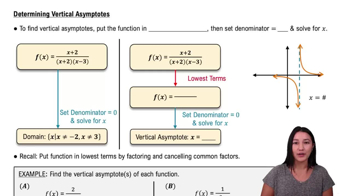
Determining Vertical Asymptotes

Behavior Near Vertical Asymptotes

The behavior of a function near a vertical asymptote depends on the power of the factor in the denominator. When the denominator is squared, as in (x-2)^2, the function approaches the same infinity (positive or negative) on both sides of the asymptote, resulting in a 'U'-shaped graph near x=2.
추천 영상:
3:12
Determining Vertical Asymptotes

Sign and Shape of the Graph Near the Asymptote

The negative sign in ƒ(x) = -1/(x-2)^2 flips the graph below the x-axis. Since the denominator is squared and always positive (except at x=2), the function values are always negative and approach negative infinity on both sides of x=2, creating a downward 'U' shape near the vertical asymptote.
추천 영상:
6:24
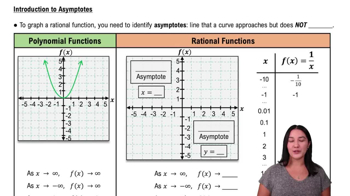
Introduction to Asymptotes