For each polynomial function, find all zeros and their multiplicities.
Ch. 3 - Polynomial and Rational Functions

4장, 문제 51
Work each problem. Which function has a graph that does not have a vertical asymptote?
A. ƒ(x)=1/(x2+2)
B. ƒ(x)=1/(x2-2)
C. ƒ(x)=3/x2
D. ƒ(x)=(2x+1)/(x-8)
검증된 단계별 안내1
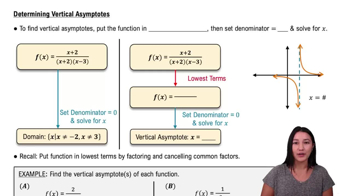
Recall that vertical asymptotes occur where the denominator of a rational function is equal to zero, causing the function to be undefined at those points.
For each function, identify the denominator and set it equal to zero to find potential vertical asymptotes.
For option A: The denominator is \(x^2 + 2\). Set \(x^2 + 2 = 0\) and solve for \(x\).
For option B: The denominator is \(x^2 - 2\). Set \(x^2 - 2 = 0\) and solve for \(x\).
For option C: The denominator is \(x^2\). Set \(x^2 = 0\) and solve for \(x\). For option D: The denominator is \(x - 8\). Set \(x - 8 = 0\) and solve for \(x\). Then determine which function's denominator has no real solutions, indicating no vertical asymptotes.

비슷한 문제에 대한 검증된 영상 답변:
이 영상 해법은 위 문제에 도움이 된다고 튜터들이 추천한 것입니다.
영상 길이:
4m도움이 되었나요?
주요 개념
질문에 올바르게 답하기 위해 반드시 이해해야 하는 핵심 개념들은 다음과 같습니다.
Vertical Asymptotes
Vertical asymptotes occur in the graph of a function where the function approaches infinity or negative infinity as the input approaches a specific value, typically where the denominator of a rational function is zero and the numerator is nonzero.
추천 영상:
Determining Vertical Asymptotes
Domain of Rational Functions
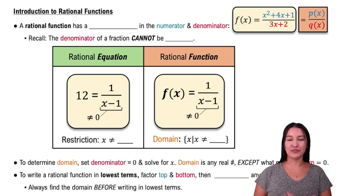
The domain of a rational function includes all real numbers except where the denominator equals zero, since division by zero is undefined. Identifying these values helps determine where vertical asymptotes may exist.
추천 영상:
Intro to Rational Functions
Analyzing Quadratic Expressions in Denominators
Quadratic expressions in denominators can be factored or analyzed using the discriminant to find real roots. If the quadratic has no real roots, the denominator never equals zero, meaning no vertical asymptotes occur.
추천 영상:
Rationalizing Denominators
관련 실천
교과서 질문
399
views
교과서 질문
Use synthetic division to determine whether the given number k is a zero of the polynomial function. If it is not, give the value of ƒ(k). ƒ(x) = 2x3 - 6x2 -9x + 4; k=1
389
views
교과서 질문
Work each problem. Choices A–D below show the four ways in which the graph of a rational function can approach the vertical line x=2 as an asymptote. Identify the graph of each rational function defined in parts (a) – (d).
225
views
교과서 질문
Connecting Graphs with Equations Find a quadratic function f having the graph shown. (Hint: See the Note following Example 3.)
1311
views
교과서 질문
For each polynomial function, find all zeros and their multiplicities.
660
views
교과서 질문
Use the intermediate value theorem to show that each polynomial function has a real zero between the numbers given. ƒ(x)=2x4-4x2+4x-8; 1 and 2
1058
views