Ch. 4 - Inverse, Exponential, and Logarithmic Functions
Lial - College Algebra 13th Edition
Lial13th EditionCollege AlgebraISBN: 9780136881063당신이 사용하는 게 아니라요?교과서 변경
5장, 문제 53

Graph each function. Give the domain and range. ƒ(x) = (1/3)x+2

검증된 단계별 안내
1
Identify the function given: \(f(x) = \left(\frac{1}{3}\right)^{x+2}\). This is an exponential function with base \(\frac{1}{3}\), which is between 0 and 1, indicating exponential decay.
Determine the domain of the function. Since exponential functions are defined for all real numbers, the domain is all real numbers, expressed as \((-\infty, \infty)\).
Analyze the range of the function. Because \(\left(\frac{1}{3}\right)^{x+2}\) is always positive (a positive base raised to any real power), the function's values are always greater than 0. Therefore, the range is \((0, \infty)\).
To graph the function, start by plotting key points. For example, calculate \(f(x)\) at \(x = -2\) to find the y-intercept: \(f(-2) = \left(\frac{1}{3}\right)^0 = 1\). Then choose other values like \(x = 0\) and \(x = -4\) to see how the function behaves.
Sketch the curve showing exponential decay: as \(x\) increases, \(f(x)\) approaches 0 but never touches the x-axis (horizontal asymptote at \(y=0\)), and as \(x\) decreases, \(f(x)\) grows larger. Label the domain and range on your graph accordingly.

비슷한 문제에 대한 검증된 영상 답변:

이 영상 해법은 위 문제에 도움이 된다고 튜터들이 추천한 것입니다.
영상 길이:
6m
도움이 되었나요?

주요 개념

질문에 올바르게 답하기 위해 반드시 이해해야 하는 핵심 개념들은 다음과 같습니다.

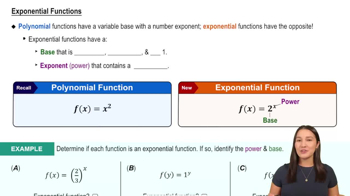
Exponential Functions

An exponential function has the form f(x) = a^x, where the base a is a positive constant not equal to 1. In this problem, the function is f(x) = (1/3)^(x+2), which means the output changes exponentially as x changes. Understanding how the base affects growth or decay is essential for graphing.
추천 영상:
6:13
Exponential Functions

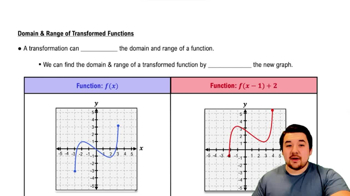
Domain and Range of Functions

The domain of a function is the set of all possible input values (x-values), and the range is the set of all possible output values (f(x)-values). For exponential functions like this one, the domain is all real numbers, while the range is typically positive real numbers, reflecting the function's behavior.
추천 영상:
4:22
Domain & Range of Transformed Functions

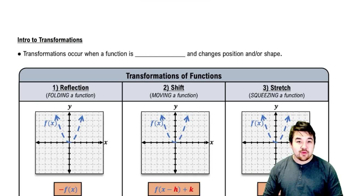
Graphing Transformations

Graphing transformations involve shifts, stretches, or reflections of the basic function graph. The term (x+2) inside the exponent shifts the graph horizontally to the left by 2 units. Recognizing this helps in accurately plotting the function and understanding its behavior.
추천 영상:
5:25
Intro to Transformations