Ch. 4 - Inverse, Exponential, and Logarithmic Functions
Lial - College Algebra 13th Edition
Lial13th EditionCollege AlgebraISBN: 9780136881063당신이 사용하는 게 아니라요?교과서 변경
5장, 문제 31

Solve each equation. In Exercises 11–34, give irrational solutions as decimals correct to the nearest thousandth. In Exercises 35-40, give solutions in exact form. 2(1.05)x + 3 = 10

검증된 단계별 안내
1
Start by isolating the exponential expression. Subtract 3 from both sides of the equation to get: \(2(1.05)^x = 10 - 3\).
Simplify the right side: \(2(1.05)^x = 7\).
Divide both sides by 2 to isolate the exponential term: \((1.05)^x = \frac{7}{2}\).
To solve for \(x\), take the natural logarithm (ln) of both sides: \(\ln\left((1.05)^x\right) = \ln\left(\frac{7}{2}\right)\).
Use the logarithm power rule to bring down the exponent: \(x \cdot \ln(1.05) = \ln\left(\frac{7}{2}\right)\). Then solve for \(x\) by dividing both sides by \(\ln(1.05)\): \(x = \frac{\ln\left(\frac{7}{2}\right)}{\ln(1.05)}\).

비슷한 문제에 대한 검증된 영상 답변:

이 영상 해법은 위 문제에 도움이 된다고 튜터들이 추천한 것입니다.
영상 길이:
1m
도움이 되었나요?

주요 개념

질문에 올바르게 답하기 위해 반드시 이해해야 하는 핵심 개념들은 다음과 같습니다.

Exponential Equations

An exponential equation is one in which the variable appears in the exponent, such as 2(1.05)^x + 3 = 10. Solving these requires isolating the exponential expression before applying logarithms or other methods to find the variable.
추천 영상:
5:47
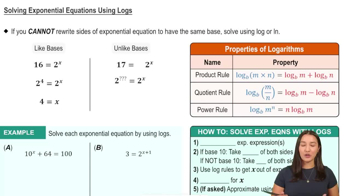
Solving Exponential Equations Using Logs

Isolating the Exponential Term

To solve an exponential equation, first isolate the term containing the exponent by performing inverse operations like subtraction and division. For example, subtract 3 and then divide by 2 to get (1.05)^x alone.
추천 영상:
6:13
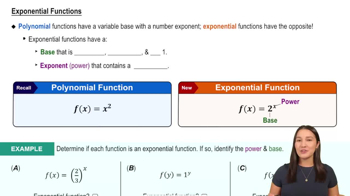
Exponential Functions

Using Logarithms to Solve for the Exponent

Once the exponential term is isolated, apply logarithms (common or natural) to both sides to bring the exponent down. This allows solving for x by using the property log(a^x) = x log(a), enabling calculation of the variable.
추천 영상:
5:02
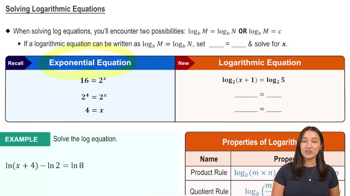
Solving Logarithmic Equations