
교과서 질문
To solve each problem, refer to the formulas for compound interest. A = P (1 + r/n)tn and A = Pert Find t, to the nearest hundredth of a year, if \$1786 becomes \$2063 at 2.6%, with interest compounded monthly.
715
views

 검증된 단계별 안내
 5:36
5:36
 5:26
5:26 4:22
4:22To solve each problem, refer to the formulas for compound interest. A = P (1 + r/n)tn and A = Pert Find t, to the nearest hundredth of a year, if \$1786 becomes \$2063 at 2.6%, with interest compounded monthly.
Use the properties of inverses to determine whether ƒ and g are inverses. ƒ(x) = log↓2 x+1, g(x) = 2x-1
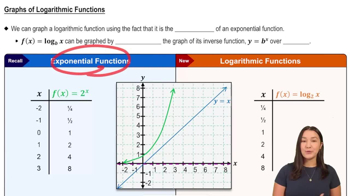
Use the properties of inverses to determine whether ƒ and g are inverses. ƒ(x) = 5^x, g(x) = log↓5 x
To solve each problem, refer to the formulas for compound interest. A = P (1 + r/n)tn and A = Pert At what interest rate, to the nearest hundredth of a percent, will \$16,000 grow to \$20,000 if invested for 7.25 yr and interest is compounded quarterly?
Use properties of logarithms to rewrite each function, then graph. ƒ(x) = log3 [9 (x+2) ]
Use properties of logarithms to rewrite each function, then graph. ƒ(x) = log3 (x+1)/9