To solve each problem, refer to the formulas for compound interest. A = P (1 + r/n)tn and A = Pert Find t, to the nearest hundredth of a year, if \$1786 becomes \$2063 at 2.6%, with interest compounded monthly.
Ch. 4 - Inverse, Exponential, and Logarithmic Functions

5장, 문제 103
Use properties of logarithms to rewrite each function, then graph. ƒ(x) = log3 (x+1)/9
검증된 단계별 안내1
Identify the given function: \(f(x) = \log_{3} \left(x + \frac{1}{9}\right)\). The goal is to rewrite it using properties of logarithms to simplify or transform the expression for easier graphing.
Recall the logarithm property for sums inside the log: \(\log_b (a + c)\) cannot be directly separated into simpler log terms. However, check if the argument \(x + \frac{1}{9}\) can be rewritten as a product or quotient to apply log properties like \(\log_b (mn) = \log_b m + \log_b n\) or \(\log_b \left(\frac{m}{n}\right) = \log_b m - \log_b n\).
Since \(x + \frac{1}{9}\) is a sum, try to express it in a form involving multiplication or division. For example, consider if \(x + \frac{1}{9}\) can be rewritten as \(\frac{9x + 1}{9}\), which is a quotient.
Use the logarithm quotient property: \(\log_b \left(\frac{m}{n}\right) = \log_b m - \log_b n\). Applying this to \(\log_3 \left(\frac{9x + 1}{9}\right)\) gives \(\log_3 (9x + 1) - \log_3 9\).
Simplify \(\log_3 9\) since \(9 = 3^2\), so \(\log_3 9 = 2\). Thus, the function can be rewritten as \(f(x) = \log_3 (9x + 1) - 2\). This form is easier to analyze and graph.

비슷한 문제에 대한 검증된 영상 답변:
이 영상 해법은 위 문제에 도움이 된다고 튜터들이 추천한 것입니다.
영상 길이:
4m도움이 되었나요?
주요 개념
질문에 올바르게 답하기 위해 반드시 이해해야 하는 핵심 개념들은 다음과 같습니다.
Properties of Logarithms
Properties of logarithms include rules such as the product, quotient, and power rules that simplify logarithmic expressions. For example, log_b(xy) = log_b(x) + log_b(y) and log_b(x^k) = k log_b(x). These properties help rewrite complex logarithmic functions into simpler forms for easier analysis and graphing.
추천 영상:
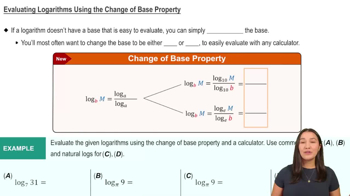
Change of Base Property
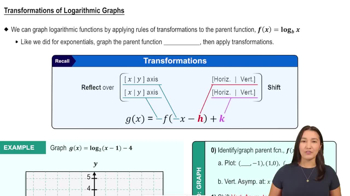
Logarithmic Function Transformation
Transformations of logarithmic functions involve shifts, stretches, and reflections that change the graph's position or shape. Adding or subtracting constants outside the log shifts the graph vertically, while changes inside the log affect horizontal shifts. Understanding these helps in sketching the graph accurately after rewriting the function.
추천 영상:
Transformations of Logarithmic Graphs
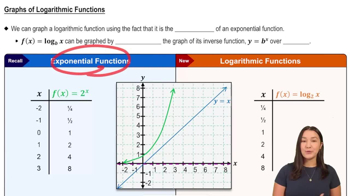
Graphing Logarithmic Functions
Graphing logarithmic functions requires knowledge of their domain, range, intercepts, and asymptotes. The basic log function has a vertical asymptote where the argument is zero and passes through (1,0). After rewriting the function using properties, these features guide the sketching of the graph.
추천 영상:
Graphs of Logarithmic Functions
관련 실천
교과서 질문
715
views
교과서 질문
Use properties of logarithms to rewrite each function, then graph. ƒ(x) = log2 [4 (x-3) ]
1014
views
교과서 질문
Use the properties of inverses to determine whether ƒ and g are inverses. ƒ(x) = 5^x, g(x) = log↓5 x
665
views
교과서 질문
To solve each problem, refer to the formulas for compound interest. A = P (1 + r/n)tn and A = Pert At what interest rate, to the nearest hundredth of a percent, will \$16,000 grow to \$20,000 if invested for 7.25 yr and interest is compounded quarterly?
726
views
교과서 질문
Use properties of logarithms to rewrite each function, then graph. ƒ(x) = log3 [9 (x+2) ]
752
views
교과서 질문
Use properties of logarithms to rewrite each function, and describe how the graph of the given function compares to the graph of g(x) = ln x. ƒ(x) = ln(e2x)
46
views