
교과서 질문
Use the various properties of exponential and logarithmic functions to evaluate the expressions in parts (a)–(c). Given ƒ(x) = 3x, find ƒ(log3 2)
775
views

 검증된 단계별 안내
 6:13
6:13
 5:26
5:26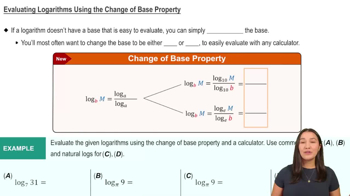 5:36
5:36Use the various properties of exponential and logarithmic functions to evaluate the expressions in parts (a)–(c). Given ƒ(x) = 3x, find ƒ(log3 2)
Use the various properties of exponential and logarithmic functions to evaluate the expressions in parts (a)–(c). Given g(x) = ex, find g(ln 4)
Use the various properties of exponential and logarithmic functions to evaluate the expressions in parts (a)–(c). Given g(x) = ex, find g(ln ln 52)
Solve each equation. See Examples 4–6. 1/27 = x-3
Use the various properties of exponential and logarithmic functions to evaluate the expressions in parts (a)–(c). Given ƒ(x) = 3x, find ƒ(log3 (ln 3))
Use the various properties of exponential and logarithmic functions to evaluate the expressions in parts (a)–(c). Given ƒ(x) = 3x, find ƒ(log3 (2 ln 3))