뒤로
뒤로Chapter 1: Accounting and the Business Environment – Study Notes
스터디 가이드 - 스마트 노트
 자료에 맞춘 맞춤형 노트, 핵심 정의, 예시, 맥락을 확장해 제공합니다.
Accounting and the Business Environment
Introduction to Accounting
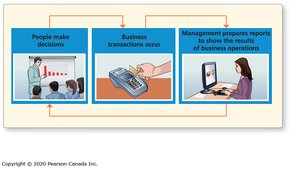
Accounting is often referred to as the "language of business" because it provides a structured way to measure, process, and communicate financial information. This information is essential for decision-making by various stakeholders, both inside and outside the organization.
Accounting is an information system that measures business financial activities, processes that information into reports, and communicates it to decision makers.
Bookkeeping is a subset of accounting, focused on recording transactions, while accounting encompasses analysis and interpretation for decision-making.
Accounting helps answer questions such as: Is the business making a profit? Should we hire more staff? Can we afford to purchase equipment?
Users of Accounting Information
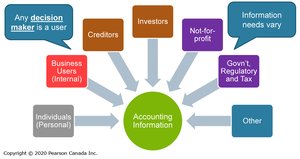
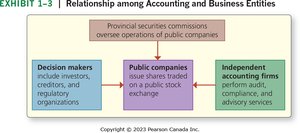
Accounting information is used by a wide range of decision makers, each with unique information needs. These users can be internal or external to the organization.
Internal users: Management, employees, and business owners who use information for planning, controlling, and decision-making within the organization.
External users: Investors, creditors, government agencies, regulatory bodies, and the public who use information to make investment, lending, and regulatory decisions.
Types of Accounting
Financial Accounting vs. Management Accounting
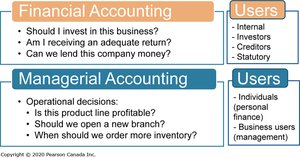
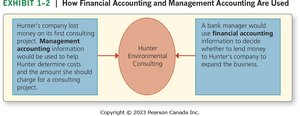
There is a key distinction between financial accounting and management accounting, primarily based on the intended users of the information.
Financial Accounting: Provides information for external decision makers (e.g., investors, creditors, regulatory agencies). Focuses on historical data and compliance with accounting standards.
Management Accounting: Provides information for internal decision makers (e.g., managers, employees). Focuses on future projections, budgeting, and operational decisions.
Professional Accounting in Canada
Canadian Professional Accounting Designations
Canada's accounting profession is unified under the Chartered Professional Accountant (CPA) designation, which governs standards of professional conduct and ethics.
Legacy designations: Chartered Accountant (CA), Certified General Accountant (CGA), Certified Management Accountant (CMA).
CPA Advanced Certificate in Accounting and Finance (ACAF) is an alternative for those not pursuing the full CPA designation.
Audits are conducted by designated accountants to provide assurance on the fairness of financial statements.
Ethics in Accounting
Professional accountants are held to high ethical standards, including confidentiality, integrity, objectivity, and independence. Ethical lapses can undermine trust in financial reporting and have led to major scandals in the past.
Rules focus on confidentiality, reputation, integrity, due care, competence, and independence.
External audits and regulatory requirements are designed to enhance the reliability of financial information.
Forms of Business Organization
Common Forms of Business Organizations
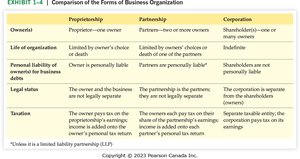
Businesses can be organized in several forms, each with distinct characteristics regarding ownership, liability, and taxation.
Form | Owner(s) | Life of Organization | Personal Liability | Legal Status | Taxation |
|---|---|---|---|---|---|
Sole Proprietorship | One owner | Limited by owner's choice or death | Owner is personally liable | Not legally separate | Owner pays tax on business earnings |
Partnership/LLP | Two or more owners | Limited by owners' choices or death of one partner | Partners are personally liable (except LLP) | Partnership is not legally separate | Owners pay tax on share of earnings |
Corporation | Shareholders (one or more) | Indefinite | Shareholders are not personally liable | Corporation is legally separate | Corporation pays tax on its earnings |
Accounting Concepts and Principles
Generally Accepted Accounting Principles (GAAP)
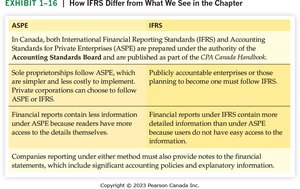
GAAP are the common guidelines for measuring, processing, and communicating financial information. In Canada, public companies follow International Financial Reporting Standards (IFRS), while private enterprises may use Accounting Standards for Private Enterprises (ASPE).
GAAP ensures consistency, comparability, and reliability in financial reporting.
IFRS and ASPE are principles-based, requiring professional judgment.
Hierarchy of Financial Statement Concepts
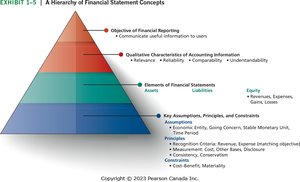
The conceptual framework for financial reporting is structured in four levels, from broad objectives to specific principles and constraints.
Level 1: Objective – Communicate useful information to users.
Level 2: Qualitative Characteristics – Relevance, reliability, comparability, understandability.
Level 3: Elements – Assets, liabilities, equity, revenues, expenses, gains, losses.
Level 4: Key Assumptions, Principles, Constraints – Economic entity, going concern, stable monetary unit, cost/benefit, materiality, etc.
Key Accounting Assumptions and Principles
Economic-Entity Assumption: Each entity is accounted for separately from its owners or other entities.
Going-Concern Assumption: The business will continue operating in the foreseeable future.
Stable-Monetary-Unit Assumption: The value of the dollar is stable over time, ignoring inflation unless extreme.
Cost Principle: Assets and services are recorded at their historical cost, which is considered more reliable than current value.
Constraints: Cost/benefit (information should not cost more than its value) and materiality (information is material if it would affect a decision maker's decision).
The Accounting Equation
Basic Accounting Equation
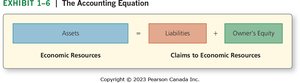
The accounting equation is the foundation of the double-entry accounting system, showing the relationship among assets, liabilities, and owner's equity.
Assets = Economic resources controlled by the entity.
Liabilities = Debts owed to outsiders (creditors).
Owner's Equity = The owner's claim on the assets after liabilities are settled.
The equation is expressed as:
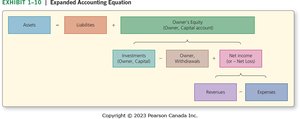
Expanded Accounting Equation
The expanded equation provides more detail on the components of owner's equity, including investments, withdrawals, revenues, and expenses.
Business Transactions and Their Impact
Recording Business Transactions
Business transactions are events that affect the financial position of the entity and can be measured reliably. Examples include investments by owners, purchases of assets, incurring expenses, earning revenues, and withdrawals by owners.
"Received" indicates a cash transaction.
"Sale on account" creates a receivable (cash to be received later).
"Purchased on credit" creates a payable (cash to be paid later).
"Paid" means cash was used to settle an obligation.
Financial Statements
Types of Financial Statements
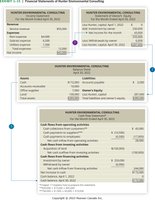
Financial statements are formal reports that summarize the financial activities and position of an entity. The primary statements are:
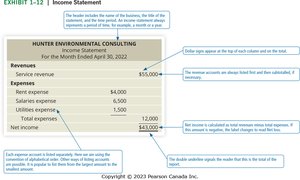
Income Statement: Summarizes revenues and expenses to determine net income for a period.
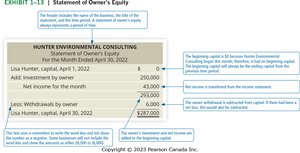
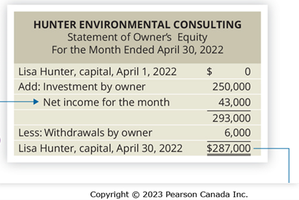
Statement of Owner's Equity: Shows changes in owner's equity during the period.
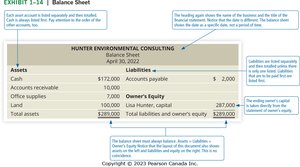
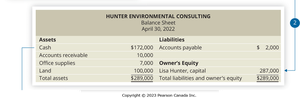
Balance Sheet: Presents assets, liabilities, and owner's equity as of a specific date.
Cash Flow Statement: Reports cash inflows and outflows (covered in later chapters).
Relationship Among Financial Statements
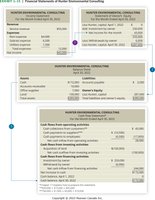
The financial statements are interrelated. Net income from the income statement is used in the statement of owner's equity, which then provides the ending capital balance for the balance sheet. The cash flow statement reconciles the change in cash, which must match the cash balance on the balance sheet.
Accounting Standards in Canada
ASPE and IFRS
In Canada, two main sets of accounting standards are used:
ASPE (Accounting Standards for Private Enterprises): Used by private companies; less complex and less detailed than IFRS.
IFRS (International Financial Reporting Standards): Used by publicly accountable enterprises; more comprehensive and detailed.
ASPE | IFRS |
|---|---|
Used by sole proprietorships and private companies; simpler and less costly to implement. | Used by public companies and those planning to go public; more detailed and comprehensive. |
Financial reports contain less information; easier for users to access details. | Financial reports contain more detailed information; users may not have easy access to details. |
Notes to financial statements required. | Notes to financial statements required, including significant accounting policies and explanatory information. |