 뒤로
뒤로Chapter 4: The Time Value of Money – Financial Accounting Study Notes
스터디 가이드 - 스마트 노트
 자료에 맞춘 맞춤형 노트, 핵심 정의, 예시, 맥락을 확장해 제공합니다.
The Time Value of Money
Introduction
The time value of money is a fundamental concept in financial accounting and finance, recognizing that the value of money changes over time due to its earning potential. Investment decisions often involve costs and benefits occurring at different points in time, requiring methods to compare and evaluate these cash flows accurately.
Key Point: Money received today is worth more than money received in the future due to its potential to earn interest.
Key Point: Comparing cash flows at different times without adjustment leads to incorrect conclusions.
Example: A project with a $100,000 cost today and a $105,000 benefit in one year cannot simply be evaluated as a $5,000 gain; the timing must be considered.
4.1 The Timeline
Visualizing Cash Flows
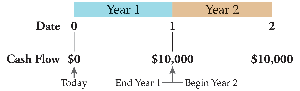
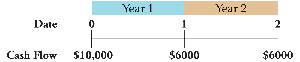
Timelines are used to represent the timing and magnitude of cash flows, helping to clarify financial problems and decisions.
Key Point: Timelines show when cash inflows (benefits) and outflows (costs) occur.
Key Point: Outflows are negative cash flows, inflows are positive.
Example: Lending $10,000 today and receiving two $6,000 payments over the next two years.
4.2 The Three Rules of Time Travel
Rules for Comparing and Moving Cash Flows
Financial decisions require combining or comparing cash flows at different times. Three rules govern these processes:
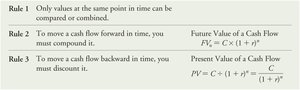
Rule 1: Only values at the same point in time can be compared or combined.
Rule 2: To move a cash flow forward in time, compound it to find its Future Value (FV).
Rule 3: To move a cash flow backward in time, discount it to find its Present Value (PV).
Rule | Description | Formula |
|---|---|---|
Rule 1 | Only values at the same point in time can be compared or combined. | |
Rule 2 | Compound cash flows to move them forward in time. | |
Rule 3 | Discount cash flows to move them backward in time. |
Future Value & Compounding
Understanding Compound Interest
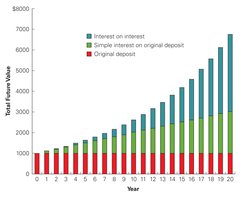
Compounding is the process of moving a value forward in time, accumulating interest on both the principal and previously earned interest.
Key Point: Compound interest means earning interest on interest, leading to exponential growth.
Key Point: Simple interest is earned only on the original principal.
Example: Depositing $1,000 at 8% annual interest for 3 years results in $1,259.71.
Present Value & Discounting
Calculating Present Value
Discounting is the process of determining the current value of a future sum by applying an interest rate.
Key Point: Present value (PV) reflects the value today of a future cash flow.
Key Point: The discount rate is the interest rate used to reduce a future value to its present value.
Formula:
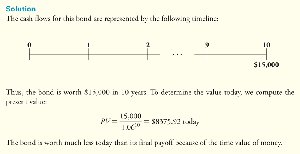
Example: What is the present value of $15,000 to be received in 10 years if the discount rate is 6%?

4.4 Calculating the Net Present Value (NPV)
Evaluating Investment Opportunities
Net Present Value (NPV) is used to evaluate investments with multiple cash flows by comparing the present value of inflows and outflows.
Key Point: NPV = PV(benefits) – PV(costs)
Key Point: Accept projects with positive NPV; reject those with negative NPV.
Formula:
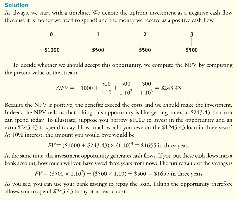
Example: Should you invest $5,000 today to receive $900 at the end of each of the next three years if the discount rate is 7%?

4.5 Annuities
Definition and Calculation
An annuity is a series of equal cash flows occurring at regular intervals for a finite number of periods.
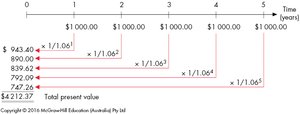
Key Point: Present Value of an Annuity (PVA) is calculated by discounting each cash flow.
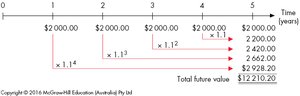
Key Point: Future Value of an Annuity (FVA) is calculated by compounding each cash flow.
Formula (PVA):
Formula (FVA):

Examples of Annuity Calculations
Example: An investor pays $100 at the end of each year for 3 years into a savings account yielding 12% per year. The present value is $240.18.
Example: An investor receives $50 per year for 19 years and $100 in the 20th year at 5% interest. The present value is $641.96.
Example: Borrowing $5,000 today for 3 years at 12% interest, the annual repayment is $2,081.74.
Future Value of Annuities
Example: Depositing $3,000 at the end of every year for 8 years at 7% interest results in a future value of $30,779.40.
Example: To accumulate $50,000 in 8 years at 7% interest, annual deposits must be $4,873.39.
Example: Saving $5,000 per year from age 40 to 65 at 9% interest results in $423,504.48; saving until age 70 results in $681,537.69.
Summary Table: Present and Future Value Calculations
Type | Formula | Application |
|---|---|---|
Future Value (FV) | Value of a single sum in the future | |
Present Value (PV) | Value of a single sum today | |
Present Value of Annuity (PVA) | Value today of a series of equal payments | |
Future Value of Annuity (FVA) | Value in the future of a series of equal payments | |
Net Present Value (NPV) | Evaluating investments with multiple cash flows |
Conclusion
Understanding the time value of money is essential for making informed financial decisions, evaluating investments, and planning for future cash flows. Mastery of present and future value calculations, annuities, and net present value enables students to analyze and compare financial opportunities effectively.
