 뒤로
뒤로Chapter 5: Receivables and Revenue – Financial Accounting Study Notes
스터디 가이드 - 스마트 노트
 자료에 맞춘 맞춤형 노트, 핵심 정의, 예시, 맥락을 확장해 제공합니다.
Receivables and Revenue
Introduction
This chapter explores the accounting for receivables and revenue, focusing on the application of GAAP for revenue recognition, the management of sales returns, allowances, and discounts, and the evaluation of receivables collectibility. It also covers the calculation of liquidity ratios and the use of aging schedules for analyzing receivables.
GAAP for Proper Revenue Recognition
Revenue Recognition Principles
Revenue is recognized when earned: This occurs when goods are delivered or services are performed.
Measurement: Revenue is recorded at the amount of cash received or the fair market value of assets received in exchange.
Definition: Revenue represents amounts companies are entitled to receive from customers for delivering goods or performing services.
Five-Step Revenue Recognition Model
Identify the contract(s) with a customer.
Identify the performance obligations in the contract.
Determine the transaction price.
Allocate the transaction price to the performance obligations.
Recognize revenue when (or as) the entity satisfies a performance obligation.
Example: Apple Inc. recognizes revenue when control of products is transferred to customers (usually when shipped), and for services, revenue is recognized over time as services are delivered.
Multiple Performance Obligations
Revenue is allocated to distinct performance obligations based on their relative stand-alone selling prices (SSPs).
Observable prices are used when available; otherwise, estimates are made based on market trends and company objectives.
Revenue for delivered hardware/software is recognized at shipment; revenue for bundled services and software upgrades is deferred and recognized over time.
Shipping Terms
FOB Shipping Point: Ownership and revenue recognition occur when goods leave the seller's dock.
FOB Destination: Ownership and revenue recognition occur when goods are delivered to the customer.
Sales Returns and Allowances
Accounting for Returns and Allowances
Customers may return unsatisfactory or damaged goods.
A credit memo authorizes a credit to the customer’s account receivable.
Companies with significant returns estimate returns and record them in a Sales Returns & Allowances contra-revenue account.
Sales Revenue on the income statement is reported net of returns and allowances.
Example: If Apple expects 1% of sales to be returned and has $200 million in sales, it estimates $2 million in returns for the period, matching revenue and related returns in the same period.
Price Protection Allowances
Companies may grant allowances for price reductions after a sale (e.g., Apple’s 14-day price protection policy).
Estimated refunds must be reserved in the period of the sale, not when refund requests are received, to comply with the matching principle.
Sales Discounts
Accounting for Sales Discounts
Sales discounts are incentives for early payment (e.g., 2/10, n/30 means a 2% discount if paid within 10 days; otherwise, full payment is due in 30 days).
Sales Discounts are recorded in a contra-revenue account.
Net Revenue = Sales – Sales Returns & Allowances – Sales Discounts
Example: If a customer pays a $2,000 invoice within the discount period, the cash received is $1,960 ($2,000 x 98%).
Accounts Receivable
Types of Receivables
Receivables are monetary claims against others, classified as current assets.
Acquired by selling goods/services (accounts receivable) or lending money (notes receivable).
The subsidiary ledger tracks individual customer balances.
Managing Receivables
Credit risk can be managed by credit checks, effective collection procedures, and monitoring payment habits.
Allowance for Uncollectible Accounts
Allowance Method
Estimates uncollectible accounts based on past experience.
Uses a contra-asset account (Allowance for Uncollectible Accounts) to reduce accounts receivable to net realizable value (NRV).
NRV = Accounts Receivable – Allowance for Uncollectible Accounts


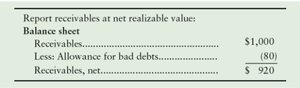
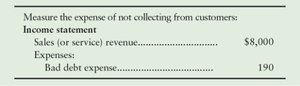
Methods for Estimating Uncollectibles
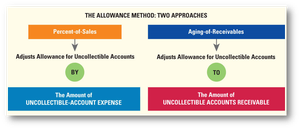
Percent-of-Sales Method: Estimates uncollectible expense as a percentage of revenue (income statement approach).
Aging-of-Receivables Method: Analyzes receivables by age to estimate the allowance (balance sheet approach).
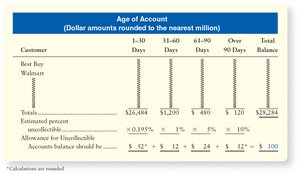
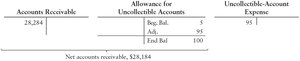
Writing Off Uncollectible Accounts
When a specific account is deemed uncollectible, it is written off against the allowance account.
Writing off does not affect the net realizable value of accounts receivable.
Direct Write-Off Method
Records expense only when a specific account is uncollectible.
Not GAAP-compliant except for immaterial amounts, as it may overstate assets and mismatches expenses and revenues.
Notes Receivable and Interest Revenue
Key Terms
Creditor: The lender or party to whom money is owed.
Debtor: The borrower or party who owes money.
Interest: The cost of borrowing, stated as an annual percentage rate.
Maturity date: When the note must be repaid.
Maturity value: Principal plus interest due at maturity.
Principal: The amount borrowed.
Term: The length of the loan.
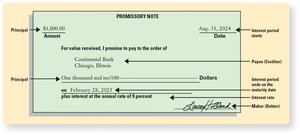
Interest Calculation Formula:
Liquidity Ratios and Receivables Analysis
Quick (Acid-Test) Ratio
Measures a company's ability to pay current liabilities with quick assets (cash, short-term investments, receivables).
Benchmark is typically 1:1, but varies by industry.

Accounts Receivable Turnover and Days' Sales Outstanding (DSO)
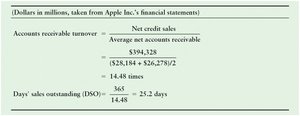
Accounts Receivable Turnover: Number of times per year a company collects its average accounts receivable.
Days' Sales Outstanding (DSO): Average number of days to collect receivables.
Aging Schedule and Pivot Tables
Using Aging Schedules
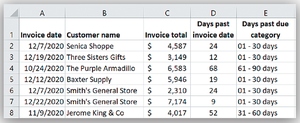
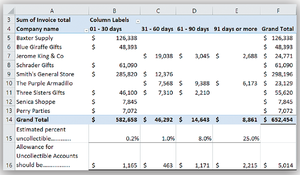
An aging schedule categorizes receivables by how long they have been outstanding, helping estimate uncollectibles more accurately.
Pivot tables in Excel can summarize large data sets for analysis.
Summary Table: Key Accounts and Methods
Account/Method | Purpose | Key Feature |
|---|---|---|
Accounts Receivable | Records amounts owed by customers | Current asset |
Allowance for Uncollectible Accounts | Estimates uncollectible receivables | Contra-asset |
Percent-of-Sales Method | Estimates bad debts as % of sales | Income statement focus |
Aging-of-Receivables Method | Estimates based on age of receivables | Balance sheet focus |
Direct Write-Off Method | Records bad debts when identified | Not GAAP (except immaterial) |
Additional info: This chapter provides foundational knowledge for understanding how companies recognize revenue, manage receivables, and estimate uncollectible accounts, which are critical for accurate financial reporting and analysis.
