 뒤로
뒤로IFRS 16 Leases: Comprehensive Study Notes for Financial Accounting Students
스터디 가이드 - 스마트 노트
 자료에 맞춘 맞춤형 노트, 핵심 정의, 예시, 맥락을 확장해 제공합니다.
Leases – IFRS 16
Overview and Objective
IFRS 16 Leases establishes principles for the recognition, measurement, presentation, and disclosure of leases. The objective is to ensure that lessees provide relevant information that faithfully represents lease transactions, enabling users of financial statements to assess the effect of leases on the entity’s financial position, performance, and cash flows.
Lease Definition: A lease is a contract, or part of a contract, that conveys the right to use an asset (the underlying asset) for a period of time in exchange for consideration.
Key Parties: Lessee (obtains right to use asset), Lessor (provides right to use asset).
Scope: IFRS 16 applies to most leases, with specific exclusions (e.g., leases for minerals, licensing agreements, biological assets).
Reporting Framework: IFRS vs IFRS for SMEs
IFRS 16 and Section 20 of IFRS for SMEs both prescribe accounting for leases, but there are notable differences:
Main Difference | IFRS 16 | Section 20 (IFRS for SMEs) |
|---|---|---|
Scope | Excludes certain leases (minerals, licensing, investment property, biological assets) | Similar exclusions, plus onerous operating leases |
Short-term leases | Operating lease payments expensed on straight-line basis unless another method is more representative | Expensed on straight-line or another basis; inflation-adjusted payments expensed when payable |
Initial measurement | No difference | No difference |
Subsequent measurement | No difference | No difference |
Disclosure | No difference | No difference |
Identifying a Lease
Definition and Criteria
IFRS 16 defines a lease as a contract that conveys the right to control the use of an identified asset for a period of time in exchange for consideration. The lessee must have both:
The right to obtain substantially all economic benefits from the use of the asset
The right to direct the use of the asset
If only part of the contract term conveys these rights, only that portion is considered a lease.
Steps to Determine Whether a Contract Contains a Lease
To assess if a contract contains a lease, follow a logical decision process:
Is there an identified asset?
Does the customer have the right to obtain substantially all economic benefits?
Does the customer have the right to direct the use of the asset?
If not, is the use predetermined or controlled by the supplier?
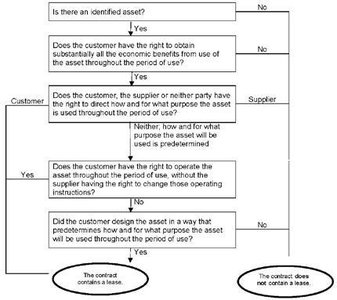
Example: If the supplier can substitute the asset at minimal cost, or the customer does not control the asset, the contract does not contain a lease.
Separating Components of a Contract
Contracts may contain both lease and non-lease components. Each lease component should be accounted for separately unless the lessee elects the practical expedient to combine them.
Allocate consideration based on relative stand-alone prices.
If observable prices are unavailable, estimate using observable information.
Example: If a contract includes leasing a bus and maintenance, allocate the total payment proportionally to each component based on their stand-alone prices.
Lease Term
The lease term is the non-cancellable period plus any extension or termination options that the lessee is reasonably certain to exercise or not exercise. Judgement is required to assess certainty.
Includes rent-free periods
Considers enforceability and penalties for termination
Example: If a lessee is reasonably certain to extend a lease, the lease term includes the extension period.
Recognition and Measurement: Lessee
Recognition Exemptions
Lessee may elect not to recognize assets and liabilities for:
Short-term leases (12 months or less)
Leases of low-value assets (e.g., tablets, small office furniture)
Lease payments for exempt leases are expensed on a straight-line or systematic basis.
Initial Recognition and Measurement
At commencement, the lessee recognizes:
Right-of-use asset at cost, including:
Initial measurement of lease liability
Lease payments made before commencement
Initial direct costs
Estimated dismantling/restoration costs
Lease liability at present value of unpaid lease payments, discounted using the interest rate implicit in the lease or the lessee’s incremental borrowing rate.
Formula:
Where r is the discount rate and n is the period.
Interest Rate Implicit in the Lease
The interest rate implicit in the lease is the rate that causes the present value of lease payments and unguaranteed residual value to equal the fair value of the asset plus initial direct costs.
Formula:
Subsequent Measurement
Right-of-use asset: measured at cost less accumulated depreciation and impairment
Lease liability: increased by interest, reduced by lease payments, adjusted for modifications
Depreciation is calculated over the useful life or lease term, whichever is shorter.
Reassessment of Lease Liability
If lease payments change (e.g., index/rate changes, residual value guarantee changes), remeasure the lease liability using the original discount rate. Adjust the right-of-use asset accordingly.
Presentation and Disclosure: Lessee
Disclosure Requirements
Depreciation charge for right-of-use assets by class
Interest expense on lease liabilities
Expenses relating to variable payments not included in lease liability
Income from subleasing right-of-use assets
Total cash outflow for leases
Additions to right-of-use assets
Gains/losses from sale and leaseback transactions
Carrying amount of right-of-use assets at period end
Maturity analysis of lease liabilities
Additional qualitative and quantitative information about leasing activities must be disclosed.
Comprehensive Examples
Low-Value Assets – Recognition Exemption
When the recognition exemption is applied, lease payments are expensed on a straight-line basis. Prepaid or accrued expenses may arise if actual payments differ from equalized lease expense.
Amortisation Tables
Amortisation tables are used to split lease payments between capital and interest. The interest rate implicit in the lease is calculated using financial calculators or manually.
Payment Date | Instalment | Interest | Capital | Outstanding Balance |
|---|---|---|---|---|
1 Jan 20.17 | - | - | - | 40,000 |
30 Jun 20.17 | 13,200 | 4,844 | 8,356 | 31,644 |
31 Dec 20.17 | 13,200 | 3,832 | 9,368 | 22,276 |
30 Jun 20.18 | 13,200 | 2,698 | 10,502 | 11,774 |
31 Dec 20.18 | 13,200 | 1,426 | 11,774 | 0 |
Example: The present value of minimum lease payments equals the fair value of the asset, so both asset and liability are recognized at R40,000.
Summary Table: Key Lease Accounting Steps
Step | Description |
|---|---|
Identify Lease | Assess contract for right to control use of identified asset |
Separate Components | Allocate consideration to lease and non-lease components |
Determine Lease Term | Include non-cancellable period and options reasonably certain to be exercised |
Initial Recognition | Recognize right-of-use asset and lease liability at commencement |
Subsequent Measurement | Depreciate asset, adjust liability for payments and interest |
Disclosure | Provide detailed information in financial statements |
Key Terms and Definitions
Right-of-use asset: Asset representing lessee’s right to use the underlying asset
Lease liability: Obligation to make lease payments
Interest rate implicit in the lease: Rate equating present value of payments and residual value to asset’s fair value
Incremental borrowing rate: Rate lessee would pay to borrow funds for similar asset
Residual value guarantee: Minimum value guaranteed to lessor at lease end
Low-value asset: Asset with value less than $5,000 when new
Conclusion
IFRS 16 Leases requires lessees to recognize right-of-use assets and lease liabilities for most leases, with specific exemptions for short-term and low-value leases. Proper identification, measurement, and disclosure are essential for accurate financial reporting.
