 뒤로
뒤로Recording Business Transactions: Financial Accounting Study Notes
스터디 가이드 - 스마트 노트
 자료에 맞춘 맞춤형 노트, 핵심 정의, 예시, 맥락을 확장해 제공합니다.
Recording Business Transactions
Accounts and the Accounting Equation
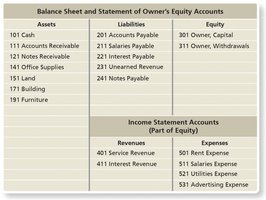
The accounting equation forms the foundation of financial accounting, categorizing accounts into assets, liabilities, and equity. Each category contains specific accounts that track increases and decreases over time.
Account: A detailed record of all increases and decreases in a specific asset, liability, or equity item during a period.
Assets: Resources owned by the business (e.g., cash, accounts receivable, land).
Liabilities: Obligations owed to outsiders (e.g., accounts payable, notes payable).
Equity: Owner’s interest in the business (e.g., capital, withdrawals).
Chart of Accounts: An organized listing of all accounts used by a company.
Ledger: The record holding all accounts, their changes, and balances.
Example: The chart of accounts for Smart Touch Learning includes asset, liability, equity, revenue, and expense accounts.
Data Analytics in Accounting
Modern accounting leverages data analytics to process transactions, analyze data, compare periods, identify errors, and track account changes. The complexity and number of accounts depend on the business’s size and activities.
Debits, Credits, and Double-Entry Accounting
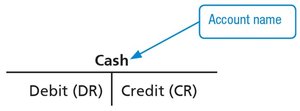
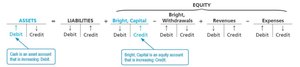
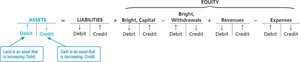
Double-entry accounting ensures that every transaction affects at least two accounts, maintaining the balance of the accounting equation. The T-account is a visual tool used to record debits (left side) and credits (right side).
Debit (DR): An entry on the left side of a T-account.
Credit (CR): An entry on the right side of a T-account.
Double-entry system: Each transaction involves at least one debit and one credit.
Rules of Debit and Credit
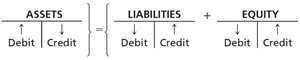
The rules for debits and credits depend on the account type:
Assets: Increase with debits, decrease with credits.
Liabilities: Increase with credits, decrease with debits.
Equity: Increase with credits, decrease with debits.



Normal Account Balances
Each account has a normal balance, which is the side (debit or credit) that increases the account:
Assets: Normal balance is debit.
Liabilities and Equity: Normal balance is credit.

Determining T-Account Balances
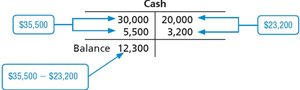
The ending balance of a T-account is found on the side with the larger total. This helps determine the account’s current value.
Journalizing and Posting Transactions
Transactions are recorded in a journal using source documents as evidence. The journal entries are then posted to the ledger.
Source Documents: Include purchase invoices, bank checks, sales invoices.
Journal: Chronological record of transactions.
Posting: Transferring journal data to the ledger.
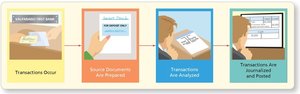
Steps in Journalizing and Posting
Identify the accounts and their types.
Determine increases or decreases and apply debit/credit rules.
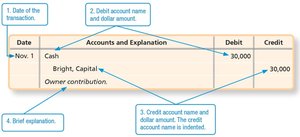
Record the transaction in the journal.
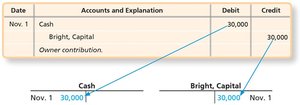
Post the journal entry to the ledger.
Check if the accounting equation is balanced.
Example: Owner Contribution
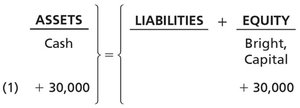
On November 1, Smart Touch Learning received $30,000 cash from the owner, increasing both Cash (asset) and Capital (equity).
Example: Purchase of Land for Cash
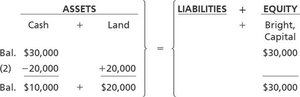
On November 2, Smart Touch Learning paid $20,000 cash for land, decreasing Cash and increasing Land (both assets).
Example: Office Supplies on Account
Buying office supplies on account increases Office Supplies (asset) and Accounts Payable (liability).

Example: Earning Service Revenue for Cash
Collecting cash for services increases Cash (asset) and Service Revenue (equity).

Example: Earning Service Revenue on Account
Performing services for clients on account increases Accounts Receivable (asset) and Service Revenue (equity).

Example: Payment of Expenses with Cash
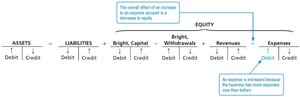
Paying expenses decreases Cash (asset) and increases expense accounts (equity reduction).

Example: Payment on Account
Paying accounts payable decreases Cash (asset) and Accounts Payable (liability).

Example: Collection on Account
Collecting receivables increases Cash (asset) and decreases Accounts Receivable (asset).

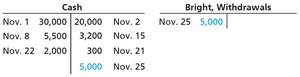
Example: Owner Withdrawal
Owner withdrawal decreases Cash (asset) and Owner Withdrawals (equity).
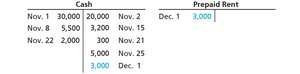
Example: Prepaid Expenses
Prepaying rent increases Prepaid Rent (asset) and decreases Cash (asset).
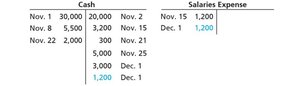
Example: Payment of Salaries
Paying salaries decreases Cash (asset) and increases Salaries Expense (equity reduction).
Example: Purchase of Building with Notes Payable
Purchasing a building increases Building (asset) and Notes Payable (liability).

Example: Owner Contribution of Furniture
Owner contributes furniture, increasing Furniture (asset) and Capital (equity).

Example: Accrued Liability
Receiving a bill increases Utilities Payable (liability) and Utilities Expense (equity reduction).

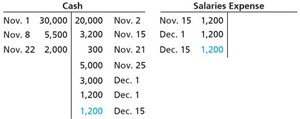
Example: Payment of Salaries
Paying salaries decreases Cash (asset) and increases Salaries Expense (equity reduction).
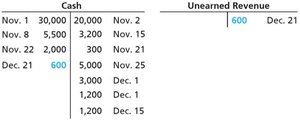
Example: Unearned Revenue
Receiving payment in advance increases Cash (asset) and Unearned Revenue (liability).
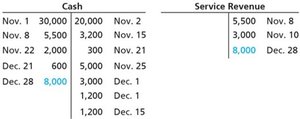
Example: Earning Service Revenue for Cash
Collecting cash for services increases Cash (asset) and Service Revenue (equity).
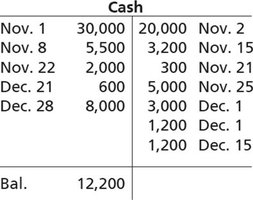
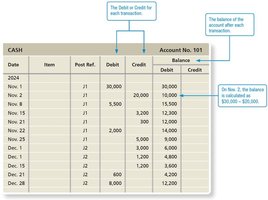
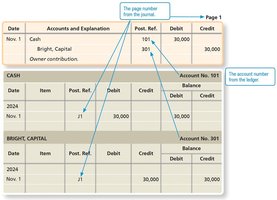
Four-Column Account vs. T-Account
The four-column account provides more detail than the T-account, including running balances and posting references.
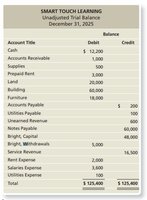
Unadjusted Trial Balance
The trial balance lists all ledger accounts and their balances at a specific point in time. It is used to prepare financial statements.
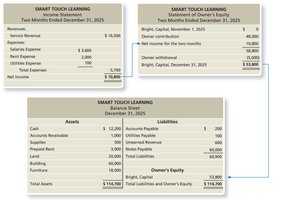
Financial Statements
Financial statements summarize the business’s financial position and performance, including the income statement, statement of owner’s equity, and balance sheet.
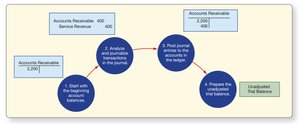
The Accounting Cycle
The accounting cycle is the process by which companies produce financial statements for a specific period. It includes identifying, recording, posting, and summarizing transactions.
Debt Ratio and Business Performance
The debt ratio measures the proportion of assets financed by debt, helping evaluate a company’s financial health and ability to pay its debts.
Debt Ratio Formula:
A higher debt ratio indicates more risk; a lower ratio suggests financial stability.
Example: PepsiCo, Inc. had total liabilities of $76,226 million and total assets of $92,377 million, resulting in a debt ratio of approximately 0.83.
Additional info: The debt ratio is a key metric for creditors and investors assessing a company’s leverage.
