 뒤로
뒤로The Adjusting Process in Financial Accounting: Principles, Examples, and Applications
스터디 가이드 - 스마트 노트
 자료에 맞춘 맞춤형 노트, 핵심 정의, 예시, 맥락을 확장해 제공합니다.
The Adjusting Process in Financial Accounting
Time Period Concept and Revenue Recognition Principle
The time period concept assumes that a business’s activities can be divided into specific, short time segments (such as months, quarters, or years) for which financial statements are prepared. The revenue recognition principle guides accountants on when to record revenues, following a five-step process:
Identify the contract with the customer.
Identify the performance obligations in the contract.
Determine the transaction price: the amount expected for transferring goods or services.
Allocate the transaction price to the performance obligations.
Recognize revenue when the company fulfills the obligation.
These principles ensure that revenues are reported in the period in which they are earned, not necessarily when cash is received.
The Matching Principle
The matching principle ensures that all expenses are recorded in the period in which they are incurred and matched with the revenues they help generate. This principle is essential for accurately calculating net income or net loss for a period.
Accrual Basis vs. Cash Basis Accounting
Accrual basis accounting records revenues and expenses when they are earned or incurred, regardless of when cash is exchanged. In contrast, cash basis accounting records transactions only when cash changes hands.
Cash basis | Accrual basis |
|---|---|
Records entire expense or revenue when cash is paid or received | Spreads expense or revenue over the periods it applies to |
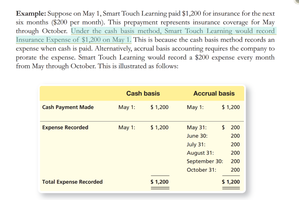
Example: If $1,200 is paid for six months of insurance, cash basis records the full amount in May, while accrual basis records $200 per month from May to October.
Unadjusted Trial Balance and the Need for Adjustments
An unadjusted trial balance lists all revenues and expenses but may omit transactions that have occurred but not yet been recorded. Accrual accounting requires reviewing this balance to ensure all revenues and expenses are properly recognized.
Types of Adjusting Entries
Adjusting entries are made at the end of the accounting period to ensure that revenues and expenses are recorded in the correct period. There are two main types:
Deferrals: Cash is exchanged before revenue is earned or expense is incurred (e.g., prepaid expenses, unearned revenue).
Accruals: Revenue is earned or expense is incurred before cash is exchanged (e.g., accrued expenses, accrued revenues).
Deferral Adjustments
Deferred expenses (prepaid expenses) are advance payments for future expenses. They are not recognized as expenses until they are used up.

For example, if supplies are purchased and used over time, an adjusting entry is made to transfer the cost from the asset account (Supplies) to an expense account (Supplies Expense).
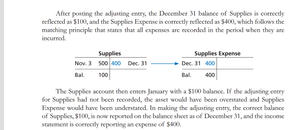
After adjustment, the Supplies account reflects the remaining asset, and Supplies Expense reflects the amount used during the period.
Accrual Adjustments
Accrued expenses are expenses that have been incurred but not yet paid (e.g., salaries, interest). Accrued revenues are revenues that have been earned but not yet received in cash.
Depreciation and Plant Assets
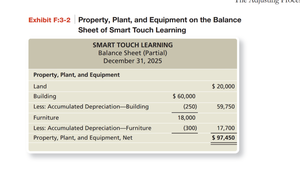
Property, plant, and equipment are long-lived tangible assets used in business operations. Depreciation is the process of allocating the cost of these assets (except land) over their useful lives.
Depreciation expense is recorded periodically to reflect the usage of the asset.
The straight-line method allocates an equal amount of depreciation each year:
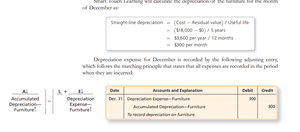
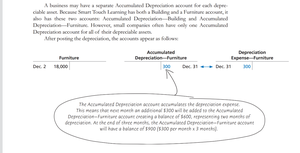
For example, furniture costing $18,000 with a 5-year useful life and no residual value results in $300 depreciation per month.
Contra Accounts and Accumulated Depreciation
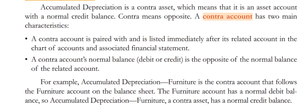
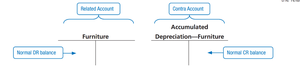
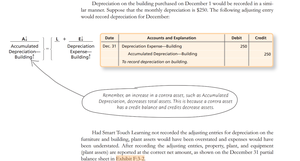
Accumulated Depreciation is a contra asset account, meaning it is paired with a related asset account and has a normal credit balance (opposite of the asset’s normal debit balance). It accumulates the total depreciation recorded against an asset.
Book Value
The book value of an asset is its cost minus accumulated depreciation. This represents the unexpired cost of the asset.
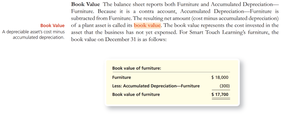
Example: Furniture with a cost of $18,000 and accumulated depreciation of $300 has a book value of $17,700.
Depreciation for Multiple Assets
Each depreciable asset may have its own accumulated depreciation account. Depreciation expense is recorded for each asset as appropriate.
Property, Plant, and Equipment on the Balance Sheet
On the balance sheet, property, plant, and equipment are reported net of accumulated depreciation.
Deferred Revenue (Unearned Revenue)
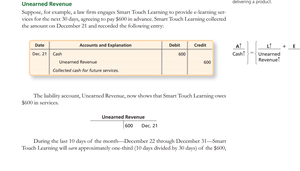
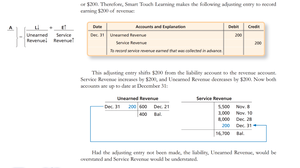
Deferred revenue is a liability created when cash is received before services are performed or goods delivered. As the service is performed, revenue is recognized, and the liability is reduced.
Accrued Salaries Expense
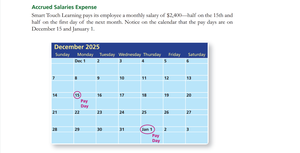
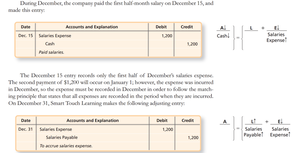
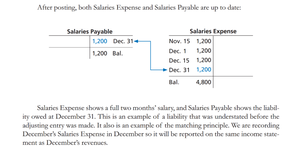
Accrued salaries are salaries that have been earned by employees but not yet paid by the end of the period. An adjusting entry is required to recognize the expense and the related liability (Salaries Payable).
Summary Table: Key Adjusting Entries
Type | When Recorded | Example |
|---|---|---|
Deferred Expense | Cash paid before expense incurred | Prepaid rent, supplies |
Deferred Revenue | Cash received before revenue earned | Unearned revenue |
Accrued Expense | Expense incurred before cash paid | Salaries payable, interest payable |
Accrued Revenue | Revenue earned before cash received | Interest receivable, services performed but not yet billed |
Adjusted Trial Balance
An adjusted trial balance lists all accounts and their balances after adjusting entries have been made, ensuring that the financial statements reflect all earned revenues and incurred expenses for the period.
Additional info: These concepts are foundational for preparing accurate financial statements and are essential for understanding the accrual basis of accounting, which is required by generally accepted accounting principles (GAAP).
