 뒤로
뒤로Transaction Analysis and the Accounting Equation: A Comprehensive Guide
스터디 가이드 - 스마트 노트
 자료에 맞춘 맞춤형 노트, 핵심 정의, 예시, 맥락을 확장해 제공합니다.
Transaction Analysis and the Accounting Equation
Introduction to Business Transactions and Accounts
Business transactions are the foundation of financial accounting. Each transaction affects the financial position of a business and is recorded in specific accounts. Understanding the types of accounts and how transactions impact them is essential for accurate financial reporting.
Transaction: Any event with a financial impact on a business that can be measured reliably. Examples include purchasing inventory, selling goods, or paying rent.
Account: A record of all changes in a particular asset, liability, or stockholders' equity during a period.
Types of Accounts:
Assets: Economic resources providing future benefit (e.g., Cash, Accounts Receivable, Inventory, Prepaid Expenses, Investments, Property and Equipment).
Liabilities: Debts or obligations (e.g., Accounts Payable, Notes Payable, Accrued Liabilities).
Stockholders’ Equity: Owners’ claim to assets (e.g., Common Stock, Retained Earnings, Dividends, Revenues, Expenses).
Analyzing the Impact of Transactions on the Accounting Equation
The accounting equation is the core framework for recording transactions:
Each transaction must keep this equation in balance. Below are examples of how typical transactions affect the equation:
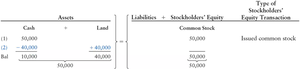
Investment by Owners: Increases both cash (asset) and common stock (equity).
Purchase of Land for Cash: Increases land (asset) and decreases cash (asset).
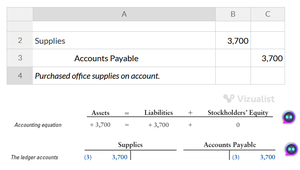
Purchase of Supplies on Account: Increases supplies (asset) and accounts payable (liability).
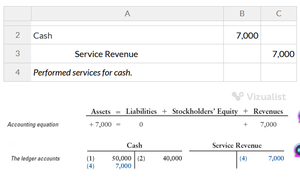
Revenue Earned in Cash: Increases cash (asset) and retained earnings (equity).
Expenses Paid in Cash: Decreases cash (asset) and retained earnings (equity).
Payment on Account: Decreases cash (asset) and accounts payable (liability).
Dividends Paid: Decreases cash (asset) and retained earnings (equity).
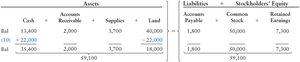
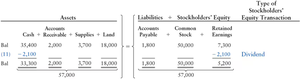
Summary of Transactions
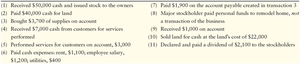
The following table summarizes the sequence of transactions for a sample company:
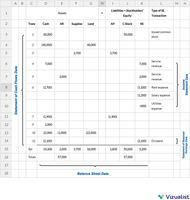
Tabular Analysis of Transactions
Tabular analysis helps visualize the impact of each transaction on the accounting equation:
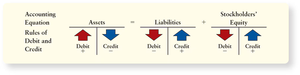
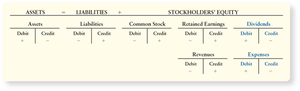
Rules of Debit and Credit
Every account has a normal balance side, and the rules of debit and credit determine how transactions are recorded:
Assets: Increase with debits, decrease with credits.
Liabilities: Increase with credits, decrease with debits.
Stockholders’ Equity: Increase with credits, decrease with debits.
Dividends and Expenses: Increase with debits, decrease with credits.
Revenues: Increase with credits, decrease with debits.
Journalizing Transactions
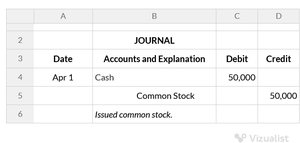
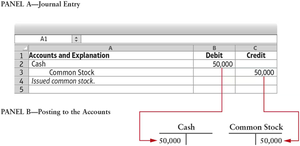
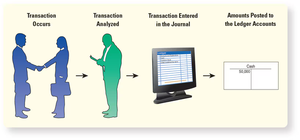
Journalizing is the process of recording transactions in the journal in chronological order. Each entry includes the date, accounts affected, amounts, and a brief explanation.
Debits are listed first and to the left; credits are indented to the right.
Posting to the Ledger
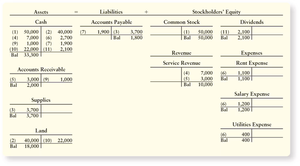
After journalizing, transactions are posted to the ledger, which groups all T-accounts and their balances. This process is essential for preparing financial statements.
Transaction Analysis Examples
Below are examples of how specific transactions are analyzed and recorded:
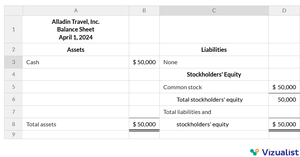
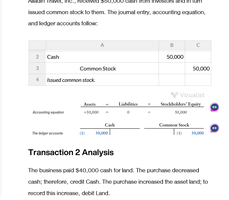
Transaction 1: Owner invests $50,000 cash for common stock.
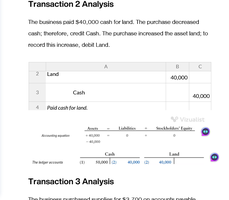
Transaction 2: Purchase of land for $40,000 cash.
Transaction 3: Purchase of supplies on account for $3,700.
Transaction 4: Services performed for cash, $7,000.
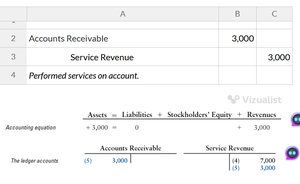
Transaction 5: Services performed on account, $3,000.
Transaction 7: Paid $1,900 on account.
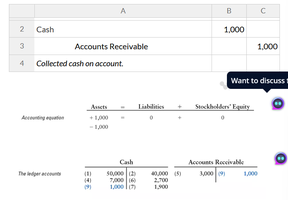
Transaction 9: Collected $1,000 cash on account.
Ledger Accounts and Balances
After posting, each account shows its balance, which is the difference between total debits and credits. The ledger provides a comprehensive view of all accounts.
Trial Balance
A trial balance lists all accounts and their balances at a specific date, ensuring that total debits equal total credits. It is used to prepare financial statements.
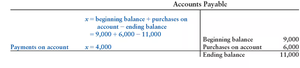
Analyzing Accounts for Decision Making
By analyzing account balances, such as cash or accounts receivable, businesses can infer operational activities and cash flows. For example, knowing the beginning and ending balances, along with receipts, allows calculation of payments:
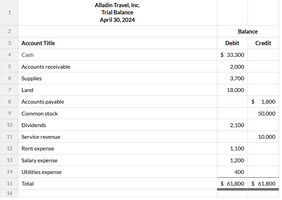


Chart of Accounts
The chart of accounts is a systematic listing of all accounts used by an organization, each with a unique number. This structure facilitates organization and reporting.
Normal Balance of Accounts
The normal balance of an account is the side (debit or credit) where increases are recorded. For example, assets, dividends, and expenses have a normal debit balance, while liabilities and equity have a normal credit balance.
Correcting Accounting Errors
Errors can cause accounts to be overstated or understated. Common techniques for finding errors include:
Searching for missing accounts or transactions.
Dividing the out-of-balance amount by 2 (to find reversed debits/credits).
Dividing by 9 (to detect slide or transposition errors).
Additional info:
Examples and images provided reinforce the process of transaction analysis, journalizing, posting, and preparing a trial balance.
Understanding the flow from transaction to financial statement is critical for accurate accounting and decision-making.
