Skip to main content
General Chemistry
나의 코스
배우기
시험 준비
AI 튜터
학습 가이드
교과서적 해결책
플래시카드
탐험해 보세요
앱을 사용해 보세요
나의 코스
배우기
시험 준비
AI 튜터
학습 가이드
교과서적 해결책
플래시카드
탐험해 보세요
앱을 사용해 보세요
뒤로
Chemistry Gas Laws quiz
카드를 뒤집기 위해 탭할 수 있습니다.
What is the equation for the ideal gas law?
카드를 뒤집기 위해 탭할 수 있습니다.
👆
What is the equation for the ideal gas law?
The ideal gas law is PV = nRT, where P is pressure, V is volume, n is moles, R is the gas constant, and T is temperature.
진행 상황 추적
컨트롤 버튼이 '내비게이션' 모드로 변경되었습니다.
1/15
관련 플래시카드
관련 실천
추천 영상
Chemistry Gas Laws definitions
Chemistry Gas Laws
15 용어
Chemistry Gas Laws quiz #1
Chemistry Gas Laws
24 용어
Chemistry Gas Laws
7. Gases
3 문제점
주제
Jules
Chemistry Gas Laws: Combined Gas Law
7. Gases
4 문제점
주제
Jules
7. Gases - Part 1 of 4
5 주제
14 문제점
장
Jules
7. Gases - Part 2 of 4
5 주제
13 문제점
장
Jules
7. Gases - Part 3 of 4
5 주제
13 문제점
장
Jules
7. Gases - Part 4 of 4
5 주제
13 문제점
장
Jules
VideoThumbView.guidedCourse
02:55
Gay Lussac's Law
5823
views
55
rank
VideoThumbView.guidedCourse
01:14
Chemistry Gas Laws Example
5407
views
43
rank
VideoThumbView.guidedCourse
02:06
Charles's Law
5442
views
38
rank
이 집합의 용어 (15)
하이드의 정의
What is the equation for the ideal gas law?
The ideal gas law is PV = nRT, where P is pressure, V is volume, n is moles, R is the gas constant, and T is temperature.
Which variables does Boyle's Law relate, and how are they related?
Boyle's Law relates pressure and volume, which are inversely proportional at constant temperature and moles.
What is the mathematical formula for Boyle's Law?
Boyle's Law is expressed as P1V1 = P2V2.
How does increasing pressure affect the volume of a gas according to Boyle's Law?
Increasing pressure decreases the volume of a gas if temperature and moles are constant.
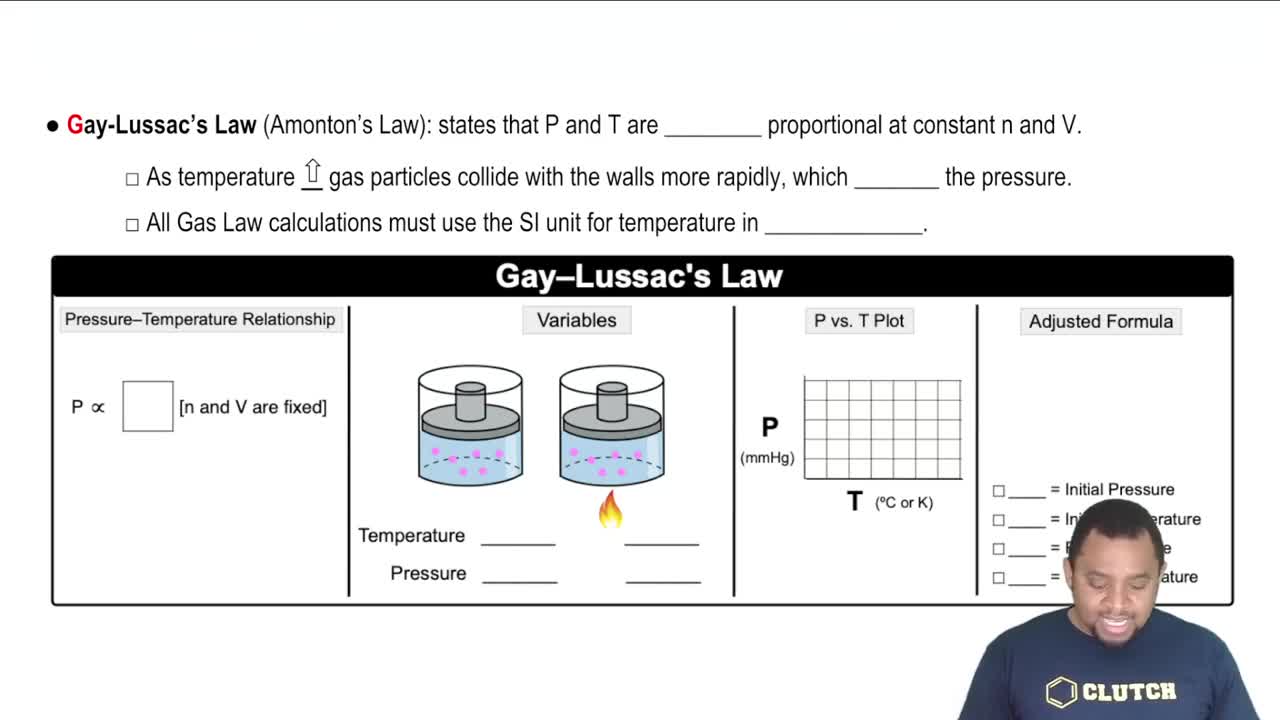
Which variables does Gay-Lussac's Law relate, and how are they related?
Gay-Lussac's Law relates pressure and temperature, which are directly proportional at constant volume and moles.
What is the formula for Gay-Lussac's Law?
Gay-Lussac's Law is P1/T1 = P2/T2.
Why must temperature be measured in Kelvin for gas law calculations?
Temperature must be in Kelvin because gas laws require absolute temperature to ensure direct proportionality.
What happens to the pressure of a gas if its temperature increases while volume is constant?
The pressure increases because gas particles move faster and collide with the container walls more forcefully.
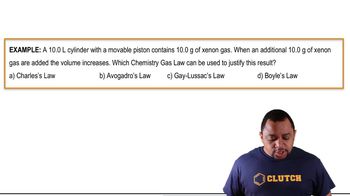
Which variables does Avogadro's Law relate, and how are they related?
Avogadro's Law relates volume and moles, which are directly proportional at constant pressure and temperature.
What is the formula for Avogadro's Law?
Avogadro's Law is V1/n1 = V2/n2.
If the number of moles of gas increases at constant pressure and temperature, what happens to the volume?
The volume increases because volume and moles are directly proportional.
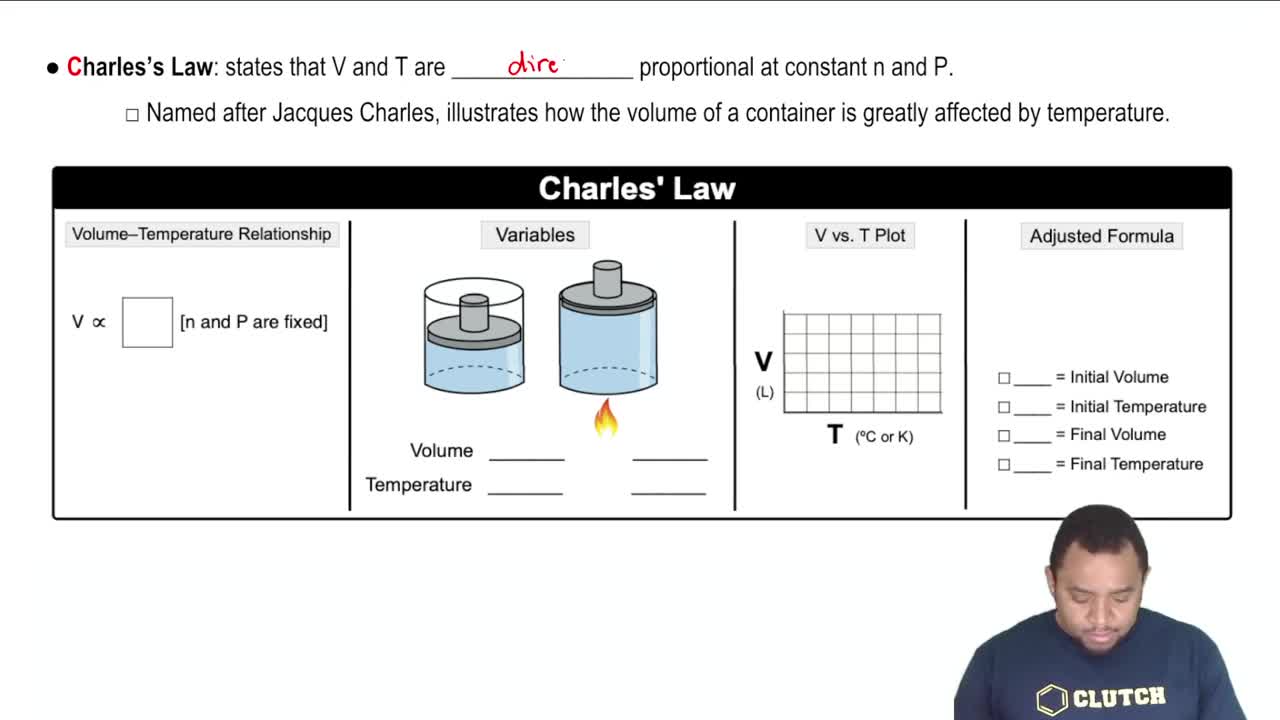
Which variables does Charles's Law relate, and how are they related?
Charles's Law relates volume and temperature, which are directly proportional at constant pressure and moles.
What is the formula for Charles's Law?
Charles's Law is V1/T1 = V2/T2.
What happens to the volume of a gas if its temperature increases while pressure is constant?
The volume increases because the gas particles gain energy and push the piston outward.
How can you remember the four main chemistry gas laws and their variable pairings?
Remember 'Be Great At Chemistry': Boyle's (Pressure & Volume), Gay-Lussac's (Pressure & Temperature), Avogadro's (Volume & Moles), Charles's (Volume & Temperature).
 뒤로뒤로
뒤로뒤로
 02:55
02:55