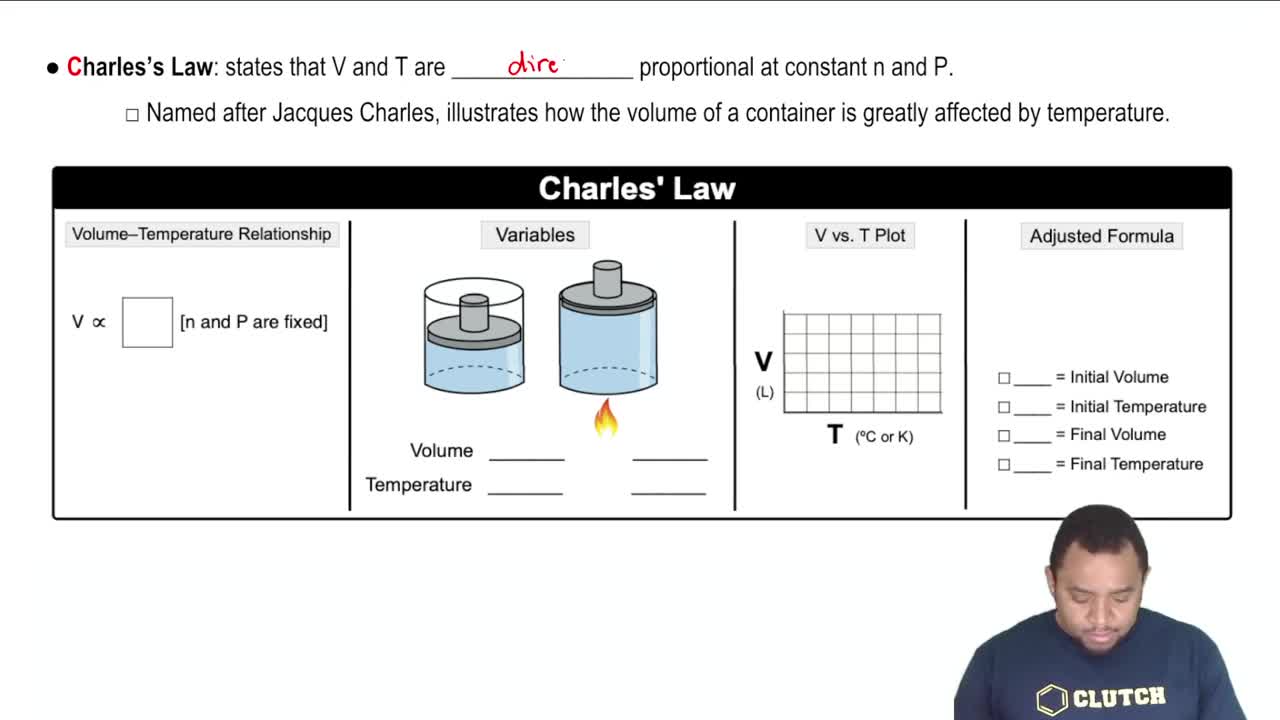
Which graph best illustrates the relationship between temperature and volume as described in Charles' Law?
A graph showing a direct linear relationship, with volume increasing as temperature increases, represents Charles' Law.
Which formula correctly represents Charles’s Law?
Charles’s Law is represented by the formula V1/T1 = V2/T2.
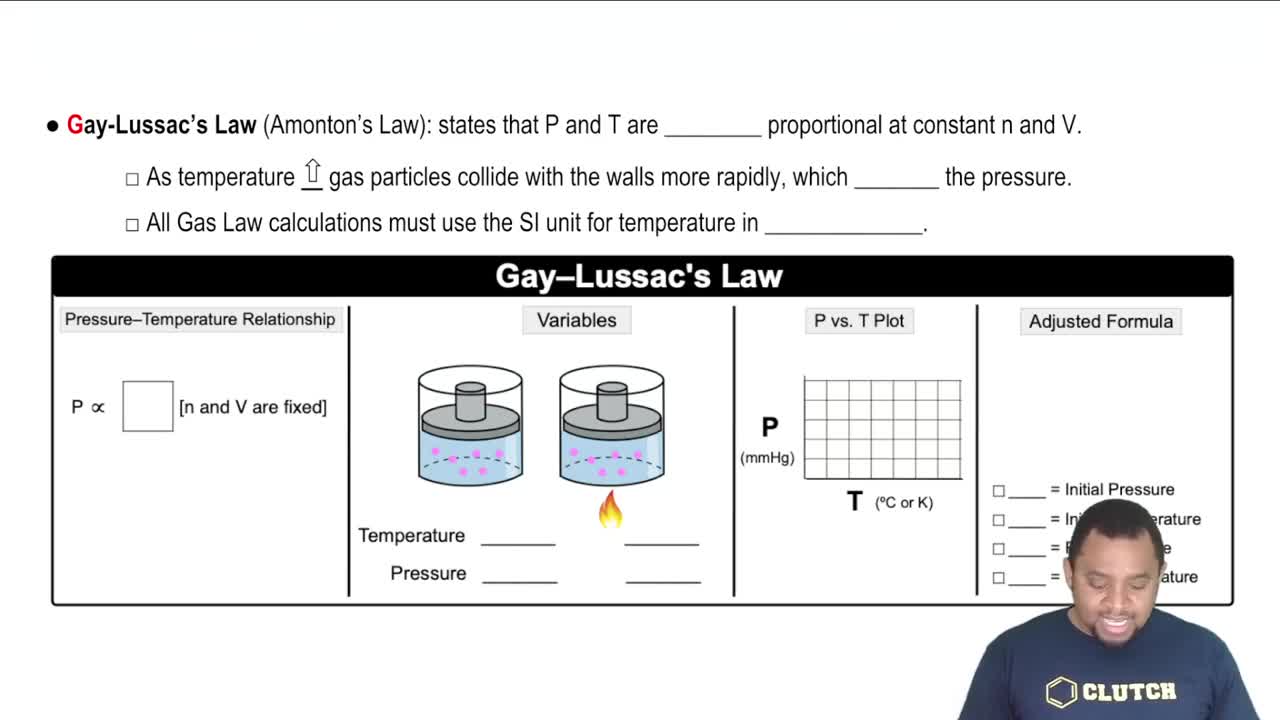
What happens to the pressure of a gas if the temperature increases while volume is held constant?
The pressure of the gas increases as temperature increases, according to Gay-Lussac’s Law.
Gas laws involve which three main variables?
Gas laws involve pressure, volume, and temperature.
Which statement best describes Gay-Lussac’s Law?
Gay-Lussac’s Law states that the pressure of a gas is directly proportional to its temperature at constant volume.
What does Charles's Law state about the relationship between the volume of a gas and its temperature at constant pressure?
Charles's Law states that the volume of a gas is directly proportional to its temperature at constant pressure.
What does Charles’s Law state regarding volume and temperature?
Charles’s Law states that volume and temperature are directly proportional when pressure and moles are constant.
Which law describes the relationship between the pressure and volume of a gas at constant temperature?
Boyle’s Law describes the inverse relationship between pressure and volume at constant temperature.
Which statement best describes Charles’s Law?
Charles’s Law states that the volume of a gas increases as its temperature increases, provided pressure is constant.
Gas laws involve which three terms?
The three terms are pressure, volume, and temperature.
What happens to the volume of a gas if its temperature increases while pressure remains constant?
If the temperature of a gas increases, its volume increases, provided pressure is constant.
How are the pressure and volume of a gas related at constant temperature?
Pressure and volume are inversely related at constant temperature, as described by Boyle’s Law.
Which is a correct way of stating Charles’s Law?
At constant pressure, the volume of a gas is directly proportional to its temperature in Kelvin.
What will happen to the volume of a gas under constant temperature if the pressure increases?
The volume of the gas will decrease if pressure increases at constant temperature, according to Boyle’s Law.
What is the expression of Boyle's Law?
Boyle’s Law is expressed as P1V1 = P2V2.
What happens to the volume of a gas at constant temperature when the pressure is increased?
The volume decreases as pressure increases at constant temperature.
Increasing the pressure on a gas at constant temperature does what to the volume of the gas?
It decreases the volume of the gas.
If you increase the pressure of a gas at constant volume, what happens to the temperature?
The temperature increases, according to Gay-Lussac’s Law.
What two variables does Boyle's Law relate?
Boyle’s Law relates pressure and volume.
What does Boyle's Law state about the relationship between volume and pressure of a gas at constant temperature?
Boyle’s Law states that the volume of a gas is inversely proportional to its pressure at constant temperature.
Which quantity is held constant when working with Boyle’s Law?
Temperature is held constant in Boyle’s Law.
How does Boyle’s Law explain the mechanics of breathing?
During inhalation, lung volume increases and pressure decreases, allowing air to flow in; during exhalation, volume decreases and pressure increases, pushing air out.
Which of the gas laws explains what happens when an aerial shell explodes?
Boyle’s Law explains the rapid increase in pressure and decrease in volume during an explosion.
What happens to the pressure of a gas when it is compressed isothermally according to Boyle’s Law?
The pressure of the gas increases as its volume decreases, according to Boyle’s Law.
 뒤로
뒤로
 02:55
02:55