Skip to main content
General Chemistry
나의 코스
배우기
시험 준비
AI 튜터
학습 가이드
교과서적 해결책
플래시카드
탐험해 보세요
앱을 사용해 보세요
나의 코스
배우기
시험 준비
AI 튜터
학습 가이드
교과서적 해결책
플래시카드
탐험해 보세요
앱을 사용해 보세요
뒤로
Half-Life quiz
카드를 뒤집기 위해 탭할 수 있습니다.
What is the definition of half-life in chemistry?
카드를 뒤집기 위해 탭할 수 있습니다.
👆
What is the definition of half-life in chemistry?
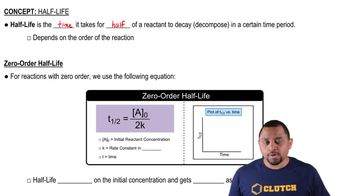
Half-life is the time it takes for half of a reactant to decay or decompose.
진행 상황 추적
컨트롤 버튼이 '내비게이션' 모드로 변경되었습니다.
1/15
관련 플래시카드
관련 실천
추천 영상
Half-Life definitions
Half-Life
10 용어
Half-Life quiz
Half-Life
10 용어
Half-Life quiz #1
Half-Life
33 용어
Half-Life
15. Chemical Kinetics
7 문제점
주제
Jules
Integrated Rate Law
15. Chemical Kinetics
7 문제점
주제
Jules
15. Chemical Kinetics - Part 1 of 3
5 주제
12 문제점
장
Jules
15. Chemical Kinetics - Part 2 of 3
4 주제
11 문제점
장
Jules
15. Chemical Kinetics - Part 3 of 3
4 주제
11 문제점
장
Jules
VideoThumbView.guidedCourse
01:18
First-Order Half-Life Example
3818
views
35
rank
1
comments
VideoThumbView.guidedCourse
02:17
Zero-Order Half-life
5179
views
34
rank
VideoThumbView.guidedCourse
01:19
Zero-Order Half-life Example
4598
views
29
rank
2
comments
이 집합의 용어 (15)
하이드의 정의
What is the definition of half-life in chemistry?
Half-life is the time it takes for half of a reactant to decay or decompose.
How does the half-life of a zero-order reaction depend on the initial concentration?
For zero-order reactions, half-life is directly proportional to the initial concentration of the reactant.
What is the equation for the half-life of a zero-order reaction?
The equation is t₁/₂ = [A]₀ / (2k), where [A]₀ is the initial concentration and k is the rate constant.
What happens to the half-life of a zero-order reaction as the concentration decreases?
The half-life gets shorter as the concentration decreases.
How is half-life represented graphically for a zero-order reaction?
It is shown as a decreasing line (negative slope) with half-life on the y-axis and time on the x-axis.
What is the equation for the half-life of a first-order reaction?
The equation is t₁/₂ = ln(2) / k, where k is the rate constant.
Does the half-life of a first-order reaction depend on the initial concentration?
No, the half-life of a first-order reaction is independent of the initial concentration.
What is the value of ln(2) used in the first-order half-life equation?
ln(2) is approximately 0.693.
How does the half-life of a first-order reaction change over time?
It remains constant throughout the reaction.
What type of reactions commonly follow first-order kinetics?
Radioactive decay processes commonly follow first-order kinetics.
What is the equation for the half-life of a second-order reaction?
The equation is t₁/₂ = 1 / (k[A]₀), where [A]₀ is the initial concentration and k is the rate constant.
How does the half-life of a second-order reaction depend on the initial concentration?
The half-life increases as the initial concentration decreases.
How is half-life represented graphically for a first-order reaction?
It is shown as a flat line (constant) with half-life on the y-axis and time on the x-axis.
Why are first-order processes preferred for radioactive decay studies?
Because their half-life remains constant, making them more predictable and consistent.
What are the units of the rate constant k for zero, first, and second-order reactions?
Zero-order: M·time⁻¹; First-order: time⁻¹; Second-order: M⁻¹·time⁻¹.
 뒤로뒤로
뒤로뒤로
 01:18
01:18