 뒤로
뒤로Acid-Base Equilibria, Conjugate Pairs, and Polyprotic Acids
스터디 가이드 - 스마트 노트
 자료에 맞춘 맞춤형 노트, 핵심 정의, 예시, 맥락을 확장해 제공합니다.
Conjugate Acid-Base Pairs and Equilibrium
Definition and Identification of Conjugate Pairs
In aqueous equilibrium reactions, acids and bases exist in conjugate pairs. A conjugate acid-base pair consists of two species that differ by a single proton (H+). When an acid donates a proton, it forms its conjugate base; when a base accepts a proton, it forms its conjugate acid.
Acid Example:
Base Example:
Conjugate pairs: HA/A- and B/BH+
Key Point: The strength of an acid is inversely related to the strength of its conjugate base.
Equilibrium Constants: Ka, Kb, and Kw
The acid dissociation constant () and the base dissociation constant () quantify the strengths of acids and bases in water. The product of and $K_b$ for a conjugate acid-base pair equals the ion-product constant for water ():
at 25°C
Example: For acetic acid (), the for acetate is .
Polyprotic Acids
Definition and Successive Ionizations
Polyprotic acids are acids that can donate more than one proton per molecule. Each ionization step has its own dissociation constant (, , , etc.), with due to decreasing ease of proton removal.
Example: Phosphoric acid ()
First ionization:
Second ionization:
Third ionization:
Table: Successive Values for Polyprotic Acids
Name (Formula) | Lewis Structure | |||
|---|---|---|---|---|
Oxalic acid () | HOOC–COOH | |||
Sulfurous acid () | HO–SO–OH | |||
Phosphoric acid () | HO–PO–OH | |||
Arsenic acid () | HO–AsO–OH | |||
Carbonic acid () | HO–CO–OH | |||
Hydrosulfuric acid () | H–S–H |
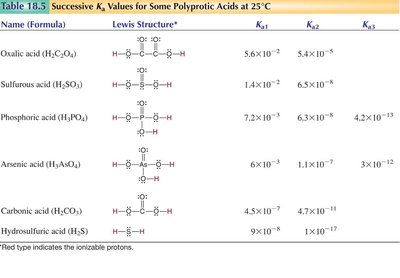
Additional info: The table above shows that each successive proton is harder to remove, reflected in the much smaller values for later ionizations.
Bond Strength, Electronegativity, and Acid Strength
Bond Strength and Acid Strength in Binary Acids
The strength of a binary acid (HX) in water depends on the bond strength between H and X. Weaker H–X bonds make it easier for the acid to donate a proton, resulting in a stronger acid.
H–X Bond | Bond Strength (kJ/mol) | Acid Strength in Water |
|---|---|---|
H–F | 565 | Weak |
H–Cl | 427 | Strong |
H–Br | 363 | Strong |
H–I | 295 | Strong |
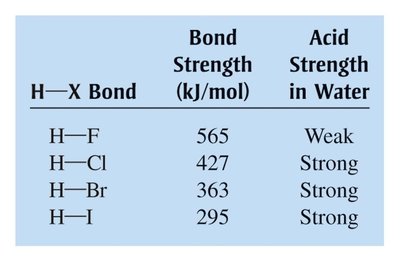
Key Point: As the bond strength decreases down the group, acid strength increases.
Electronegativity and Oxyacid Strength
For oxyacids (acids with the structure H–O–Y), the electronegativity of the central atom (Y) and the number of oxygen atoms bonded to Y influence acid strength:
As the electronegativity of Y increases, the O–H bond becomes more polarized and weaker, increasing acidity.
Additional oxygen atoms bonded to Y withdraw electron density, further weakening the O–H bond and increasing acidity.
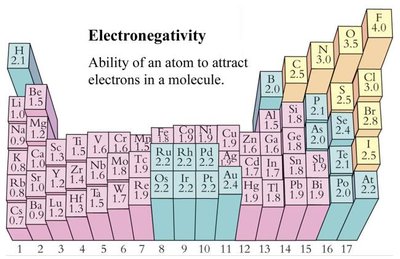
Example: Among the oxyacids of chlorine, (perchloric acid) is the strongest because it has the most oxygen atoms, which increases the electron-withdrawing effect and acid strength.
Calculations Involving Conjugate Pairs
Calculating Kb from Ka
Given the of a weak acid, the of its conjugate base can be calculated using :
Example: For acetic acid (), for acetate is .
pH Calculations for Salt Solutions
Salts of weak acids or bases can hydrolyze in water to produce basic or acidic solutions. For example, sodium acetate () produces a basic solution because acetate is a weak base.
Example: Calculate the pH of 0.25 M using the of acetate.
Set up the equilibrium:
Use to solve for , then calculate pOH and pH.
Additional info: The same approach applies to salts like , where cyanide is the conjugate base of a weak acid.
Relative Strengths of Conjugate Pairs and Spectator Ions
Identifying Spectator Ions and Reaction Direction
When analyzing acid-base reactions, first identify spectator ions (ions that do not participate in the reaction). Then, determine if the reaction involves strong or weak acids/bases, and whether equilibrium is established by comparing the reaction quotient (Q) to the equilibrium constant (K).
If Q < K, the reaction proceeds forward; if Q > K, it proceeds in reverse.
Common ion effect and simultaneous equilibria may need to be considered in complex solutions.
Additional info: In solutions with multiple weak acids or bases, simultaneous equilibria can occur, requiring careful setup of initial and equilibrium concentrations.
