 뒤로
뒤로CHEM 131 Chapter 17: Acid-Base Equilibria: Properties, Definitions, Calculations, and Applications
스터디 가이드 - 스마트 노트
 자료에 맞춘 맞춤형 노트, 핵심 정의, 예시, 맥락을 확장해 제공합니다.
Ch. 17: Acid-Base Equilibria
General Properties of Acids and Bases
Acids and bases are two fundamental classes of compounds in chemistry, each with distinct properties and behaviors in aqueous solutions.
Acids:
Sour taste
Ability to dissolve many metals
Change blue litmus paper to red
Neutralize bases
Examples: Acetic acid (vinegar), hydrochloric acid (stomach acid)
Bases:
Bitter taste
Slippery feel
Change red litmus paper to blue
Neutralize acids
Examples: Sodium hydroxide (NaOH), ammonia (NH3)


Definitions of Acids and Bases
There are three main definitions of acids and bases, each with increasing generality:
Arrhenius Definition:
Acid: Produces H3O+ (or H+) in water
Base: Produces OH- in water
Brønsted–Lowry Definition:
Acid: Proton (H+) donor
Base: Proton (H+) acceptor
Conjugate acid-base pairs: Related by gain/loss of a proton
Lewis Definition:
Acid: Electron pair acceptor
Base: Electron pair donor
Structure and Acid Strength
The strength of an acid depends on its molecular structure, including bond polarity and bond strength.
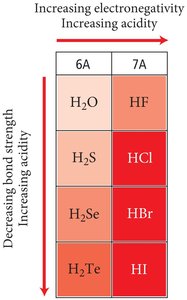
Binary Acids (H–X):
Acid strength increases with bond polarity (more polarized H–X bond = stronger acid)
Acid strength increases as bond strength decreases (weaker H–X bond = stronger acid)
Trends: Across a period (left to right) and down a group (top to bottom) in the periodic table
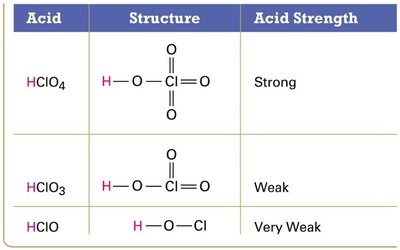
Oxyacids (H–O–Y):
Acid strength increases with the electronegativity of the central atom (Y)
More oxygen atoms attached to Y increase acid strength
Higher oxidation number of Y = stronger acid
Carboxylic Acids and Organic Acids
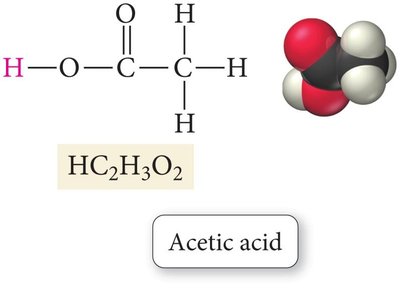
Carboxylic acids are a common class of organic acids containing the –COOH group. Only the hydrogen in the carboxyl group is acidic.
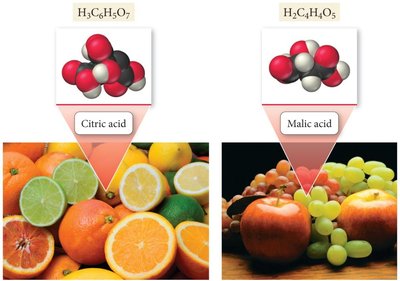
Examples: Acetic acid (HC2H3O2), citric acid, malic acid
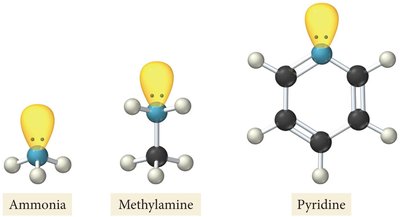
Structure of Organic Bases: Amines
Amines are organic weak bases containing a nitrogen atom with a lone pair. Their base strength depends on the ability to accept a proton (H+).
Electron-donating groups increase base strength
Electron-withdrawing groups decrease base strength
Examples: Ammonia (NH3), methylamine (CH3NH2), pyridine
Strong vs. Weak Acids and Bases
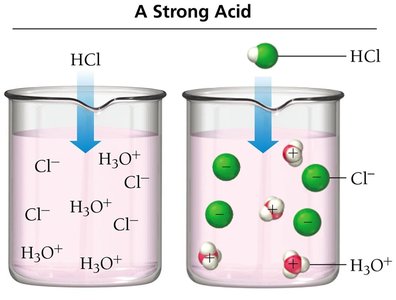
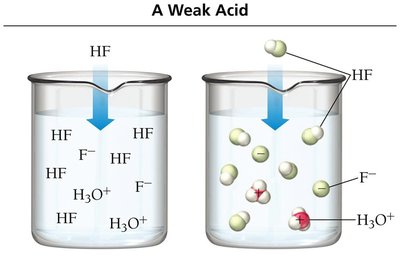
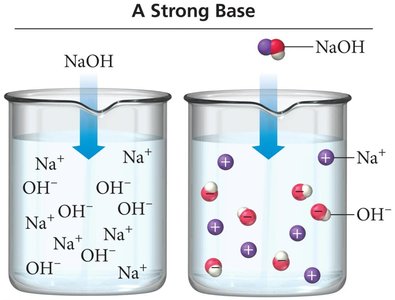
The strength of an acid or base is determined by its degree of ionization in water.
Strong acids/bases: Completely or nearly completely ionize in water (strong electrolytes)
Weak acids/bases: Partially ionize in water (weak electrolytes); establish equilibrium


Acid and Base Ionization Constants (Ka and Kb)
The strength of a weak acid or base is quantified by its ionization constant.
Acid ionization constant (Ka):
Base ionization constant (Kb):
Larger Ka or Kb = stronger acid or base
Autoionization of Water and the pH Scale
Water can act as both an acid and a base (amphoteric), undergoing autoionization:
Ion product constant for water: at 25°C
pH = –log[H3O+]; pOH = –log[OH-]; pH + pOH = 14
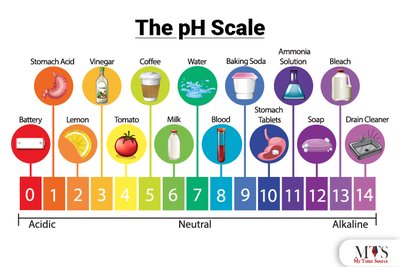
![The pH scale with corresponding [H+] values](https://static.studychannel.pearsonprd.tech/study_guide_files/general-chemistry/sub_images/906f7547_image_25.png)
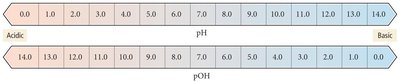
pKa and pKb
The strength of acids and bases is often expressed using pKa and pKb:
pKa = –log(Ka); pKb = –log(Kb)
Smaller pKa or pKb = stronger acid or base
Relationship:
Calculating pH and Ion Concentrations
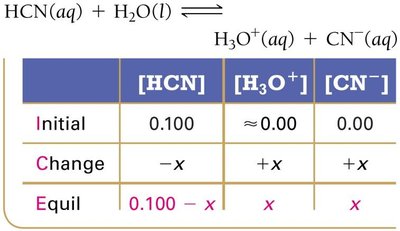
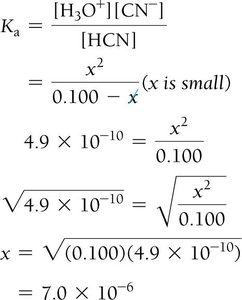
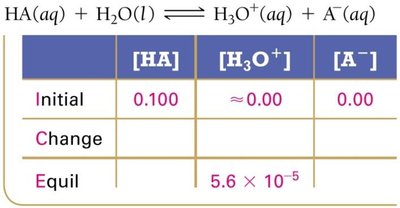
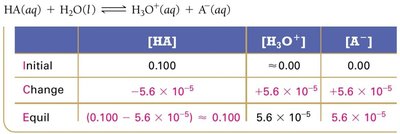
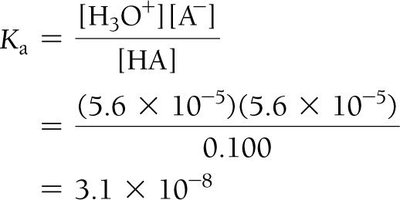
For strong acids and bases, pH and ion concentrations can be calculated directly from the initial concentration. For weak acids and bases, equilibrium calculations (ICE tables) are required.
For monoprotic strong acids: [H+] = [acid]
For strong bases: [OH-] = [base] × number of OH- per formula unit
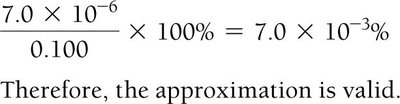
For weak acids/bases: Use ICE tables and Ka or Kb
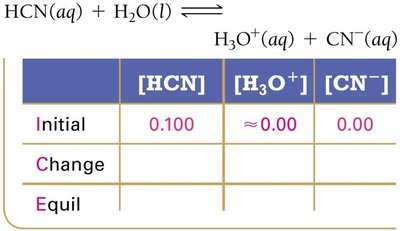
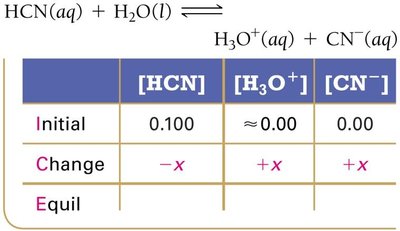
Polyprotic Acids
Polyprotic acids can donate more than one proton, with each ionization step having its own Ka value (Ka1 > Ka2 > Ka3). Usually, only the first ionization significantly affects pH, except in cases like H2SO4 where the second ionization is also significant.
Lewis Acid–Base Theory
The Lewis definition broadens the concept of acids and bases to include electron pair transfer. Lewis acids accept electron pairs, while Lewis bases donate them. This theory encompasses all Arrhenius and Brønsted–Lowry acid–base reactions.
Acid–Base Titrations
Titration is a laboratory technique used to determine the concentration of an unknown acid or base by reacting it with a standard solution. The endpoint is detected by an indicator, and the equivalence point is when stoichiometric amounts of acid and base have reacted.
Naming Acids
Binary acids: Use the prefix "hydro-", the root of the nonmetal, the suffix "-ic", and the word "acid" (e.g., HCl = hydrochloric acid).
Oxyacids: If the polyatomic ion ends in "-ate", change to "-ic acid"; if "-ite", change to "-ous acid" (e.g., HNO3 = nitric acid, HNO2 = nitrous acid).
Summary Table: Acid Strength and Structure
Acid | Structure | Acid Strength |
|---|---|---|
HClO4 | O | O=Cl=O | O–H | Strong |
HClO3 | O | O=Cl=O | H–O | Weak |
HClO | H–O–Cl | Very Weak |
Additional info: This guide covers the essential concepts of acid-base equilibria, including properties, definitions, calculations, and laboratory applications, as required for a General Chemistry college course.
