 뒤로
뒤로Acid-Base Equilibria: Properties, Strength, and Calculations in Aqueous Solution
스터디 가이드 - 스마트 노트
 자료에 맞춘 맞춤형 노트, 핵심 정의, 예시, 맥락을 확장해 제공합니다.
Properties of Aqueous Acids and Bases
Definitions and Models of Acids and Bases
Acids and bases are fundamental chemical species with several definitions, each emphasizing different aspects of their behavior in aqueous solution.
Brønsted-Lowry Model: An acid is a proton (H+) donor, and a base is a proton acceptor.
Arrhenius Model: An acid produces H+ ions in solution, while a base produces OH- ions.
Lewis Model: A Lewis acid is an electron pair acceptor, and a Lewis base is an electron pair donor.
Example: HCl (hydrochloric acid) donates a proton to water, forming Cl- and H3O+:
Ammonia (NH3) accepts a proton from water, forming NH4+ and OH-:
Acid and Base Strength in Water
Strong vs. Weak Acids and Bases
Acids and bases are classified as strong or weak based on their degree of ionization in water.
Strong acids and strong bases dissociate completely in water, producing a high concentration of ions.
Weak acids and weak bases only partially dissociate, resulting in an equilibrium between the undissociated and dissociated forms.
Example: Hydrochloric acid (HCl) is a strong acid, while acetic acid (CH3COOH) is a weak acid.
Visual Representation:
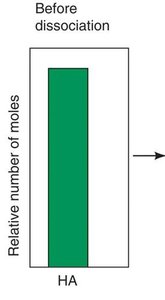
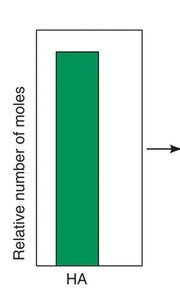
Acid and Base Dissociation Equilibria
The dissociation of weak acids and bases in water is described by equilibrium constants:
Acid dissociation constant (Ka):
Base dissociation constant (Kb):
Strong acids and bases do not have meaningful Ka or Kb values because their reactions go to completion.
Quantitative Aspects of Acid-Base Equilibria
pH and pOH Calculations
The pH of a solution is a measure of its acidity, defined as:
Similarly, pOH is defined as:
At 25°C, the relationship between pH and pOH is:
Self-Ionization of Water and the Ion-Product Constant
Water undergoes self-ionization, producing hydronium and hydroxide ions:
The equilibrium constant for this process is:
at 25°C
All aqueous solutions contain both H3O+ and OH-. The relative concentrations determine whether the solution is acidic, basic, or neutral.
Acidic:
Neutral:
Basic:
Relationship Between Ka and pKa
The strength of an acid is often expressed as its pKa:
Lower pKa values indicate stronger acids. The same applies to bases with Kb and pKb.
Tables of Acid and Base Strength
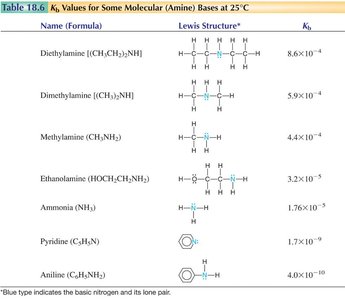
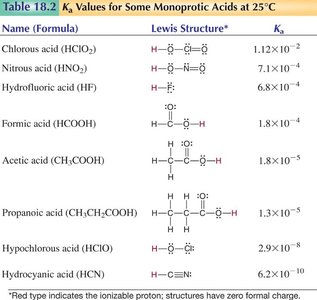
Tables of Ka and Kb values are used to compare the strengths of various acids and bases.
Name (Formula) | Lewis Structure | Ka |
|---|---|---|
Chlorous acid (HClO2) | H–O–Cl=O | 1.12×10⁻² |
Nitrous acid (HNO2) | H–O–N=O | 7.1×10⁻⁴ |
Hydrofluoric acid (HF) | H–F | 6.8×10⁻⁴ |
Formic acid (HCOOH) | H–C(=O)–OH | 1.8×10⁻⁴ |
Acetic acid (CH3COOH) | CH3–C(=O)–OH | 1.8×10⁻⁵ |
Propanoic acid (CH3CH2COOH) | CH3CH2–C(=O)–OH | 1.3×10⁻⁵ |

Name (Formula) | Lewis Structure | Kb |
|---|---|---|
Diethylamine ((CH3CH2)2NH) | Et2NH | 8.6×10⁻⁴ |
Dimethylamine ((CH3)2NH) | Me2NH | 5.9×10⁻⁴ |
Methylamine (CH3NH2) | MeNH2 | 4.4×10⁻⁴ |
Ethanolamine (HOCH2CH2NH2) | HOCH2CH2NH2 | 3.2×10⁻⁵ |
Ammonia (NH3) | NH3 | 1.76×10⁻⁵ |
Common Ion Effect and Buffer Solutions
Common Ion Effect
The common ion effect occurs when a solution contains two substances that share a common ion. The presence of the common ion suppresses the ionization of a weak acid or base, shifting the equilibrium position according to Le Chatelier's Principle.
Example: Adding sodium acetate (which provides acetate ions) to a solution of acetic acid decreases the ionization of acetic acid.
Buffer Solutions
A buffer is a solution that resists changes in pH upon addition of small amounts of acid or base. Buffers are typically composed of a weak acid and its conjugate base, or a weak base and its conjugate acid.
Sample Calculations and Problem-Solving Strategies
Calculating pH of Strong and Weak Acid Solutions
For strong acids, assume complete dissociation: initial acid concentration.
For weak acids, set up an ICE (Initial, Change, Equilibrium) table and solve for using the Ka expression.
Example: Calculate the pH of a 0.50 M HF solution ():
Set up the equilibrium:
Let be the amount dissociated:
Solve for and then calculate pH.
Calculating pOH and [OH-] for Bases
For strong bases, initial base concentration.
For weak bases, use the Kb expression and an ICE table.
Relationship Between pH, pOH, and Kw
For any aqueous solution at 25°C:
Visualizing Acid and Base Dissociation
Diagrams can help illustrate the difference between strong and weak acid dissociation in water.
Solubility Rules (for Reference in Acid-Base and Precipitation Reactions)
Rule | Description |
|---|---|
1 | Most alkali metal salts and ammonium salts are soluble. |
2 | Most nitrates, acetates, and perchlorates are soluble. |
3 | Most silver, lead, and mercury(I) salts are insoluble. |
4 | Most chlorides, bromides, and iodides are soluble. |
5 | Most carbonates, chromates, sulfides, oxides, phosphates, and hydroxides are insoluble, except for hydroxides of Ba2+, Ca2+, and Sr2+ (slightly soluble). |
6 | Most sulfates are soluble, except for calcium sulfate, barium sulfate, and strontium sulfate, which are insoluble. |
Summary Table: Key Equations and Relationships
Concept | Equation |
|---|---|
Acid dissociation constant | |
Base dissociation constant | |
Ion-product constant for water | |
pH | |
pOH | |
Relationship |
Additional info:
When solving equilibrium problems for weak acids and bases, the 5% rule can be used to simplify calculations if the change in concentration is less than 5% of the initial value.
Common ion problems and buffer calculations are essential for understanding real-world acid-base systems, such as biological fluids and industrial processes.
