 뒤로
뒤로Acid-Base Equilibria: Structure, Properties, and Calculations
스터디 가이드 - 스마트 노트
 자료에 맞춘 맞춤형 노트, 핵심 정의, 예시, 맥락을 확장해 제공합니다.
Acid-Base Equilibria
Acids and Bases in Water
Acids and bases are fundamental chemical species that interact with water to produce characteristic ions. Their behavior in aqueous solution is central to understanding chemical equilibria and reactions.
Acids produce hydronium ions (H3O+) in water.
Bases produce hydroxide ions (OH-) in water.
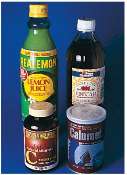
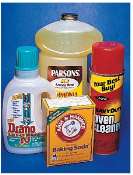
Acids and bases are commonly found in household products and biological systems.
Acids have a sour taste, can dissolve metals, and turn blue litmus paper red.
Bases taste bitter, feel slippery, and turn red litmus paper blue.
Arrhenius Acid-Base Definition
The Arrhenius definition classifies acids and bases based on their behavior in water:
Arrhenius Acid: Substance with H in its formula that dissociates to yield H3O+.
Arrhenius Base: Substance with OH in its formula that dissociates to yield OH-.
Acid-base neutralization:
Strong and Weak Acids
Acids are classified by their extent of dissociation in water:
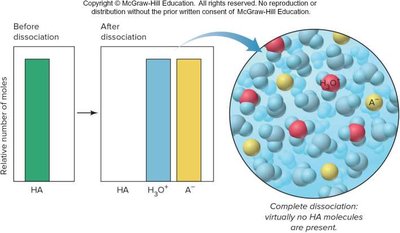
Strong acids dissociate completely, leaving no undissociated molecules.
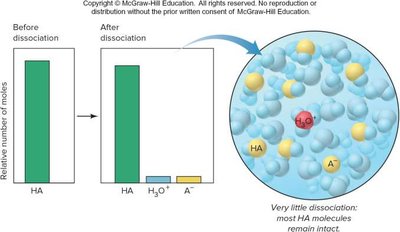
Weak acids dissociate only slightly, with most molecules remaining intact.
Acid Dissociation Constant (Ka)
The strength of an acid is quantified by its acid dissociation constant, Ka:
For the reaction:
Larger Ka indicates a stronger acid; smaller Ka indicates a weaker acid.
Classifying Acid and Base Strength
Acids and bases are classified as strong or weak based on their dissociation:
Strong acids: Hydrohalic acids (HCl, HBr, HI), oxoacids with excess O atoms (HNO3, H2SO4, HClO4).
Weak acids: HF, HCN, oxoacids with fewer O atoms, carboxylic acids (RCOOH).
Strong bases: Group 1A and 2A metal hydroxides (NaOH, KOH, Ca(OH)2).
Weak bases: Ammonia (NH3), amines (RNH2).
Autoionization of Water and the pH Scale
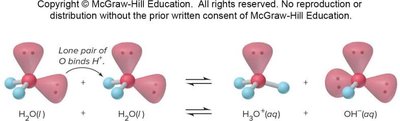
Water undergoes autoionization, producing both H3O+ and OH- ions:
Ion-product constant: at 25°C
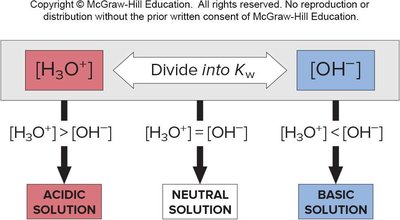
Acidic solution:
Neutral solution:
Basic solution:
The pH Scale
The pH scale quantifies the acidity or basicity of a solution:
Acidic: pH < 7; Neutral: pH = 7; Basic: pH > 7
pOH:
Relationship: at 25°C
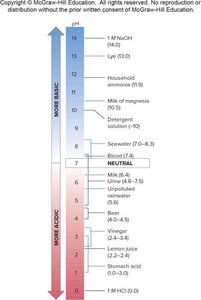
![Relationship among [H3O+], pH, [OH-], and pOH](https://static.studychannel.pearsonprd.tech/study_guide_files/general-chemistry/sub_images/e5f4fa54_image_10.png)
Methods for Measuring pH
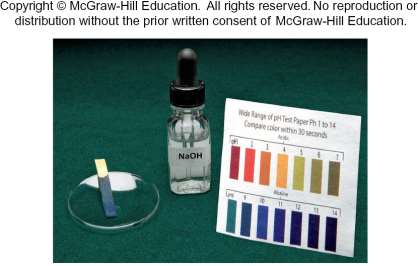
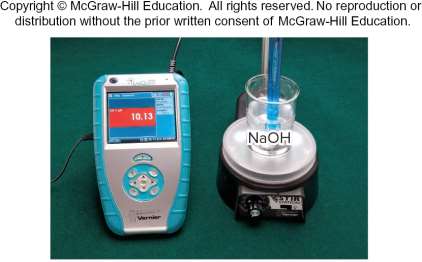
pH can be measured using indicators or electronic meters:
pH test paper changes color based on acidity/basicity.
pH meters provide precise digital readings.
Brønsted-Lowry Acid-Base Definition
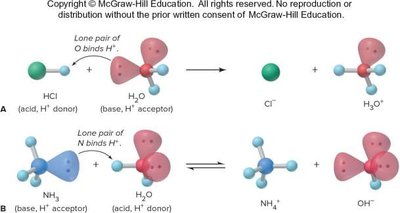
The Brønsted-Lowry theory defines acids and bases by proton transfer:
Acid: Proton donor (must contain H).
Base: Proton acceptor (must have a lone pair).
Acid-base reactions involve transfer of H+ between species.
Conjugate Acid-Base Pairs
Acid-base reactions produce conjugate pairs:
Each acid has a conjugate base, and each base has a conjugate acid.
Example:
Conjugate pairs: H2S/HS-, NH3/NH4+
Strengths of Conjugate Acid-Base Pairs
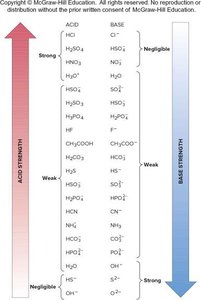
The strength of an acid is inversely related to the strength of its conjugate base:
Strong acids have negligible conjugate base strength.
Weak acids have stronger conjugate bases.
Predicting Net Direction of Acid-Base Reactions
Acid-base reactions favor the formation of the weaker acid and base:
Reaction proceeds toward the side with weaker acid/base (Kc > 1).
Use relative strengths to predict equilibrium direction.
Solving Weak-Acid Equilibria
To solve for equilibrium concentrations in weak acid solutions:
Write the balanced equation.
Write the Ka expression.
Define x as the change in concentration.
Construct a reaction table (ICE table).
Make simplifying assumptions (e.g., x is small).
Solve for x and check assumptions.
Polyprotic Acids
Polyprotic acids have more than one ionizable proton, each with its own Ka:
First dissociation (Ka1) is strongest; subsequent Ka values decrease.
Example: Phosphoric acid (H3PO4) has three dissociation steps.
Acid Strength and Molecular Properties
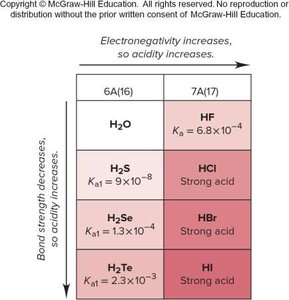
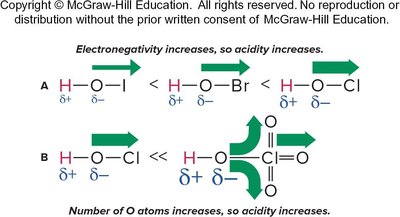
Acid strength depends on electronegativity and bond strength:
For nonmetal hydrides, acid strength increases with electronegativity and decreases with bond strength.
For oxoacids, acid strength increases with the number of O atoms and the electronegativity of the central atom.
Hydrated Metal Ions
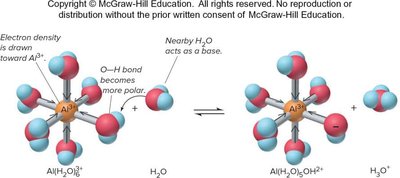
Small, highly charged metal ions can act as acids by polarizing water molecules and releasing H+:
Example: Al3+ forms acidic solutions by transferring H+ to water.
Weak Bases and Their Equilibria
Weak bases accept protons from water, producing OH-:
Base ionization constant:
Common weak bases: ammonia, amines, pyridine.
Acid-Base Properties of Salt Solutions
The pH of a salt solution depends on the nature of its ions:
Salts of strong acid and strong base yield neutral solutions.
Salts of weak acid and strong base yield basic solutions.
Salts of weak base and strong acid yield acidic solutions.
Salts of weak acid and weak base: pH depends on relative Ka and Kb.
The Leveling Effect
In water, all strong acids and bases are leveled to the strength of H3O+ and OH- respectively, due to complete dissociation.
Lewis Acid-Base Definition
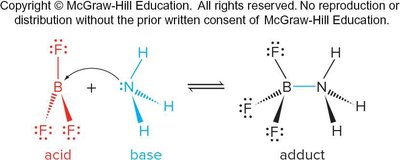
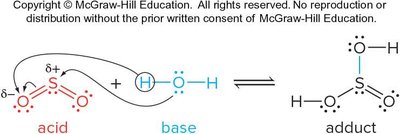
The Lewis definition expands acid-base concepts to electron pair transfer:
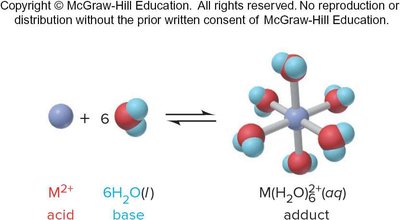
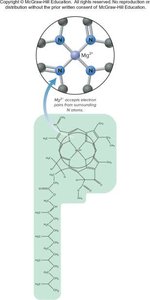
Lewis acid: Electron pair acceptor (must have a vacant orbital).
Lewis base: Electron pair donor (must have a lone pair).
Many metal cations and molecules with polar multiple bonds act as Lewis acids.
Nature of Ions | Examples | Ion(s) That React(s) with Water | pH |
|---|---|---|---|
Cation of strong base, anion of strong acid | NaCl, KBr, Ba(NO3)2 | None | 7.0 |
Cation of weak base, anion of strong acid | NH4Cl, NH4NO3, CH3NH3Br | Cation: NH4+ + H2O ⇄ NH3 + H3O+ | <7.0 |
Small, highly charged metal cation, anion of strong acid | Al(NO3)3, CrBr3, FeCl3 | Cation: Al(H2O)63+ + H2O ⇄ Al(H2O)5OH2+ + H3O+ | <7.0 |
Cation of strong base, anion of weak acid | KNO2, NaClO, Na2CO3 | Anion: NO2- + H2O ⇄ HNO2 + OH- | >7.0 |
Cation of weak base or small, highly charged metal cation, anion of weak acid | NH4ClO2, NH4CN, Pb(CH3COO)2 | Cation and anion: NH4+ + H2O ⇄ NH3 + H3O+; ClO2- + H2O ⇄ HClO2 + OH- | <7.0 if Ka(cation) > Kb(anion); >7.0 if Kb(anion) > Ka(cation) |
Additional info: This study guide covers the essential concepts of acid-base equilibria, including definitions, properties, calculations, and molecular structure effects. It is suitable for exam preparation and self-study in General Chemistry.
