 뒤로
뒤로Acid-Base Equilibria, Titrations, and Solubility: Study Notes
스터디 가이드 - 스마트 노트
 자료에 맞춘 맞춤형 노트, 핵심 정의, 예시, 맥락을 확장해 제공합니다.
Acid-Base Equilibria and Calculations
Introduction to Acid-Base Equilibria
Acid-base equilibria involve the reversible reactions between acids and bases in aqueous solutions. Understanding these equilibria is essential for calculating pH, determining the extent of reactions, and analyzing titration curves.
Acid dissociation constant (Ka): Measures the strength of a weak acid in solution.
Base dissociation constant (Kb): Measures the strength of a weak base in solution.
pH and pOH: pH = -log[H+], pOH = -log[OH-], and pH + pOH = 14 at 25°C.
Conjugate acid-base pairs: An acid and base that differ by one proton (H+).
Setting Up Equilibrium Expressions
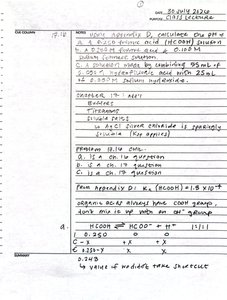
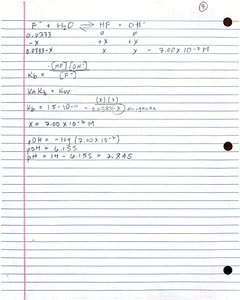
To solve acid-base equilibrium problems, write the balanced chemical equation and set up the equilibrium expression using initial concentrations and changes (ICE tables).
ICE Table: Stands for Initial, Change, Equilibrium. Used to organize concentrations at each stage.
Quadratic Equations: Sometimes required when the change in concentration is not negligible.
Example: For the dissociation of HC2H3O2 (acetic acid):
The equilibrium expression is:
Shortcuts and Approximations
For weak acids and bases, if the Ka or Kb is very small, the change in concentration (x) can often be neglected in the denominator, simplifying calculations.
5% Rule: If x is less than 5% of the initial concentration, the approximation is valid.
pKa and pKb: ;
Titrations and Buffer Calculations
Introduction to Titrations
Titration is a laboratory technique used to determine the concentration of an unknown acid or base by reacting it with a standard solution of known concentration.
Equivalence Point: The point at which the amount of acid equals the amount of base during titration.
Indicator: A substance that changes color at (or near) the equivalence point.
Calculating pH During Titration
The pH at various points during a titration depends on the amounts of acid and base present. Calculations may involve stoichiometry, buffer equations, or equilibrium expressions.
Before equivalence: Use the Henderson-Hasselbalch equation for buffer regions.
At equivalence: Calculate based on the hydrolysis of the salt formed.
After equivalence: Excess strong acid or base determines pH.
Henderson-Hasselbalch Equation:
Where [A-] is the concentration of the conjugate base and [HA] is the concentration of the weak acid.
Example: Titration of Acetic Acid with NaOH
Given 95 mL of 0.250 M acetic acid and 0.250 M NaOH, calculate the pH after adding a certain volume of NaOH.
Write the neutralization reaction:
Calculate moles of acid and base, determine limiting reactant, and use the Henderson-Hasselbalch equation if in buffer region.
Solubility Equilibria
Solubility Product Constant (Ksp)
The solubility product constant, Ksp, describes the equilibrium between a solid and its ions in a saturated solution. It is used to calculate the solubility of sparingly soluble salts.
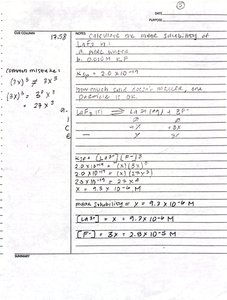
Ksp Expression: For a salt AB2:
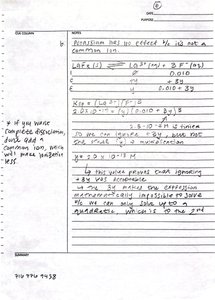
Common Ion Effect: The presence of a common ion decreases the solubility of a salt.
Calculating Molar Solubility
To find the molar solubility of a salt, set up an ICE table and solve for the concentration of ions at equilibrium.
Example: For LaF3 in pure water and in 0.010 M NaF, set up the equilibrium and solve for x (molar solubility).
Precision and Approximations in Solubility Calculations
When the common ion concentration is much larger than the solubility, the change in concentration (x) can be neglected in the denominator. However, if x is not negligible, a quadratic equation must be solved.
Quadratic Formula:
Check Approximations: Always verify if the approximation is valid by comparing x to the initial concentration.
Advanced Acid-Base and Solubility Problems
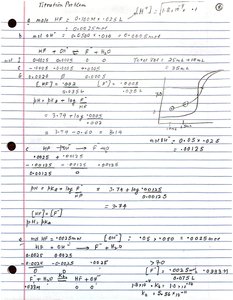
Titration Curves and Special Cases
Titration curves plot pH versus volume of titrant added and reveal buffer regions, equivalence points, and post-equivalence behavior. Special cases may require careful stoichiometric and equilibrium analysis.
Buffer Region: Where both weak acid and conjugate base are present.
Equivalence Point: Where moles of acid equal moles of base.
Post-Equivalence: Excess titrant determines pH.
Calculating pH for Weak Acid/Weak Base Systems
For weak acid/weak base reactions, use the appropriate Ka or Kb and ICE tables to solve for equilibrium concentrations and pH.
Relationship: where at 25°C.
pH Calculation: ,
Summary Table: Key Equations and Concepts
Concept | Equation | Notes |
|---|---|---|
Acid Dissociation | Use ICE table for weak acids | |
Base Dissociation | Use ICE table for weak bases | |
Henderson-Hasselbalch | Buffer region calculations | |
Solubility Product | For sparingly soluble salts | |
Relationship | For conjugate acid-base pairs |
Common Mistakes and Tips
Always check if approximations are valid (5% rule).
Use the correct form of the Henderson-Hasselbalch equation (base over acid for pOH, acid over base for pH).
Significant figures are important—typically worth 10% on quizzes.
For titrations, always account for the stoichiometry of the reaction.
When in doubt, set up the full quadratic equation.
