 뒤로
뒤로Acid-Base Titration and Limiting Reactant Situations in General Chemistry
스터디 가이드 - 스마트 노트
 자료에 맞춘 맞춤형 노트, 핵심 정의, 예시, 맥락을 확장해 제공합니다.
Q1. Imagine a solution made by mixing 50.0 mL of 0.100 M HCl(aq) with 10.0 mL of 0.100 M NaOH(aq). Will the pH be acidic, basic, or neutral? Quantify the pH.
Background
Topic: Acid-Base Reactions and Limiting Reactants
This question tests your understanding of strong acid and strong base reactions, limiting reactant concepts, and pH calculation after mixing.
Key Terms and Formulas
Strong acid: HCl dissociates completely in water.
Strong base: NaOH dissociates completely in water.
Limiting reactant: The reactant that is completely consumed first in a chemical reaction.
pH formula:
Step-by-Step Guidance
Calculate the moles of HCl and NaOH present using .
Determine which reactant is the limiting reactant by comparing the moles of HCl and NaOH.
Write the balanced equation: .
Subtract the moles of the limiting reactant from the excess reactant to find the remaining moles after reaction.
Calculate the concentration of the excess reactant in the total volume of solution.
Try solving on your own before revealing the answer!
Q2. Imagine a solution made by mixing 50.0 mL of 0.100 M HCl(aq) with 60.0 mL of 0.100 M NaOH(aq). Will the pH be acidic, basic, or neutral? Quantify the pH.
Background
Topic: Acid-Base Reactions and Limiting Reactants
This question tests your ability to determine the outcome of mixing different volumes of strong acid and strong base, and to calculate the resulting pH.
Key Terms and Formulas
Strong acid and strong base: Both dissociate completely.
Limiting reactant: The reactant that is used up first.
pH formula:
pOH formula:
Relationship:
Step-by-Step Guidance
Calculate the moles of HCl and NaOH using .
Identify the limiting reactant and determine which species remains after the reaction.
Subtract the moles of the limiting reactant from the excess reactant to find the remaining moles.
Calculate the concentration of the excess reactant in the total solution volume.
Use the appropriate formula ( or ) to set up the calculation for the final pH.
Try solving on your own before revealing the answer!
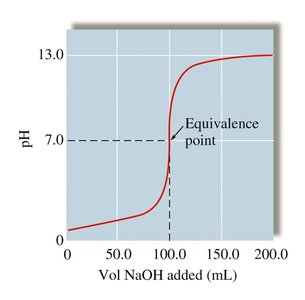
Q3. What is the molarity of 200.0 mL of a dilute aqueous HNO3 solution? (Titrate with 0.100 M NaOH)
Background
Topic: Acid-Base Titration
This question tests your understanding of titration, stoichiometry, and how to determine the concentration of an unknown analyte using a strong titrant.
Key Terms and Formulas
Analyte: The substance whose concentration is being determined (HNO3).
Titrant: The solution of known concentration added to react with the analyte (NaOH).
Stoichiometric mole ratio: Ratio from the balanced equation.
Formula:
Step-by-Step Guidance
Write the balanced equation: .
Determine the volume of NaOH used at the equivalence point (Ve).
Calculate the moles of NaOH added: .
Use the stoichiometric ratio to find moles of HNO3 neutralized.
Set up the formula to solve for the molarity of HNO3.
Try solving on your own before revealing the answer!
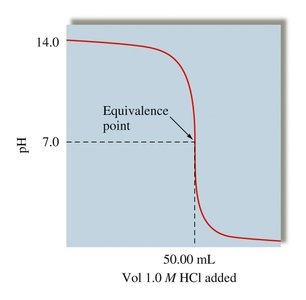
Q4. What is the molarity of 100.0 mL of an aqueous NaOH solution? (Titrate with 1.00 M HCl)
Background
Topic: Acid-Base Titration
This question tests your ability to use titration data to determine the concentration of a strong base using a strong acid titrant.
Key Terms and Formulas
Analyte: NaOH (unknown concentration).
Titrant: HCl (known concentration).
Formula:
Step-by-Step Guidance
Write the balanced equation: .
Determine the volume of HCl used at the equivalence point (Ve).
Calculate the moles of HCl added: .
Use the stoichiometric ratio to find moles of NaOH neutralized.
Set up the formula to solve for the molarity of NaOH.
Try solving on your own before revealing the answer!
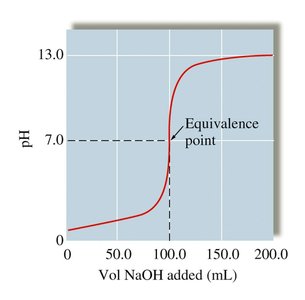
Q5. Draw the pH Curve for the Titration of 50.0 mL of 0.200 M HNO3 with 0.100 M NaOH titrant. Ve = _____ mL, pH at Ve = _____
Background
Topic: Titration Curves and Equivalence Point
This question tests your ability to interpret and sketch titration curves, identify the equivalence point, and estimate pH at equivalence.
Key Terms and Formulas
Equivalence point (Ve): The point at which stoichiometrically equivalent amounts of acid and base have reacted.
pH at equivalence: For strong acid-strong base titrations, pH is typically neutral (pH ≈ 7).
Step-by-Step Guidance
Calculate the moles of HNO3 present: .
Determine the volume of NaOH needed to reach equivalence using the stoichiometric ratio.
Sketch the titration curve, showing the initial pH, the rapid change near Ve, and the final pH after excess base is added.
Label the equivalence point (Ve) on the curve.
Try solving on your own before revealing the answer!
Q6. Draw the pH Curve for the Titration of 100.0 mL of 0.500 M NaOH with 1.00 M HCl titrant. Ve = _____ mL, pH at Ve = _____
Background
Topic: Titration Curves and Equivalence Point
This question tests your ability to interpret titration curves for strong base-strong acid titrations, identify the equivalence point, and estimate pH at equivalence.
Key Terms and Formulas
Equivalence point (Ve): The point at which stoichiometrically equivalent amounts of acid and base have reacted.
pH at equivalence: For strong acid-strong base titrations, pH is typically neutral (pH ≈ 7).
Step-by-Step Guidance
Calculate the moles of NaOH present: .
Determine the volume of HCl needed to reach equivalence using the stoichiometric ratio.
Sketch the titration curve, showing the initial pH, the rapid change near Ve, and the final pH after excess acid is added.
Label the equivalence point (Ve) on the curve.
Try solving on your own before revealing the answer!
Q7. Sketch a generic pH titration curve for the titration of 10.0 moles of NaOH with 1.0 M HCl titrant. Label the equivalence point (Ve). Sketch the first derivative of the plot.
Background
Topic: Titration Curves and Derivatives
This question tests your ability to sketch and interpret titration curves and their derivatives, focusing on the equivalence point.
Key Terms and Formulas
pH titration curve: Graph of pH vs. volume of titrant added.
First derivative: Shows the rate of change of pH with respect to volume added; sharp peak at equivalence point.
Step-by-Step Guidance
Sketch the titration curve, starting with high pH (basic solution) and dropping sharply at equivalence.
Label the equivalence point (Ve) where the sharp change occurs.
Sketch the first derivative, showing a peak at Ve.
Try solving on your own before revealing the answer!
Q8. Sketch a generic pH titration curve for the titration of 10.0 moles of HCl with 1.0 M NaOH titrant. Label the equivalence point (Ve). Sketch the first derivative of the plot.
Background
Topic: Titration Curves and Derivatives
This question tests your ability to sketch and interpret titration curves and their derivatives, focusing on the equivalence point.
Key Terms and Formulas
pH titration curve: Graph of pH vs. volume of titrant added.
First derivative: Shows the rate of change of pH with respect to volume added; sharp peak at equivalence point.
Step-by-Step Guidance
Sketch the titration curve, starting with low pH (acidic solution) and rising sharply at equivalence.
Label the equivalence point (Ve) where the sharp change occurs.
Sketch the first derivative, showing a peak at Ve.
Try solving on your own before revealing the answer!
