뒤로
뒤로Acid–Base Equilibria: Concepts, Calculations, and Applications
스터디 가이드 - 스마트 노트
 자료에 맞춘 맞춤형 노트, 핵심 정의, 예시, 맥락을 확장해 제공합니다.
Acid–Base Equilibria
Acid and Base Definitions
Acids and bases are fundamental concepts in chemistry, defined by several models:
Arrhenius Definition: An acid increases the concentration of hydrogen ions (H+) in water, while a base increases the concentration of hydroxide ions (OH-).
Brønsted–Lowry Definition: An acid is a proton donor; a base is a proton acceptor.
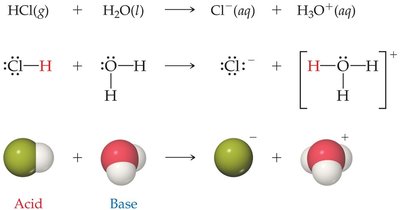
Example: HCl in water acts as an acid, donating a proton to H2O, forming Cl- and H3O+.
Water as a Proton Acceptor and Amphiprotic Substance
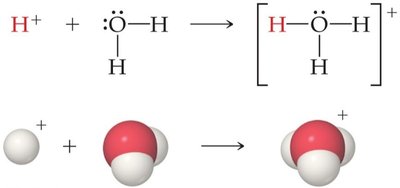
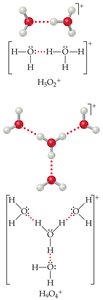
Water can both accept and donate protons, making it amphiprotic. When H+ is formed in water, it quickly bonds with H2O to form H3O+ (hydronium ion).
Example: NH3 + H2O ⇌ NH4+ + OH- (water acts as an acid).
Conjugate Acids and Bases
Acid–base reactions yield conjugate acid–base pairs, which differ by one proton (H+). The acid loses a proton to become its conjugate base, and the base gains a proton to become its conjugate acid.
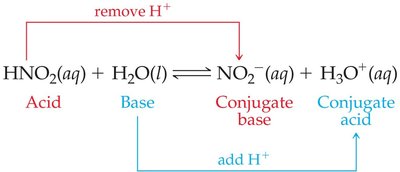
Relative Strengths of Acids and Bases
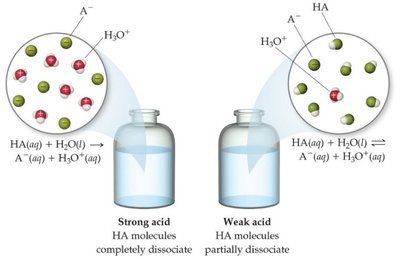
The strength of acids and bases is compared by their ability to donate or accept protons. Strong acids dissociate completely in water, while weak acids only partially dissociate.
Acids above H2O (as base) are strong acids; their conjugate bases are negligible.
Bases below H2O (as acid) are strong bases; their conjugate acids are negligible.
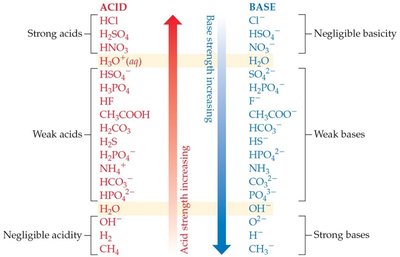
Acid and Base Strength in Equilibrium
In acid–base reactions, equilibrium favors the transfer of a proton from the stronger acid to the stronger base, forming weaker acid and base products.
Example: HCl + H2O → Cl- + H3O+ (equilibrium lies far to the right).
Example: CH3COOH + H2O ⇌ CH3COO- + H3O+ (equilibrium favors the left).
Autoionization of Water
Water undergoes autoionization, where two water molecules react to form OH- and H3O+. This process is fundamental to acid–base chemistry.
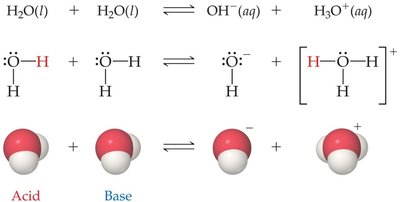
Ion Product Constant for Water (Kw)
The equilibrium constant for water's autoionization is:
$K_w = [H^+][OH^-]$
At 25°C, $K_w = 1.0 \times 10^{-14}$.
Aqueous Solutions: Acidic, Basic, or Neutral
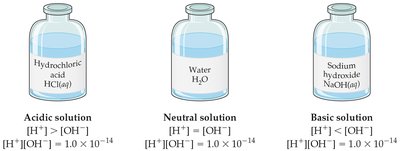
The nature of a solution depends on the relative concentrations of H+ and OH-:
Neutral: $[H^+] = [OH^-]$
Acidic: $[H^+] > [OH^-]$
Basic: $[H^+] < [OH^-]$
pH and Other "p" Scales
pH is a logarithmic measure of hydrogen ion concentration:
$\text{pH} = -\log [H^+]$
Neutral pH is 7.00; acidic pH is below 7.00; basic pH is above 7.00. Other scales include pOH and pKw:
$\text{pOH} = -\log [OH^-]$
$\text{p}K_w = -\log K_w$
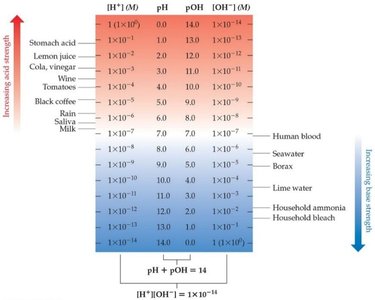
Relating pH and pOH
Because $K_w = [H^+][OH^-] = 1.0 \times 10^{-14}$, the relationship is:
$\text{pH} + \text{pOH} = 14.00$
Measuring pH
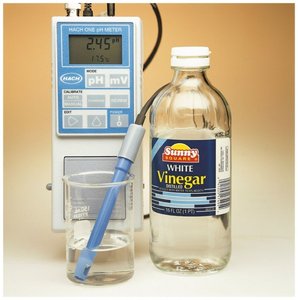
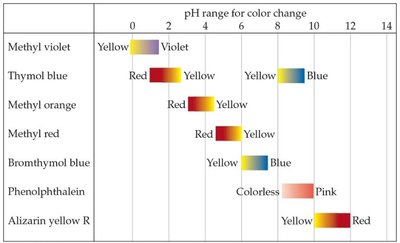
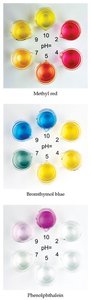
pH can be measured using a pH meter for accuracy or indicators for quick, less precise measurements. Indicators change color depending on the pH of the solution.
Strong Acids and Bases
Strong acids (e.g., HCl, HBr, HNO3) and strong bases (e.g., NaOH, KOH) dissociate completely in water. For monoprotic strong acids:
$[H^+] = [\text{acid}]$
Weak Acids and Bases
Weak acids and bases only partially dissociate. Their equilibrium is described by dissociation constants:
Acid-dissociation constant: $K_a = \frac{[H^+][A^-]}{[HA]}$
Base-dissociation constant: $K_b = \frac{[OH^-][BH^+]}{[B]}$
The larger the $K_a$ or $K_b$, the stronger the acid or base.
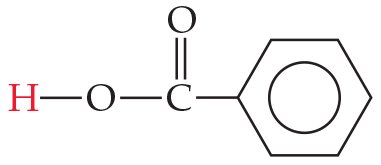
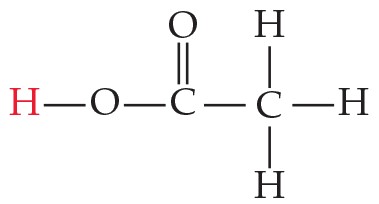
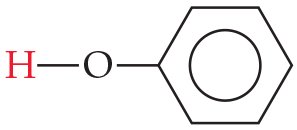
Comparing Strong and Weak Acids
Strong acids dissociate completely, while weak acids only partially dissociate. This affects conductivity and reaction rates.
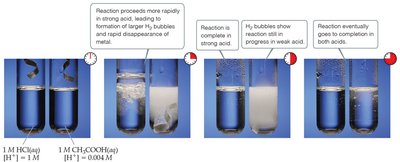
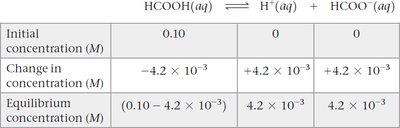
Calculating Equilibrium Concentrations and pH
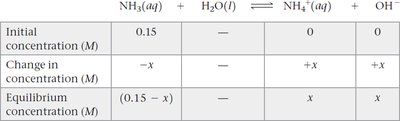
To calculate pH for weak acids or bases:
Write the ionization equilibrium equation.
Write the equilibrium constant expression.
Set up a table for initial, change, and equilibrium concentrations.
Substitute equilibrium concentrations into the constant expression and solve for x.

Percent Ionization
Percent ionization quantifies the fraction of acid molecules that ionize:
$\text{Percent ionization} = \frac{[H^+]_{eq}}{[HA]_{initial}} \times 100$
Polyprotic Acids
Polyprotic acids have more than one acidic proton. The first proton is always easier to remove than subsequent ones. If $K_a$ values differ by a factor of 103 or more, pH depends mainly on the first dissociation.
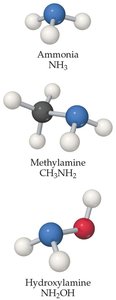
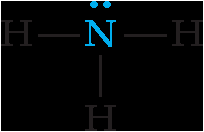
Weak Bases: Types and Examples
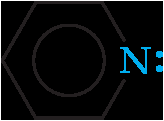
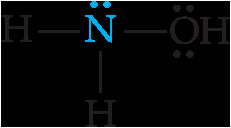
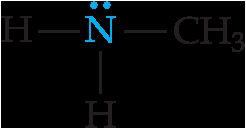
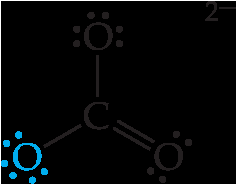
Weak bases include neutral substances with lone pairs (e.g., ammonia, amines) and anions of weak acids (conjugate bases).
Relationship Between Ka and Kb
For a conjugate acid–base pair:
$K_a \times K_b = K_w$
If you know one, you can calculate the other.
Acid–Base Properties of Salts
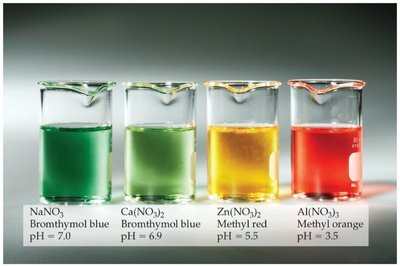
Many salts react with water (hydrolysis) to produce acidic or basic solutions. The nature of the salt depends on the cation and anion:
Group I/II metal cations: neutral
Polyatomic cations: often conjugate acids of weak bases
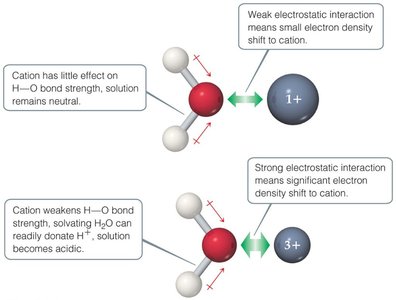
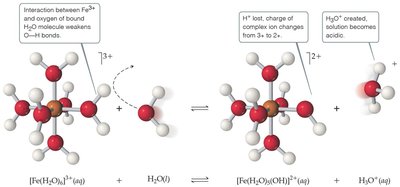
Transition/post-transition metal cations: acidic due to hydrated ion formation
Factors Affecting Acid Strength
Acid strength is influenced by:
Bond polarity (H–A bond must be polarized)
Bond strength (weaker bonds are easier to break)
Stability of the conjugate base (A-)
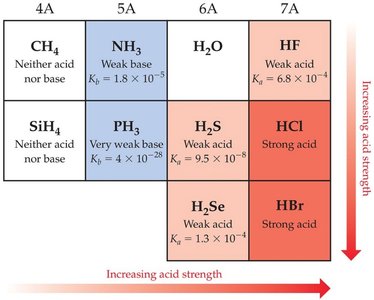
Binary Acids
Binary acids consist of hydrogen and one other element. Within a group, bond strength is most important; within a period, bond polarity is most important.
Oxyacids
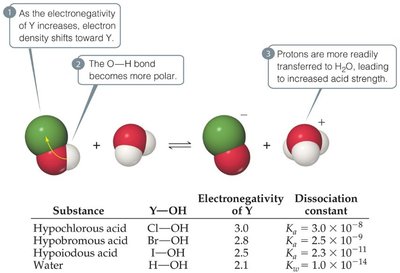
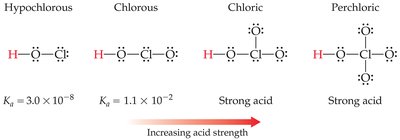
Oxyacids contain hydrogen, oxygen, and a nonmetal. As the electronegativity of the nonmetal increases, acidity increases. For oxyacids with the same element, more oxygen atoms mean higher acidity.
Carboxylic Acids
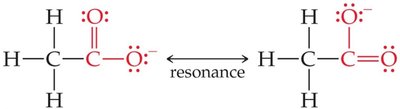
Carboxylic acids are organic acids with the –COOH group. Their acidity is enhanced by electron-withdrawing oxygen atoms and resonance stabilization of the conjugate base.
Lewis Acid–Base Chemistry
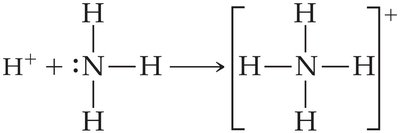
Lewis acids are electron pair acceptors; Lewis bases are electron pair donors. All Brønsted–Lowry acids and bases are also Lewis acids and bases, but the Lewis definition is broader.
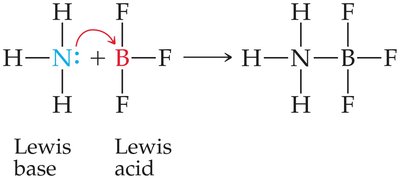
Lewis Acid–Base Chemistry and Hydrated Metal Cations
Hydrated metal cations exemplify electron pair donor/acceptor chemistry. Higher charges on the metal result in stronger water–metal bonds and greater acidity.