뒤로
뒤로Acid–Base Equilibria: Concepts, Calculations, and Applications
스터디 가이드 - 스마트 노트
 자료에 맞춘 맞춤형 노트, 핵심 정의, 예시, 맥락을 확장해 제공합니다.
Acid–Base Equilibria
Definitions of Acids and Bases
Understanding acids and bases is fundamental to chemistry. Several definitions exist, each broadening the scope of what constitutes an acid or a base:
Arrhenius Definition: An acid increases the concentration of hydrogen ions (H+) in water, while a base increases the concentration of hydroxide ions (OH-).
Brønsted–Lowry Definition: An acid is a proton (H+) donor, and a base is a proton acceptor. This definition is more general and includes more substances.
Water as a Proton Acceptor and Amphiprotic Nature
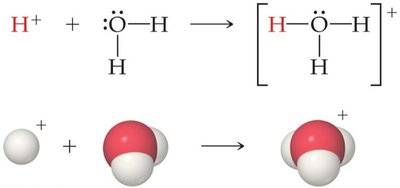
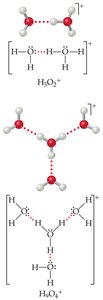
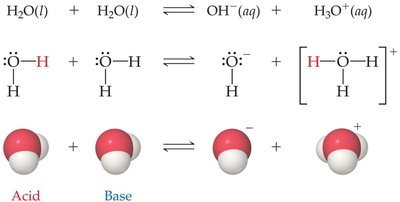
Water is unique because it can act as both a Brønsted–Lowry acid and base, making it amphiprotic. When a hydrogen ion is formed in water, it quickly associates with water molecules via hydrogen bonding, forming hydronium ions and larger clusters.
Conjugate Acid–Base Pairs
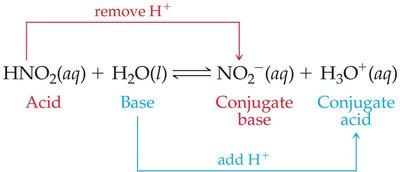
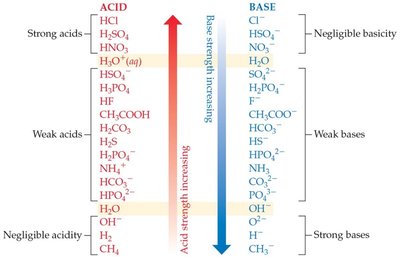
Acid–base reactions always yield conjugate acid–base pairs. Two species that differ by a single proton (H+) are called a conjugate acid–base pair. The acid donates a proton to become its conjugate base, and the base accepts a proton to become its conjugate acid.
Relative Strengths of Acids and Bases
The strength of an acid or base depends on its tendency to donate or accept protons. Strong acids and bases dissociate completely in water, while weak acids and bases only partially dissociate. The position of equilibrium in acid–base reactions favors the formation of the weaker acid and base.
Autoionization of Water and the Ion Product Constant
Water undergoes autoionization, where two water molecules react to form hydronium and hydroxide ions. The equilibrium constant for this process is called the ion product constant for water (K_w):
At 25°C,
Acidic, Basic, and Neutral Solutions
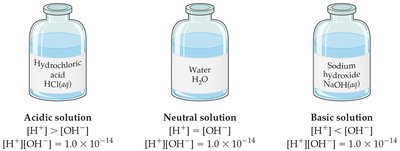
The relative concentrations of H+ and OH- ions determine whether a solution is acidic, basic, or neutral:
Acidic:
Neutral:
Basic:
pH and pOH Scales
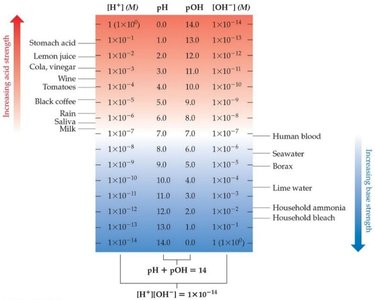
The pH scale is a logarithmic measure of hydrogen ion concentration:
Neutral pH is 7.00; acidic solutions have pH < 7, basic solutions have pH > 7.
pOH is defined as
At 25°C,
Measuring pH
pH can be measured using:
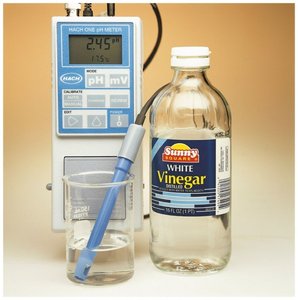
pH meters for accurate, quantitative measurements.
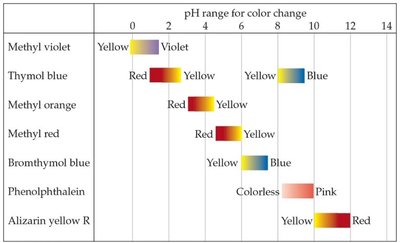
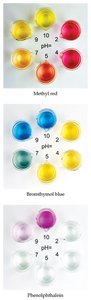
Indicators for quick, qualitative measurements. Indicators change color depending on the pH of the solution.
Acid and Base Strength
Strong and Weak Acids
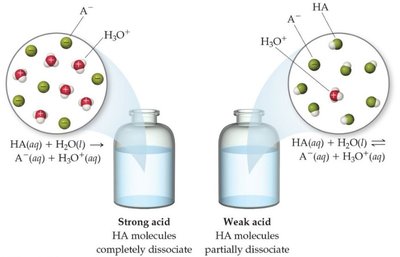
Strong acids (e.g., HCl, HNO3) dissociate completely in water, while weak acids (e.g., acetic acid, formic acid) only partially dissociate. The acid-dissociation constant (K_a) quantifies the strength of a weak acid:
Larger means a stronger acid.
Calculating from pH
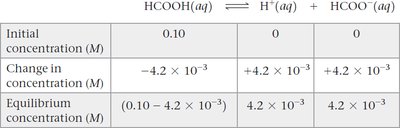
To determine for a weak acid from pH:
Write the ionization equilibrium equation.
Write the equilibrium constant expression.
Set up an ICE (Initial, Change, Equilibrium) table.
Use pH to find at equilibrium, then solve for .
Percent Ionization
The percent ionization of a weak acid is given by:
Polyprotic Acids
Polyprotic acids can donate more than one proton. Each successive proton is removed with greater difficulty, and the first dissociation constant () is always larger than the second (), etc. If and differ by a factor of 103 or more, the pH is determined mainly by the first dissociation.
Bases and Base Strength
Strong and Weak Bases
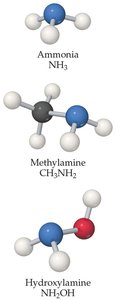
Strong bases (e.g., NaOH, KOH) dissociate completely in water. Weak bases (e.g., ammonia, amines) only partially accept protons. The base-dissociation constant (K_b) quantifies base strength:
Relationship Between and
For a conjugate acid–base pair:
If you know one, you can calculate the other.
Acid–Base Properties of Salts
Hydrolysis of Salts
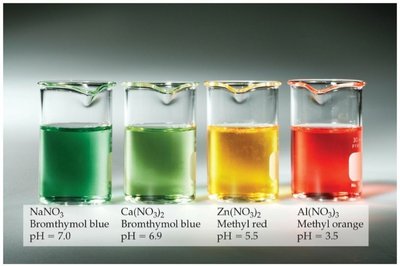
Salts can affect the pH of a solution depending on the acid–base properties of their constituent ions:
Anions of strong acids are neutral; anions of weak acids are basic.
Cations of group I/II metals are neutral; transition metal and polyatomic cations are often acidic.
Hydrated Metal Cations
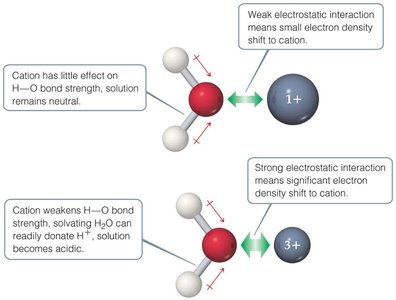
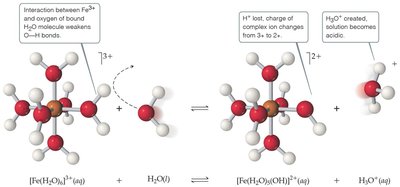
Transition and post-transition metals form hydrated cations, which can act as acids by donating protons from the coordinated water molecules. Higher charge increases acidity.
Factors Affecting Acid Strength
Binary Acids
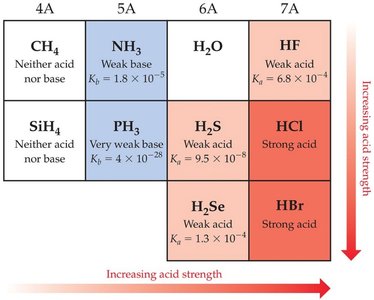
For binary acids (H–A):
Within a group, bond strength is most important (weaker bonds = stronger acids).
Within a period, bond polarity is most important (greater polarity = stronger acid).
Oxyacids
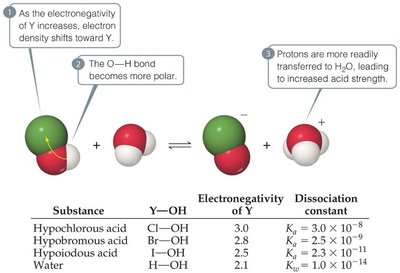
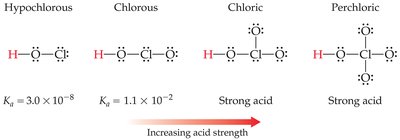
For oxyacids (H, O, and another element):
Acidity increases with the electronegativity of the central atom.
For the same central atom, more oxygen atoms increase acidity (higher oxidation state = stronger acid).
Carboxylic Acids
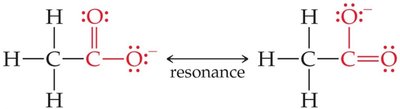
Carboxylic acids contain the –COOH group. Their acidity is enhanced by:
Electron-withdrawing effects of the second oxygen atom.
Resonance stabilization of the conjugate base.
Lewis Acid–Base Chemistry
Lewis Acids and Bases
The Lewis definition broadens acid–base chemistry:
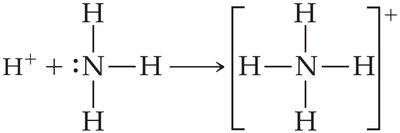
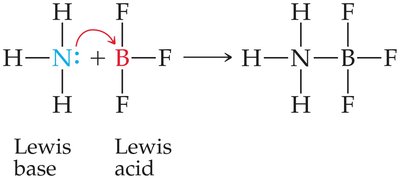
Lewis acid: Electron pair acceptor
Lewis base: Electron pair donor
All Brønsted–Lowry acids and bases are also Lewis acids and bases, but the reverse is not always true. Many metal cations and electron-deficient molecules are Lewis acids.
Hydrated Metal Cations as Lewis Acids
Hydrated metal cations are classic examples of Lewis acids, as they accept electron pairs from water molecules. Higher charge on the metal increases the acidity of the hydrated ion.