 뒤로
뒤로Atomic Spectra and Energy Levels: Electronic Structure and Periodic Trends
스터디 가이드 - 스마트 노트
 자료에 맞춘 맞춤형 노트, 핵심 정의, 예시, 맥락을 확장해 제공합니다.
Electronic Structure and Periodic Trends
Atomic Spectra and Energy Levels
The arrangement of electrons in atoms is fundamental to understanding chemical behavior. The concept of quantized energy levels explains how electrons occupy specific regions around the nucleus and how these arrangements relate to the periodic properties of elements.
Principal Quantum Number and Electron Energy Levels
Principal quantum number (n): Indicates the main energy level occupied by an electron. Values are positive integers (n = 1, 2, 3, ...).
Energy levels increase as n increases; electrons in higher n are farther from the nucleus and possess more energy.
Electrons in lower energy levels are closer to the nucleus and more tightly bound.
The energy of electrons is quantized, meaning electrons can only exist at specific energy levels, not between them.
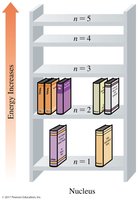
Quantization of Electron Energy
Electrons can only have certain allowed energy values in an atom.
As the value of n increases, the energy of the electron increases.
Electrons cannot exist at energies between these quantized levels.
Changes in Energy Levels
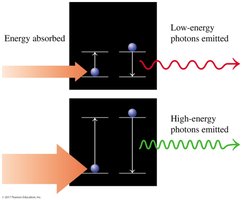
Electrons can move between energy levels by absorbing or emitting energy equal to the difference between the levels.
Absorption: When an electron moves from a lower to a higher energy level, it absorbs energy.
Emission: When an electron falls from a higher to a lower energy level, it emits energy as a photon.
The energy of the photon corresponds to the energy difference between the two levels.
Atomic Spectra
Atomic spectra provide experimental evidence for quantized energy levels in atoms. When atoms are energized, they emit or absorb light at specific wavelengths, producing characteristic spectra.
Continuous Spectrum vs. Atomic Emission Spectrum
Continuous spectrum: Produced when white light passes through a prism, resulting in a seamless rainbow of colors (all visible wavelengths).
Atomic emission spectrum: Produced when light from heated elements passes through a prism, showing only specific wavelengths as colored lines separated by dark areas. Each element has a unique emission spectrum.

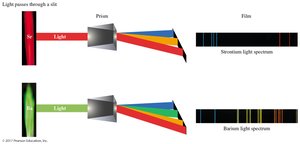
Applications of Atomic Spectra
The color of sodium streetlights (yellow) and neon signs (red) are due to the emission of light at specific wavelengths by excited atoms.
Atomic emission spectra are used to identify elements and analyze their concentrations in samples.

Atomic Absorption Spectra
When white light passes through a gas of atoms, the atoms absorb specific frequencies, resulting in dark lines (absorption lines) in the otherwise continuous spectrum.
Each element absorbs only certain frequencies, which correspond to the energy differences between quantized levels.
This principle is used in atomic absorption spectroscopy for quantitative chemical analysis.
Photons and the Nature of Light
Photon: A packet of energy (quantum) associated with electromagnetic radiation.
Photons travel at the speed of light and exhibit both wave-like and particle-like properties.
The energy of a photon is directly proportional to its frequency:
Where E is energy, h is Planck's constant ( J·s), and \nu is frequency.
Comparing Ultraviolet and Infrared Light
Ultraviolet light: Shorter wavelength ( m), higher frequency ( Hz).
Infrared light: Longer wavelength ( m), lower frequency ( Hz).
Thus, ultraviolet photons have more energy than infrared photons.
Energy Level Transitions: Absorption and Emission
When an electron moves from a lower to a higher energy level (e.g., n = 1 to n = 3), energy is absorbed.
When an electron falls from a higher to a lower energy level (e.g., n = 3 to n = 2), energy is emitted as a photon.
If an electron moves within the same energy level, there is no change in energy.
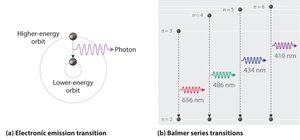
Summary Table: Electron Transitions and Energy Changes
Transition | Energy Change | Photon Emission/Absorption |
|---|---|---|
Lower n → Higher n | Energy absorbed | Photon absorbed |
Higher n → Lower n | Energy emitted | Photon emitted |
Within same n | No energy change | None |
Additional info: The Balmer series refers to electronic transitions in hydrogen where electrons fall to the n = 2 level, emitting visible light. Other series (Lyman, Paschen, etc.) correspond to transitions to different energy levels and emit ultraviolet or infrared light.
