 뒤로
뒤로Atoms and Elements: Foundations of Matter and Atomic Theory
스터디 가이드 - 스마트 노트
 자료에 맞춘 맞춤형 노트, 핵심 정의, 예시, 맥락을 확장해 제공합니다.
Atoms and Elements
Atoms as the Foundation of Matter
Atoms are the basic building blocks of all matter, forming the substances we encounter in everyday life. The properties of matter are determined by the types and arrangements of atoms present.
Atoms are the smallest identifiable units of elements.
Elements are pure substances that cannot be broken down into simpler substances by chemical means.
There are about 94 naturally occurring elements, with additional synthetic elements created by scientists.
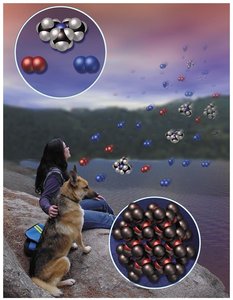
Atoms compose everything from rocks to air, and even the molecules responsible for odors.
Example: Seaside rocks are made of silicates (compounds of silicon and oxygen), while the air contains nitrogen and oxygen molecules. Amines, such as triethylamine, contribute to the characteristic smell of decaying fish.
Atomic Size and Number
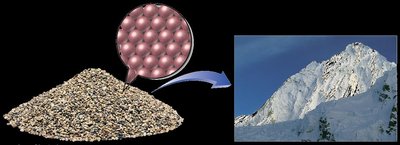
Atoms are incredibly small, and their sheer number in even a tiny object is immense. If each atom in a pebble were the size of the pebble itself, the pebble would be larger than Mount Everest.
Atoms are typically measured in picometers (1 pm = 10-12 m).
Even a small pebble contains billions upon billions of atoms.
Atomic Theory: Historical Development
Democritus and the Concept of Atoms
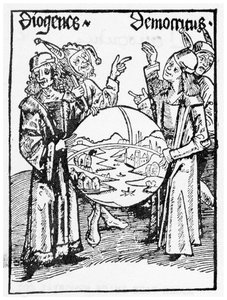
Democritus, a Greek philosopher, was the first to propose that matter is composed of tiny, indivisible particles called atoms (atomos).
Atoms are indestructible and cannot be divided further.
This idea laid the foundation for modern atomic theory.
Dalton's Atomic Theory
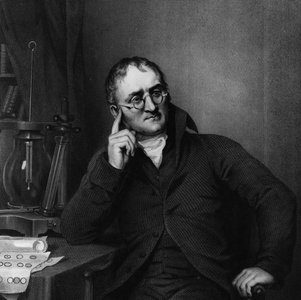
John Dalton formalized atomic theory in 1808, providing a scientific basis for the existence and behavior of atoms.
Each element is composed of tiny, indestructible particles called atoms.
All atoms of a given element have the same mass and properties.
Atoms combine in simple, whole-number ratios to form compounds.
Law of Conservation of Mass
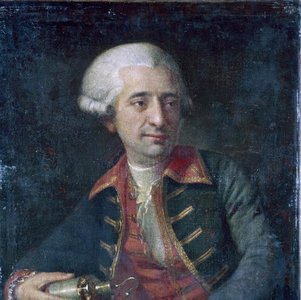
Antoine Lavoisier established that matter is neither created nor destroyed in a chemical reaction. The total mass remains constant.
Law of Conservation of Mass:
Law of Constant Composition
All samples of a pure compound contain the same elements in the same proportions by mass.
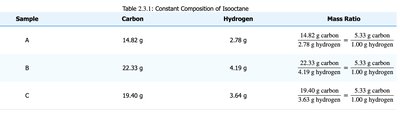
For example, isooctane always has a carbon-to-hydrogen mass ratio of 5.33:1.
Sample | Carbon | Hydrogen | Mass Ratio |
|---|---|---|---|
A | 14.82 g | 2.78 g | 5.33:1 |
B | 22.33 g | 4.19 g | 5.33:1 |
C | 19.40 g | 3.64 g | 5.33:1 |
Law of Multiple Proportions
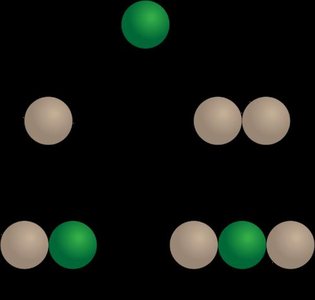
When two elements form more than one compound, the masses of one element that combine with a fixed mass of the other are in ratios of small whole numbers.
Example: Carbon and oxygen form both CO and CO2, with mass ratios of oxygen to carbon in small whole numbers.
Discovery of Subatomic Particles
J. J. Thomson and the Electron
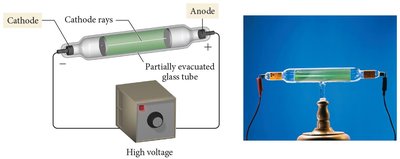
J. J. Thomson discovered the electron, a negatively charged particle much smaller than the atom, using the cathode ray tube experiment.
Electrons are present in all atoms.
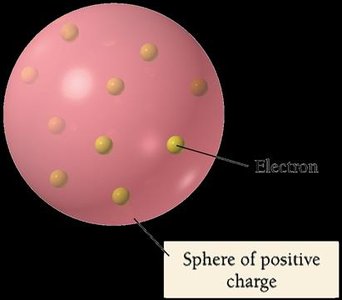
Thomson proposed the "plum pudding" model: electrons embedded in a sphere of positive charge.
Charge-to-mass ratio of electron:
Millikan's Oil Drop Experiment
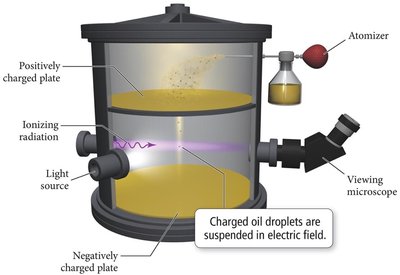
Robert Millikan determined the charge of a single electron through his oil drop experiment.
Measured the electric field needed to halt falling charged oil drops.
Calculated the charge of each drop, finding it was always a multiple of C.
Rutherford's Gold Foil Experiment and Nuclear Model
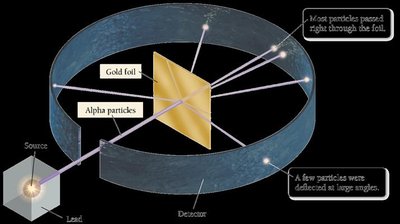
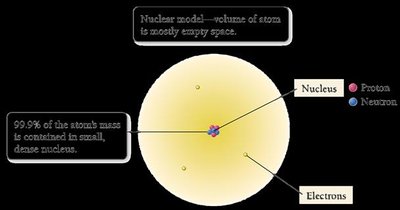
Ernest Rutherford's gold foil experiment revealed that most of the atom's mass and positive charge are concentrated in a small nucleus, with electrons dispersed in empty space.
Most alpha particles passed through the foil; some were deflected sharply.
Led to the nuclear model of the atom.
Subatomic Particles: Properties and Charges
Protons, Neutrons, and Electrons
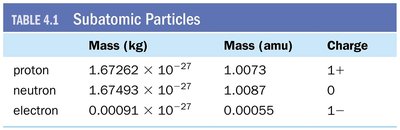
Atoms are composed of three main subatomic particles: protons, neutrons, and electrons.
Proton: Positive charge, mass ≈ 1 amu
Neutron: Neutral charge, mass ≈ 1 amu
Electron: Negative charge, mass ≈ 0.00055 amu
Particle | Mass (kg) | Mass (amu) | Charge |
|---|---|---|---|
Proton | 1.67262 × 10⁻²⁷ | 1.0073 | +1 |
Neutron | 1.67493 × 10⁻²⁷ | 1.0087 | 0 |
Electron | 0.00091 × 10⁻²⁷ | 0.00055 | -1 |
Electrical Charge and Atomic Neutrality
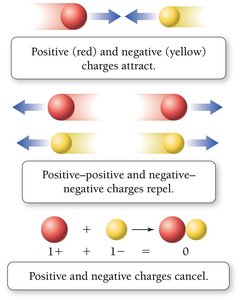
Atoms are electrically neutral when the number of protons equals the number of electrons. Opposite charges attract, while like charges repel.
Protons (+) and electrons (-) cancel each other's charge.
Neutrons have no charge.
Periodic Table and Atomic Structure
Periodic Table Organization
The periodic table arranges elements by increasing atomic number, grouping elements with similar properties together.
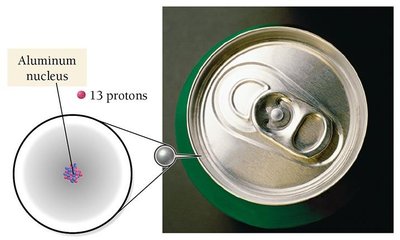
Atomic number (Z): Number of protons in the nucleus.
Groups (columns) and periods (rows) classify elements by chemical behavior.
Highlighted groups: 1A (alkali metals), 2A (alkaline earth metals), 7A (halogens), 8A (noble gases).
Atomic Symbols and Notation
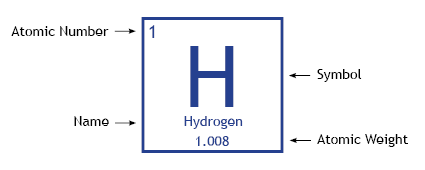
Each element is represented by a unique chemical symbol, atomic number, and atomic mass.
Atomic number (Z) identifies the element.
Atomic mass is the weighted average mass of all isotopes.
Ions and Isotopes
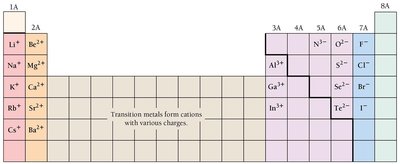
Ions: Cations and Anions
Ions are atoms or molecules that have gained or lost electrons, resulting in a net charge.
Cation: Positively charged ion (loss of electrons).
Anion: Negatively charged ion (gain of electrons).
Charge is determined by the difference between protons and electrons.
Group number often predicts ion charge for main group elements.
Isotopes and Natural Abundance
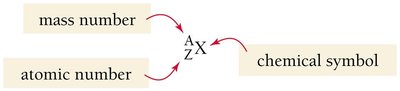
Isotopes are atoms of the same element with different numbers of neutrons. Each element has a unique distribution of naturally occurring isotopes.
Example: Neon has three isotopes: Ne-20, Ne-21, Ne-22.
Isotopes are represented as or X-A, where A is mass number and Z is atomic number.

Calculating Atomic Mass
The atomic mass of an element is calculated as the weighted average of the masses of its isotopes, based on their natural abundances.
Formula:
Example: Chlorine has two main isotopes: chlorine-35 (75.77%, 34.97 amu) and chlorine-37 (24.23%, 36.97 amu).
The Mole and Chemical Quantities
The Mole: Chemist's Counting Unit
A mole is a unit that represents 6.022 × 10²³ particles (Avogadro's number). It is used to count atoms, molecules, or other particles in a given sample.
Symbol: mol
1 mol = 6.022 × 10²³ particles
Used to relate mass, number of particles, and chemical reactions.
Molar Mass and Atomic Mass
Molar mass is the mass of 1 mol of atoms of an element, expressed in grams per mole (g/mol). It is numerically equal to the atomic mass in atomic mass units (amu).
Example: 1 mol of copper atoms has a mass of 63.55 g.
Molar mass is used to convert between grams, moles, and number of atoms.
Converting Between Grams, Moles, and Atoms
To convert between mass, moles, and number of atoms, use the molar mass and Avogadro's number as conversion factors.
Example: To find the number of atoms in 3.5 mol He, multiply by Avogadro's number.
Formula:
Molar Mass of Compounds
Determining Molar Mass
The molar mass of a compound is the sum of the molar masses of its constituent elements, multiplied by their respective quantities in the formula.
Example: Molar mass of CO = 12.01 g/mol (C) + 16.00 g/mol (O) = 28.01 g/mol
For compounds, use the periodic table to find atomic masses and calculate total molar mass.
Sample Molar Mass Calculations
CO2: 44.009 g/mol
CCl4: 153.82 g/mol
C2H3NaO2 (sodium acetate): 82.03 g/mol
SO2: 82.034 g/mol
Br2: 159.81 g/mol
Chapter Review: Key Learning Objectives
Recognize that all matter is composed of atoms.
Explain how the experiments of Thomson and Rutherford led to the development of the nuclear theory of the atom.
Describe the respective properties and charges of electrons, neutrons, and protons.
Determine the atomic symbol and atomic number for an element using the periodic table.
Use the periodic table to classify elements by group.
