 뒤로
뒤로Chapter 1: Matter, Measurement, and Problem Solving – Study Notes
스터디 가이드 - 스마트 노트
 자료에 맞춘 맞춤형 노트, 핵심 정의, 예시, 맥락을 확장해 제공합니다.
Matter, Measurement, and Problem Solving
Matter and Its Composition
Chemistry is the scientific study of matter and the changes it undergoes. Matter is anything that occupies space and has mass. The fundamental building blocks of matter are atoms, which combine to form molecules and compounds.
Atom: The smallest unit of an element that retains the properties of that element.
Element: A substance made of only one kind of atom.
Molecule: Two or more atoms bonded together.
Compound: A substance composed of two or more different elements in fixed proportions.
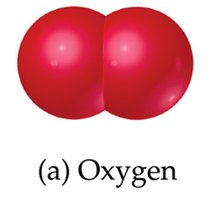
Example: Oxygen (O2) is a molecule consisting of two oxygen atoms bonded together.
The Scientific Approach to Knowledge
The scientific method is an empirical process for understanding nature, based on observation and experimentation. It involves several key steps:
Observation: Gathering data about the characteristics or behavior of nature.
Hypothesis: A tentative explanation for observations, which must be testable and falsifiable.
Experimentation: Testing hypotheses through controlled experiments.
Law: A statement summarizing consistent observations (e.g., Law of Conservation of Mass: "In a chemical reaction, matter is neither created nor destroyed.").
Theory: A well-substantiated explanation of some aspect of nature, validated by repeated experiments (e.g., Dalton’s atomic theory).
Classification of Matter
Matter can be classified by its physical state and composition:
States of Matter: Solid, liquid, and gas.
Pure Substance: Composed of only one component (element or compound) with invariant composition.
Mixture: Composed of two or more components in variable proportions.
Pure substances are further classified as:
Element: Cannot be chemically broken down into simpler substances.
Compound: Can be decomposed into simpler substances.
Mixtures are classified as:
Heterogeneous Mixture: Composition varies from one region to another (e.g., sand and salt mixture).
Homogeneous Mixture (Solution): Uniform composition throughout (e.g., sweetened tea).
Separation of Mixtures
Mixtures can be separated by exploiting differences in physical or chemical properties:
Decanting: Pouring off a liquid to separate it from a solid.
Distillation: Separating substances based on differences in boiling points.
Filtration: Separating solids from liquids using a filter.
Chromatography: Separating substances based on differences in solubility.
Physical and Chemical Properties and Changes
Physical Properties: Can be observed without changing the substance (e.g., boiling point, density).
Chemical Properties: Observed only when a substance is changed into another (e.g., flammability).
Physical Change: Does not alter the composition (e.g., melting, boiling).
Chemical Change: Alters the composition, forming new substances (e.g., rusting of iron).
Energy in Chemistry
Energy: The capacity to do work.
Kinetic Energy: Energy of motion.
Potential Energy: Energy due to position or composition.
Thermal Energy: Energy associated with temperature (a form of kinetic energy).
Law of Conservation of Energy: Energy is neither created nor destroyed in physical or chemical changes.
Units of Measurement
Chemists use the International System of Units (SI), which is based on the metric system. Key SI base units include:
Meter (m): Length
Kilogram (kg): Mass
Second (s): Time
Kelvin (K): Temperature
Temperature conversions:
Fahrenheit to Celsius:
Celsius to Kelvin:
Derived Units: Volume and Density
Volume: Space occupied by a substance (SI unit: cubic meter, m3; commonly used: liter, L).
Density: Mass per unit volume.
Uncertainty in Measurement and Significant Figures
Measurements have inherent uncertainty, and significant figures reflect the precision of a measurement. The rules for significant figures are:
All nonzero digits are significant.
Interior zeroes (between nonzero digits) are significant.
Leading zeroes (at the beginning) are not significant.
Trailing zeroes are significant only if a decimal point is present.
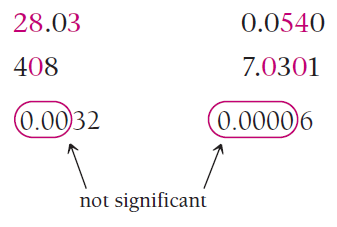
Example: In 0.0032, only the 3 and 2 are significant; in 0.0540, all three digits are significant.
Exact Numbers
Exact numbers have an unlimited number of significant figures (e.g., counted objects, defined quantities).
Rules for Calculations with Significant Figures
Addition/Subtraction: The result has the same number of decimal places as the measurement with the fewest decimal places.
Multiplication/Division: The result has the same number of significant figures as the measurement with the fewest significant figures.
Rounding: Round down if the digit dropped is less than 5; round up if it is 5 or more.
In multistep calculations, round only the final answer.
Accuracy vs. Precision
Accuracy: How close a measurement is to the true value.
Precision: How close repeated measurements are to each other.
Dimensional Analysis and Unit Conversions
Dimensional analysis is a method for solving problems by converting units using conversion factors. Units are treated algebraically and can be canceled.
Conversion Factor: A ratio of equivalent quantities (e.g., ).
When converting units raised to a power, raise both the number and the unit to that power.
Metric-to-metric and English-to-English conversions are exact; metric-to-English conversions are not exact and require attention to significant figures.
Example: To convert 8.00 m to inches:
Additional info: These notes cover all foundational aspects of matter, measurement, and problem solving as outlined in a typical General Chemistry Chapter 1.
