 뒤로
뒤로Chapter 1: Matter, Measurement, and Problem Solving – General Chemistry Study Notes
스터디 가이드 - 스마트 노트
 자료에 맞춘 맞춤형 노트, 핵심 정의, 예시, 맥락을 확장해 제공합니다.
Matter, Atoms, and Molecules
Introduction to Chemistry
Chemistry is the science that seeks to understand the behavior of matter by studying the properties and interactions of atoms and molecules. The fundamental idea is that the properties of matter are determined by the properties of molecules and atoms.
Atoms: Submicroscopic particles that constitute the fundamental building blocks of ordinary matter.
Molecules: Groups of atoms bonded together in specific geometrical arrangements.
Free atoms are rare in nature; most atoms are found bonded in molecules.
Small differences in atomic or molecular structure can result in large differences in the properties of substances.
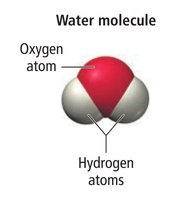
Example: Water molecules (H2O) contain two hydrogen atoms and one oxygen atom, determining water's properties.
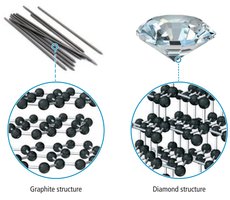
Example: Graphite and diamond are both composed of carbon atoms, but their atomic arrangements differ, resulting in distinct properties.
The Scientific Method
Scientific Approach to Knowledge
The scientific method is a systematic process for understanding nature through observation, hypothesis formation, experimentation, and the development of laws and theories.
Observation: Descriptions about the characteristics or behavior of nature (also known as data).
Hypothesis: A tentative interpretation or explanation of observations; must be falsifiable.
Law: A brief statement summarizing past observations and predicting future ones (e.g., Law of Conservation of Mass).
Theory: A model explaining why nature behaves as it does, validated by experiments (e.g., Dalton’s atomic theory).
Classification of Matter
States of Matter
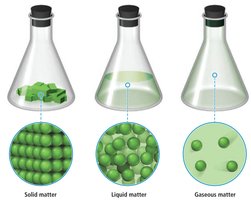
Matter can be classified according to its physical state: solid, liquid, or gas. The arrangement and movement of atoms or molecules differ in each state, leading to distinct properties.
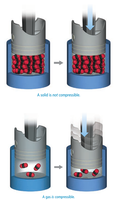
Solid: Atoms or molecules are closely packed in fixed locations; solids have fixed volume and rigid shape.
Liquid: Atoms or molecules are close but can move relative to each other; liquids have fixed volume but not fixed shape.
Gas: Atoms or molecules are far apart and move freely; gases are compressible and have neither fixed volume nor shape.
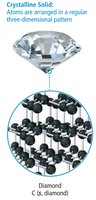
Crystalline solids: Atoms or molecules are arranged in a regular, repeating pattern (e.g., diamond).
Amorphous solids: Atoms or molecules lack long-range order (e.g., glass, plastic).
Compressibility of Solids and Gases
Solids are not compressible due to tightly packed particles, while gases are compressible because their particles are far apart.
Classification by Composition
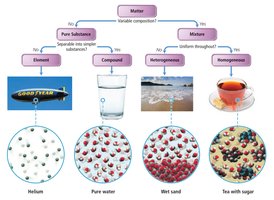
Matter can also be classified by its composition: pure substances and mixtures.
Pure Substance: Made up of only one component with invariant composition.
Mixture: Composed of two or more components in variable proportions.
Elements: Substances that cannot be chemically broken down into simpler substances.
Compounds: Substances composed of two or more elements in fixed proportions.
Heterogeneous Mixture: Composition varies from one region to another (e.g., salt and sand).
Homogeneous Mixture: Uniform composition throughout (e.g., sweetened tea).
Physical and Chemical Changes
Physical Changes
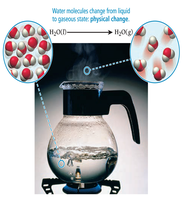
Physical changes alter only the state or appearance of a substance without changing its composition. The identity of the atoms or molecules remains unchanged.
Example: Evaporation of water.
Chemical Changes
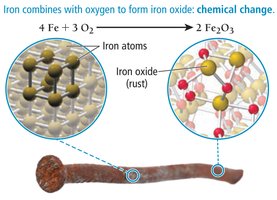
Chemical changes alter the composition of matter, resulting in the formation of new substances through the rearrangement of atoms.
Example: Rusting of iron (formation of iron oxide).
Physical vs. Chemical Properties
Physical properties are observed without changing the substance’s composition (e.g., odor, color, melting point). Chemical properties are observed only when the substance undergoes a chemical change (e.g., flammability, acidity).
Energy in Chemistry
Types of Energy
Energy is the capacity to do work, defined as the action of a force through a distance. There are several types of energy relevant to chemistry:
Kinetic Energy: Associated with motion.
Potential Energy: Associated with position or composition.
Thermal Energy: Associated with temperature; a form of kinetic energy due to molecular motion.
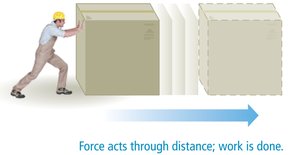
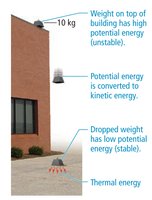
Energy is always conserved in physical or chemical changes (Law of Conservation of Energy).
Systems with high potential energy tend to change in ways that lower their potential energy, releasing energy to the surroundings.
Units of Measurement
SI Units and Prefix Multipliers
Measurements in chemistry use standard units from the International System of Units (SI), which is based on the metric system. Prefix multipliers are used to express quantities in powers of ten.
Mass: Kilogram (kg)
Time: Second (s)
Temperature: Kelvin (K)
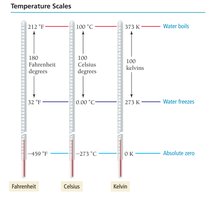
Prefix | Symbol | Multiplier |
|---|---|---|
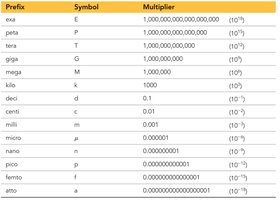
kilo | k | 1000 (103) |
centi | c | 0.01 (10-2) |
milli | m | 0.001 (10-3) |
micro | μ | 0.000001 (10-6) |
nano | n | 0.000000001 (10-9) |
Additional info: See image_19 for full table of SI prefix multipliers. |
Derived Units: Volume and Density
Derived units are combinations of base units. Volume is measured in cubic meters (m3) or liters (L). Density is the ratio of mass to volume and determines whether a substance will sink or float.
Density formula:
Volume formula:
Significant Figures and Measurement Precision
Counting Significant Figures
Scientific measurements are reported with significant figures to reflect precision. The rules for determining significant figures are:
All nonzero digits are significant.
Interior zeroes (between nonzero digits) are significant.
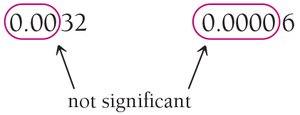
Leading zeroes (to the left of the first nonzero digit) are not significant.
Trailing zeroes after a decimal point are significant.
Trailing zeroes before an implied decimal point are ambiguous; use scientific notation to clarify.
Significant Figures in Calculations
Multiplication/Division: Result has the same number of significant figures as the factor with the fewest significant figures.
Addition/Subtraction: Result has the same number of decimal places as the quantity with the fewest decimal places.
Rounding: Round down if the last digit dropped is four or less; round up if five or more.
In multistep calculations, round only the final answer.

Precision and Accuracy
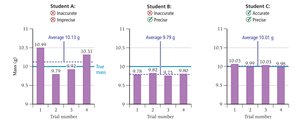
Accuracy refers to how close a measured value is to the actual value. Precision refers to how close a series of measurements are to one another.
Measurements are precise if they are consistent.
Measurements are accurate if they are close to the true value.
Review Questions
Explain the differences between a hypothesis, a law, and a theory.
How do solids, liquids, and gases differ?
Explain the difference between a pure substance and a mixture.
List some examples of a physical change and a chemical change.
Write the formula for calculating density and volume of a substance.
