 뒤로
뒤로Chapter 11: Liquids and Intermolecular Forces – Mini-Textbook Study Notes
스터디 가이드 - 스마트 노트
 자료에 맞춘 맞춤형 노트, 핵심 정의, 예시, 맥락을 확장해 제공합니다.
Liquids and Intermolecular Forces
Introduction to Intermolecular Forces
Intermolecular forces are the attractions between molecules, which are generally much weaker than the intramolecular forces (chemical bonds) that hold atoms together within a molecule. These forces play a crucial role in determining the physical properties of substances, such as boiling points, melting points, viscosity, surface tension, and capillary action.
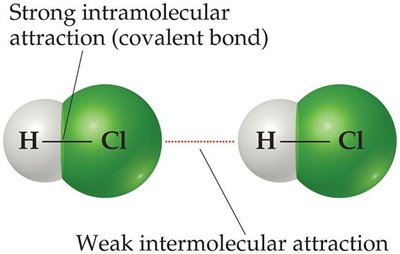
Intramolecular forces (e.g., covalent bonds) are much stronger than intermolecular forces.
Physical properties like boiling and melting points reflect the strength of intermolecular forces.
States of Matter and Intermolecular Forces
The fundamental difference between the states of matter (gas, liquid, solid) is the strength of intermolecular forces. Stronger forces bring molecules closer together, while kinetic energy keeps them apart and moving. The average kinetic energy is related to temperature.
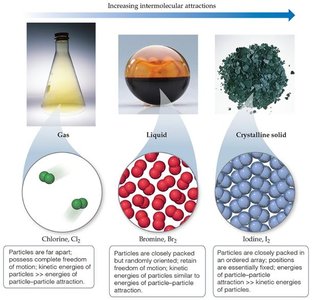
Gas: Weak intermolecular forces, particles far apart, compressible, flows readily.
Liquid: Moderate intermolecular forces, particles closer, incompressible, flows readily.
Solid: Strong intermolecular forces, particles tightly packed, incompressible, does not flow.
Relative Strength of Attractions
The melting and boiling points of substances reflect the strength of the forces holding their particles together. Chemical bonds (ionic, metallic, covalent) are much stronger than intermolecular forces (dispersion, dipole-dipole, hydrogen bonding).
Ionic bonds: High melting and boiling points (e.g., LiF).
Metallic bonds: High melting and boiling points (e.g., Be).
Covalent bonds: Extremely high melting and boiling points (e.g., diamond).
Intermolecular forces: Lower melting and boiling points (e.g., N2, HCl, HF).
Additional info: Hydrogen bonds are not true chemical bonds but are a type of strong intermolecular attraction.
Types of Intermolecular Forces
Dispersion Forces (London Dispersion Forces)
Dispersion forces are the weakest type of intermolecular force and arise from temporary fluctuations in electron distribution, creating instantaneous dipoles. All molecules, whether polar or nonpolar, exhibit dispersion forces.
Polarizability: The tendency of an electron cloud to distort, increasing dispersion forces.
Factors affecting dispersion force: number of electrons, size/molecular weight, shape (linear vs. spherical).
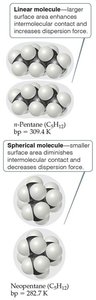
Example: n-Pentane (linear) has a higher boiling point than neopentane (spherical) due to greater surface area and stronger dispersion forces.
Dipole–Dipole Interactions
Dipole–dipole forces occur between polar molecules, where the positive end of one molecule is attracted to the negative end of another. These forces are stronger than dispersion forces for molecules of similar size and mass.
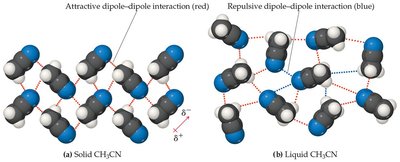
For molecules of similar mass and size, higher polarity leads to higher boiling points.
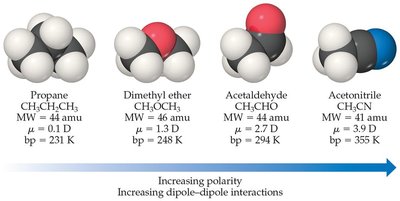
Example: Acetonitrile (CH3CN) has a higher boiling point than acetaldehyde (CH3CHO) due to greater dipole moment.
Hydrogen Bonding
Hydrogen bonding is a special, strong type of dipole–dipole interaction that occurs when hydrogen is bonded to highly electronegative atoms (N, O, F). The hydrogen bond forms between the hydrogen atom and a nearby electronegative atom in another molecule.
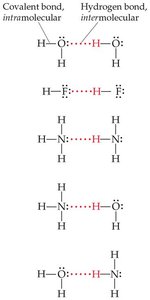
Hydrogen bonds are much stronger than regular dipole–dipole interactions.
Hydrogen bonding leads to higher boiling points and unique properties (e.g., water).

Example: Water, ammonia, and hydrogen fluoride exhibit hydrogen bonding.
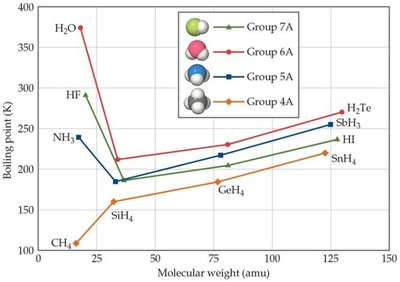
Additional info: Hydrogen bonding explains the anomalously high boiling points of H2O, HF, and NH3 compared to other group members.
Ion–Dipole Interactions
Ion–dipole forces occur between ions and polar molecules, especially in solutions of ionic compounds in polar solvents. These interactions are stronger than hydrogen bonds and are responsible for the solubility of salts in water.
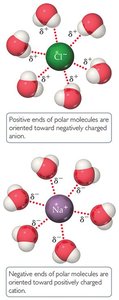
Positive ends of polar molecules are attracted to anions; negative ends to cations.
Summary Table: Types of Intermolecular Forces
Type | Strength (kJ/mol) | Occurs in | Examples |
|---|---|---|---|
Dispersion | 0.1–30 | All molecules | Ne, Ar, BF3, CH4 |
Dipole–Dipole | 2–15 | Polar molecules | HCl, CH3CN |
Hydrogen Bonding | 10–40 | H with N, O, F | H2O, NH3, HF |
Ion–Dipole | >50 | Ions in polar solvents | NaCl in H2O |
Additional info: The strongest force present dictates the extent of molecular attractions.
Liquid Properties Affected by Intermolecular Forces
Viscosity
Viscosity is the resistance of a liquid to flow. It increases with stronger intermolecular forces and decreases with higher temperature.
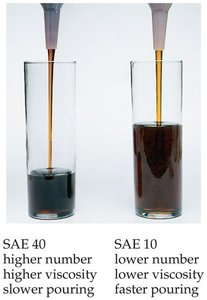
Higher viscosity: slower pouring, stronger intermolecular forces.
Lower viscosity: faster pouring, weaker intermolecular forces.
Surface Tension
Surface tension is the inward force experienced by molecules at the surface of a liquid, causing the liquid to behave as if it has a "skin." This is due to extra inward forces on the surface.
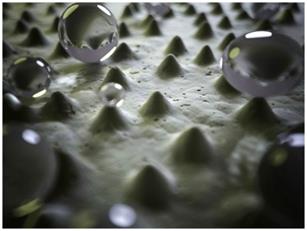
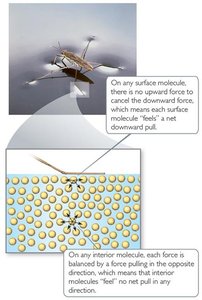
Surface tension causes water to bead up on nonpolar surfaces.
Cohesion and Adhesion
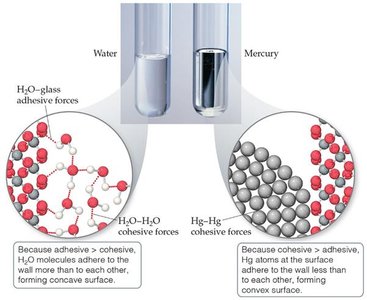
Cohesive forces bind similar molecules together, while adhesive forces bind a substance to a surface. These forces are important in capillary action.
Cohesion: Attraction between like molecules (e.g., H2O–H2O).
Adhesion: Attraction between unlike molecules (e.g., H2O–glass).
Capillary Action
Capillary action is the rise of liquids up narrow tubes, resulting from adhesive and cohesive forces. Water has stronger adhesive forces with glass, forming a concave meniscus, while mercury has stronger cohesive forces, forming a convex meniscus.
Phase Changes and Energy
Phase Changes
Phase changes are conversions between states of matter: melting/freezing, vaporizing/condensing, subliming/depositing. Energy is either added (endothermic) or released (exothermic) during these changes.
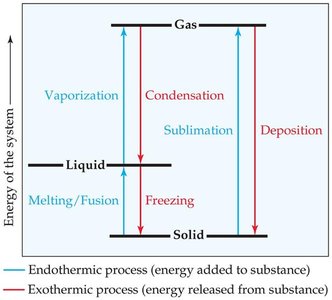
Melting/Fusion: Solid to liquid (endothermic).
Freezing: Liquid to solid (exothermic).
Vaporization: Liquid to gas (endothermic).
Condensation: Gas to liquid (exothermic).
Sublimation: Solid to gas (endothermic).
Deposition: Gas to solid (exothermic).
Energy Change and Change of State
The heat of fusion, vaporization, and sublimation are the energies required for phase changes at specific temperatures.
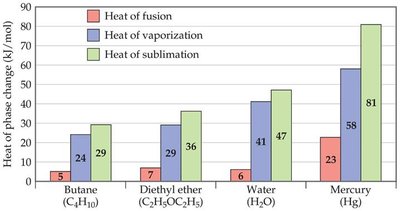
Heat of fusion (ΔHfus): Energy to melt a solid.
Heat of vaporization (ΔHvap): Energy to vaporize a liquid.
Heat of sublimation (ΔHsub): Energy to sublime a solid.
Heating Curves
A heating curve is a graph of temperature versus heat added. During a phase change, temperature remains constant while heat is absorbed or released.
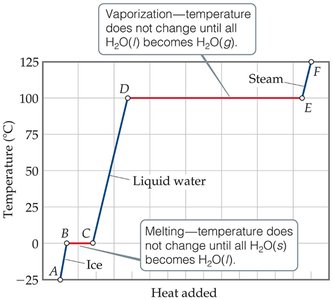
Within a phase:
During phase change:
Supercritical Fluids
Critical Temperature and Pressure
Gases liquefy when pressure is applied. The critical temperature is the highest temperature at which a gas can be liquefied by pressure. The critical pressure is the pressure required to liquefy a gas at its critical temperature. Beyond these, the substance is a supercritical fluid.
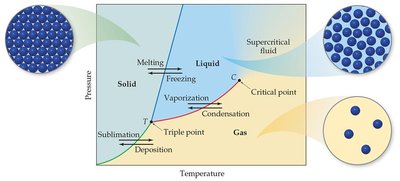
Supercritical fluid: State beyond critical temperature and pressure, with properties of both liquids and gases.
Vapor Pressure
Vapor Pressure and Boiling Point
At any temperature, some liquid molecules have enough energy to escape the surface and become a gas. As temperature increases, more molecules can escape, increasing vapor pressure. The boiling point is the temperature at which vapor pressure equals atmospheric pressure.
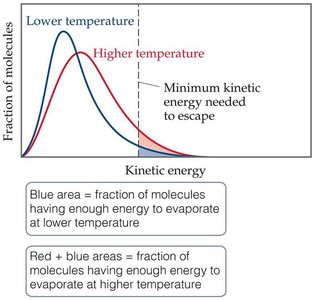
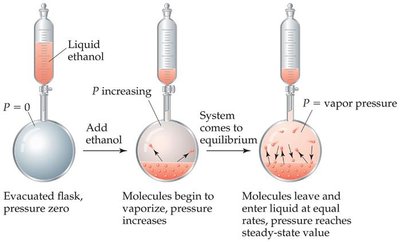
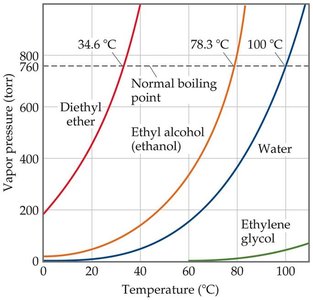
Normal boiling point: Temperature at which vapor pressure is 760 torr.
Clausius-Clapeyron Equation
The relationship between vapor pressure and temperature is given by the Clausius-Clapeyron equation:
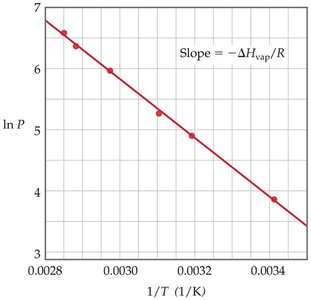
Allows calculation of heat of vaporization from vapor pressure data.
Phase Diagrams
Phase Diagram Overview
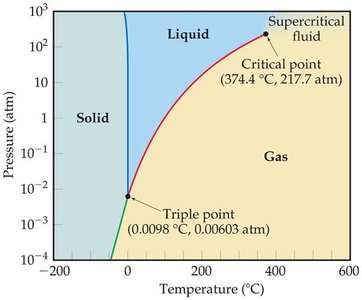
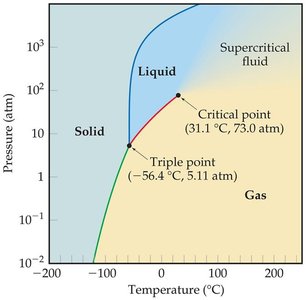
A phase diagram is a graph showing the states of matter under different conditions of temperature and pressure. It also shows the triple point (where all three phases coexist) and the critical point (end of the liquid-gas boundary).
Triple point: Unique set of conditions where all three phases coexist.
Critical point: End of the liquid-gas boundary; above this, supercritical fluid exists.
Phase Diagram of Water
Water has a high critical temperature and pressure due to strong intermolecular forces. The melting curve has a negative slope, meaning increasing pressure lowers the melting point.
Phase Diagram of Carbon Dioxide
Carbon dioxide cannot exist as a liquid at pressures below its triple point (5.11 atm). At normal atmospheric pressure, CO2 sublimes directly from solid to gas.
Liquid Crystals
Liquid Crystal Phases
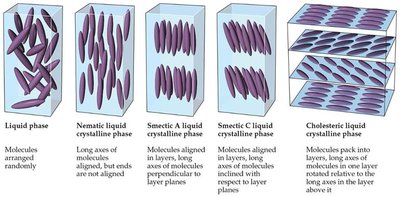
Some substances exhibit intermediate phases between solid and liquid, known as liquid crystals. These phases have some degree of molecular order.
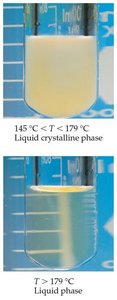
Nematic: Molecules ordered in one dimension (long axis).
Smectic: Molecules ordered in two dimensions (long axis and layers).
Cholesteric: Nematic-like crystals layered at angles to each other.
Additional info: Liquid crystals are important in display technologies and biological systems.
