 뒤로
뒤로Chapter 19: Chemical Thermodynamics – Structured Study Notes
스터디 가이드 - 스마트 노트
 자료에 맞춘 맞춤형 노트, 핵심 정의, 예시, 맥락을 확장해 제공합니다.
Chemical Thermodynamics
Introduction to Thermodynamics
Chemical thermodynamics explores the energy changes and spontaneity of chemical reactions. It builds on concepts from thermochemistry, focusing on the direction and extent of reactions, and the role of energy and entropy in determining whether a process occurs naturally.
First Law of Thermodynamics
The First Law of Thermodynamics states that energy cannot be created or destroyed, only transferred or converted between forms. The total energy of the universe remains constant.
Energy transfer: Energy can move between a system and its surroundings.
Energy conversion: Energy can change forms, such as from heat to work.
Enthalpy and Entropy
Enthalpy (H) is the heat absorbed or released by a system at constant pressure. Entropy (S) measures the randomness or disorder in a system. Both are crucial in determining whether a process is spontaneous.
Enthalpy: is positive for endothermic processes and negative for exothermic processes.
Entropy: increases with greater disorder.
Spontaneous Processes
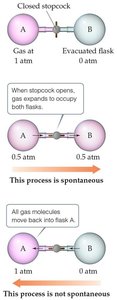
A spontaneous process occurs without external intervention. Spontaneity does not imply speed; some spontaneous reactions are slow (e.g., rusting).
Spontaneous in one direction, nonspontaneous in the reverse.
Nonspontaneous processes can occur if energy is supplied.

Experimental Factors Affecting Spontaneity
Temperature and pressure influence whether a process is spontaneous. For example, ice melts spontaneously above 0°C but freezes below 0°C.
Spontaneity depends on environmental conditions.
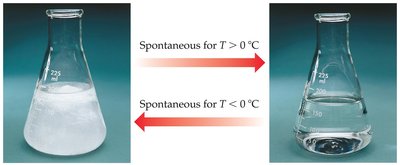
Reversible and Irreversible Processes
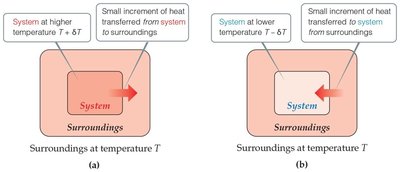
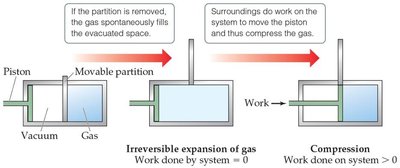
Reversible processes can be undone by exactly reversing the change, maximizing work. Irreversible processes cannot be reversed exactly; all spontaneous processes are irreversible.
Reversible: System and surroundings return to original state.
Irreversible: Cannot return to original state by reversing.
Entropy: Definition and Calculation
Entropy is a state function, calculated as the difference between final and initial states. It can be determined by heat transfer at a given temperature:
Formula:
State function:
Second Law of Thermodynamics
The Second Law of Thermodynamics states that the entropy of the universe increases in any spontaneous process:
For reversible processes:
For irreversible (spontaneous) processes:
Entropy on the Molecular Scale
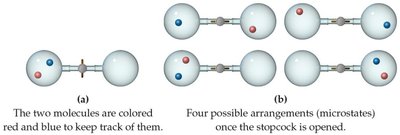
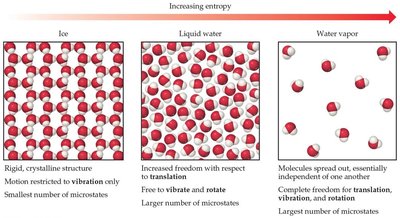
On the molecular level, entropy relates to the number of possible microstates (arrangements of molecules). The more microstates, the greater the entropy.
Boltzmann equation:
Microstate: A specific arrangement of molecules.
Statistical Thermodynamics
Statistical thermodynamics connects molecular behavior (microstates) to macroscopic properties (thermodynamics) using probability and statistics.
More microstates = higher entropy.
Microstates are snapshots of molecular positions and energies.
Effect of Volume and Temperature on Entropy
Increasing volume or temperature increases the number of microstates, thus increasing entropy.
Higher volume: More possible positions for molecules.
Higher temperature: Greater distribution of kinetic energies.
Molecular Motions and Entropy
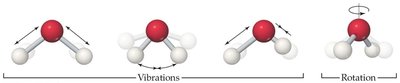
Molecules exhibit translational, vibrational, and rotational motions. More atoms and more types of motion increase the number of microstates and entropy.
Translational: Movement from place to place.
Vibrational: Atoms oscillate within the molecule.
Rotational: Molecule rotates about an axis.
Entropy and Physical States
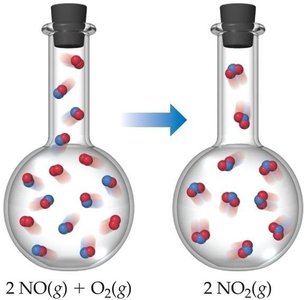
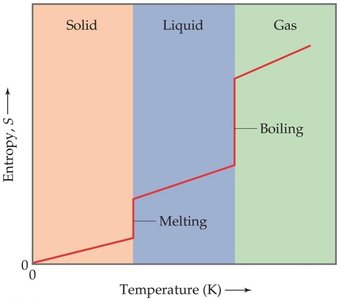
Entropy increases with the freedom of motion. Gases have the highest entropy, followed by liquids, then solids.
Processes that increase the number of gas molecules or change solids to liquids/gases increase entropy.
Third Law of Thermodynamics
The Third Law of Thermodynamics states that the entropy of a pure crystalline substance at absolute zero (0 K) is zero, as there is only one microstate.
Formula:
Predicting the Sign of ΔS
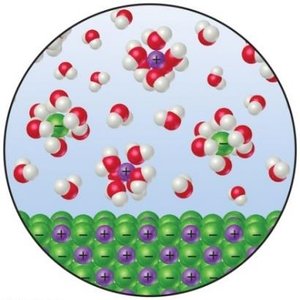
Entropy change () is positive when disorder increases, such as when a liquid becomes a gas or when the number of gas molecules increases. It is negative when order increases, such as when ions form a solid.
Phase changes: for melting, vaporization.
Formation of solids:
Standard Entropies
Standard molar entropy () values are measured at 298 K. Gases generally have higher standard entropies than liquids and solids. Entropy increases with molar mass and number of atoms.
Substance | State | (J/mol·K) |
|---|---|---|
H2 | Gas | 130.6 |
N2 | Gas | 191.5 |
O2 | Gas | 205.0 |
H2O | Gas | 188.8 |
H2O | Liquid | 69.9 |
NaCl | Solid | 72.3 |
Fe | Solid | 27.23 |
CH3OH | Gas | 237.6 |
CH3OH | Liquid | 126.8 |
Calculating Entropy Changes
Entropy changes for a reaction are calculated similarly to enthalpy changes:
Formula:
Entropy Changes in Surroundings
Heat flow into or out of the system changes the entropy of the surroundings. For an isothermal process:
Formula:
At constant pressure:
Entropy Change in the Universe
The universe consists of the system and surroundings:
Formula:
Spontaneous processes:
Gibbs Free Energy
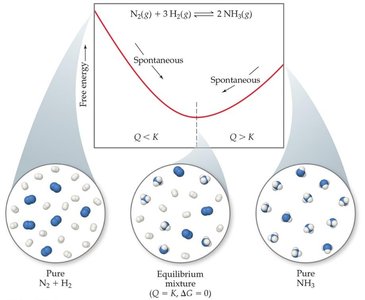
Gibbs Free Energy (G) combines enthalpy and entropy to predict spontaneity:
Formula:
: Spontaneous process
: Equilibrium
: Nonspontaneous process
Standard Free Energy Changes
Standard free energies of formation () are used to calculate reaction free energy:
Formula:
Standard states: 1 atm for gases, 1 M for solutions, pure substances for solids/liquids.
Effect of Temperature on Free Energy
The sign and magnitude of and , as well as temperature, determine spontaneity:
Formula:
Spontaneity can change with temperature.
Free Energy and Equilibrium
Free energy change under any conditions:
Formula:
At equilibrium: ,
Relationship:
Summary of Key Equations
Example Calculations
Calculate for a reaction given and at a specific temperature.
Calculate equilibrium constant from .
Suggested problems: Textbook problems 11, 12, 53-62, 75-79.
