 뒤로
뒤로Chapter 4: Solution Chemistry, Ionic Equations, and Reaction Types
스터디 가이드 - 스마트 노트
 자료에 맞춘 맞춤형 노트, 핵심 정의, 예시, 맥락을 확장해 제공합니다.
Solution Concentration: Molarity
Definition and Calculation of Molarity
Molarity (M) is a fundamental unit for expressing the concentration of a solution in chemistry. It is defined as the number of moles of solute per liter of solution.
Solute: The substance dissolved in the solvent.
Solvent: The substance in which the solute is dissolved, typically water in aqueous solutions.
Molarity formula: $\text{Molarity (M)} = \frac{\text{moles of solute}}{\text{liters of solution}}$
Example: A 1.00 M NaCl solution contains 1.00 mole of NaCl in 1 liter of solution.
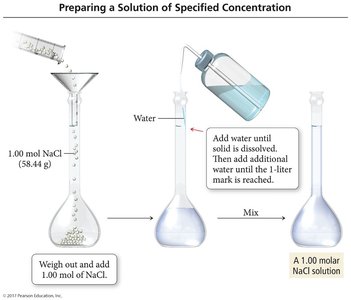
Using Molarity in Calculations
Molarity can be used as a conversion factor between moles of solute and volume of solution. This is essential for stoichiometric calculations in solution chemistry.
Conversion from volume to moles: $\text{Volume (L)} \times \text{Molarity (mol/L)} = \text{Moles of solute}$
Conversion from moles to volume: $\text{Moles of solute} \div \text{Molarity (mol/L)} = \text{Volume (L)}$
Example: A 0.500 M NaCl solution contains 0.500 mol NaCl per liter.


Solution Stoichiometry and Dilution
Concentrated vs. Dilute Solutions
Solutions are described as concentrated or dilute based on the amount of solute relative to solvent.
Dilute solution: Small amount of solute compared to solvent.
Concentrated solution: Large amount of solute compared to solvent.
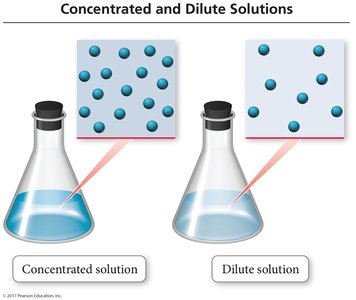
Solution Dilution
To prepare a solution of lower concentration from a stock solution, more solvent is added. The relationship is given by:
$M_1 \cdot V_1 = M_2 \cdot V_2$
M1: Initial molarity (stock solution)
V1: Initial volume
M2: Final molarity (diluted solution)
V2: Final volume
Dissolution of Ionic and Nonionic Compounds
Dissolution Process
When ionic compounds dissolve in water, they dissociate into their constituent ions. Nonionic compounds, such as sugar, dissolve as intact molecules.
Ionic compounds: Dissociate into cations and anions.
Nonionic compounds: Dissolve as molecules, do not dissociate.
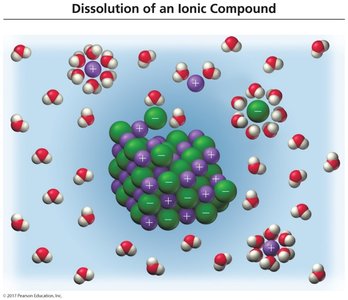
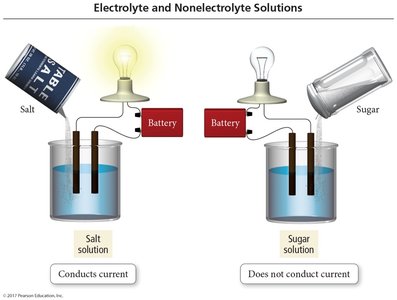
Electrolyte and Nonelectrolyte Solutions
Electrolytes are substances that conduct electricity when dissolved in water due to the presence of ions. Nonelectrolytes do not conduct electricity.
Strong electrolytes: Ionic substances that completely dissociate (e.g., NaCl).
Nonelectrolytes: Molecular compounds that dissolve as molecules (e.g., sugar).
Acids: Ionize to varying degrees; strong acids ionize completely, weak acids only partially.

Dissociation and Ionization
Dissociation of Ionic Compounds
When ionic compounds dissolve, their ions separate. Polyatomic ions remain intact during dissociation.
Example: $\text{Na}_2\text{S}(aq) \rightarrow 2\text{Na}^+(aq) + \text{S}^{2-}(aq)$
Polyatomic ions: $\text{Na}_2\text{SO}_4(aq) \rightarrow 2\text{Na}^+(aq) + \text{SO}_4^{2-}(aq)$
Ionization of Acids
Acids ionize in water to produce H+ and anions. The degree of ionization varies.
Strong acids: Ionize nearly 100% (e.g., HCl).
Weak acids: Ionize only partially (e.g., HF).
Classifying Chemical Reactions
Precipitation Reactions
Precipitation reactions occur when two aqueous solutions mix to form an insoluble solid, called a precipitate.
Empirical method: Solubility is determined experimentally and summarized in solubility rules.
Example: $\text{Na}_2\text{CO}_3(aq) + \text{CuCl}_2(aq) \rightarrow \text{CuCO}_3(s) + 2\text{NaCl}(aq)$
Solubility Rules (Summary Table)
Solubility rules help predict whether a compound will dissolve in water.
Compound Type | Solubility | Exceptions |
|---|---|---|
Li+, Na+, K+, NH4+ | Soluble | None |
NO3- | Soluble | None |
CO32- | Insoluble | Soluble with Li+, Na+, K+, NH4+ |
Cl- | Soluble | Insoluble with Ag+, Pb2+ |
Additional info: | See textbook for full solubility rules. |
Writing Precipitation Reaction Equations
Follow these steps:
Write formulas for reactants.
Combine cations and anions to form possible products.
Use solubility rules to determine if products are insoluble.
Write insoluble products as (s), soluble as (aq).
Balance the equation.
Molecular, Complete Ionic, and Net Ionic Equations
Three types of equations represent reactions in solution:
Molecular equation: Shows complete, neutral formulas.
Complete ionic equation: Shows all ions as they exist in solution.
Net ionic equation: Shows only ions and molecules directly involved in the reaction.
Example:
Molecular: $2\text{KOH}(aq) + \text{Mg(NO}_3)_2(aq) \rightarrow 2\text{KNO}_3(aq) + \text{Mg(OH)}_2(s)$
Complete ionic: $2\text{K}^+(aq) + 2\text{OH}^-(aq) + \text{Mg}^{2+}(aq) + 2\text{NO}_3^-(aq) \rightarrow 2\text{K}^+(aq) + 2\text{NO}_3^-(aq) + \text{Mg(OH)}_2(s)$
Net ionic: $2\text{OH}^-(aq) + \text{Mg}^{2+}(aq) \rightarrow \text{Mg(OH)}_2(s)$
Acid–Base Reactions
Definition and Types
Acid–base reactions, also called neutralization reactions, occur when an acid and a base react to form water and a salt.
Acid: Produces H+ in aqueous solution.
Base: Produces OH- in aqueous solution.
Polyprotic acids: Contain more than one ionizable proton.
Net ionic equation: $\text{H}^+(aq) + \text{OH}^-(aq) \rightarrow \text{H}_2\text{O}(l)$
Acid–Base Titrations
Titration is a laboratory technique used to determine the concentration of an unknown solution by reacting it with a solution of known concentration.
Equivalence point: The point at which stoichiometric amounts of acid and base have reacted.
Indicator: A dye that changes color depending on the acidity or basicity of the solution.
Example calculation: Use the balanced equation and molarity relationships to solve for unknown concentration.
Gas-Evolution Reactions
Definition and Examples
Gas-evolution reactions produce a gas as a product, often resulting in bubbling. These reactions can occur directly or through decomposition of an intermediate product.
Direct gas formation: $\text{K}_2\text{S}(aq) + \text{H}_2\text{SO}_4(aq) \rightarrow \text{K}_2\text{SO}_4(aq) + \text{H}_2\text{S}(g)$
Decomposition: $\text{NaHCO}_3(aq) + \text{HCl}(aq) \rightarrow \text{NaCl}(aq) + \text{H}_2\text{CO}_3(aq)$, then $\text{H}_2\text{CO}_3(aq) \rightarrow \text{H}_2\text{O}(l) + \text{CO}_2(g)$
Oxidation–Reduction (Redox) Reactions
Definitions and Mnemonics
Redox reactions involve the transfer of electrons between substances. Oxidation is the loss of electrons, reduction is the gain of electrons.
Mnemonics: OIL RIG (Oxidation Is Loss; Reduction Is Gain), LEO GER (Lose Electrons Oxidation; Gain Electrons Reduction)
Examples: Rusting of iron, bleaching of hair, battery operation.
Recognizing Redox Reactions
A substance reacts with elemental oxygen.
A metal reacts with a nonmetal.
One substance transfers electrons to another.
Example: $2\text{Na}(s) + \text{Cl}_2(g) \rightarrow 2\text{NaCl}(s)$
Oxidation States
Oxidation states are assigned to elements in compounds to track electron flow. They are not real charges, but imaginary values based on rules.
Free elements: Oxidation state = 0
Monatomic ions: Oxidation state = ion charge
Sum of oxidation states: In compounds, sum = 0; in polyatomic ions, sum = ion charge
Group I metals: +1; Group II metals: +2
Nonmetals: Follow priority table (e.g., O = -2, S = -2, N = -3, etc.)
Assigning Oxidation States (Examples)
Cl2: 0 (free element)
Na+: +1 (monatomic ion)
KF: K = +1, F = -1 (neutral compound)
CO2: C = +4, O = -2 (sum = 0)
SO42-: S = +6, O = -2 (sum = -2)
K2O2: K = +1, O = -1 (sum = 0)
Identifying Oxidation and Reduction
Oxidation is an increase in oxidation state; reduction is a decrease. The reducing agent is oxidized, and the oxidizing agent is reduced.
Example: $2\text{Na}(s) + \text{Cl}_2(g) \rightarrow 2\text{NaCl}(s)$ Na is oxidized (reducing agent), Cl2 is reduced (oxidizing agent).
Classifying Chemical Reactions by Atom Movement
Synthesis and Decomposition Reactions
Synthesis reactions combine simpler substances into a more complex one. Decomposition reactions break down complex substances into simpler ones.
Synthesis: $2\text{Na}(s) + \text{Cl}_2(g) \rightarrow 2\text{NaCl}(s)$
Decomposition: $2\text{H}_2\text{O}(l) \rightarrow 2\text{H}_2(g) + \text{O}_2(g)$
Displacement Reactions
Single-displacement reactions involve one element displacing another in a compound. Double-displacement reactions involve exchange of elements or groups between two compounds.
Single-displacement: Zn + CuCl2 → ZnCl2 + Cu
Double-displacement: AB + CD → AD + BC (includes precipitation, acid–base, and gas-evolution reactions)
Chemistry in the Environment: Ozone Depletion
Ozone Depletion Reactions
Chlorine atoms from chlorofluorocarbons (CFCs) catalyze the destruction of ozone in the atmosphere. The chlorine atom is regenerated, allowing a single CFC molecule to destroy thousands of ozone molecules.
Environmental impact: Ozone depletion increases UV radiation exposure.
