 뒤로
뒤로Chapter 5: Gases – Properties, Laws, and Applications
스터디 가이드 - 스마트 노트
 자료에 맞춘 맞춤형 노트, 핵심 정의, 예시, 맥락을 확장해 제공합니다.
Chapter 5: Gases
Overview of Gases
Gases are one of the fundamental states of matter, characterized by their ability to expand and fill any container. Unlike solids and liquids, gases have neither a fixed shape nor a fixed volume. Their behavior is governed by several physical laws that relate pressure, volume, temperature, and the amount of gas present.
Properties of Gases
Physical Characteristics
No fixed shape or volume: Gases take the shape and volume of their container.
Compressibility: Gases can be compressed much more easily than solids or liquids.
Low density: The density of gases is much lower than that of solids and liquids.
Mixing: Gases mix evenly and completely when confined to the same container.
Molecular Motion and Pressure
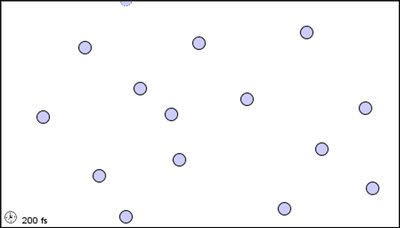
Gas molecules move rapidly in straight lines until they collide with the container walls or other molecules, exerting pressure as a result of these collisions.
Gas Pressure
Definition and Factors Affecting Pressure
Pressure is defined as the force exerted per unit area by gas molecules as they collide with surfaces. The pressure of a gas depends on:
Number of gas particles: More particles in a given volume increase pressure.
Volume of the container: Larger volume means fewer collisions and lower pressure.
Average speed of particles: Higher speed (temperature) increases pressure.

The mathematical expression for pressure is:
$ \text{Pressure} = \frac{\text{force}}{\text{area}} = \frac{F}{A} $
Atmospheric Pressure and Its Effects
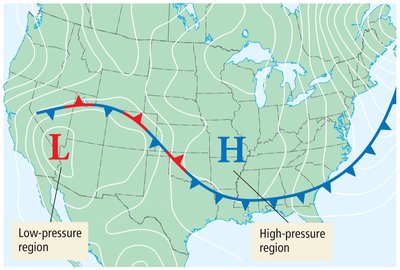
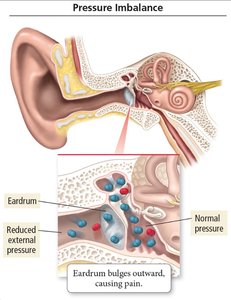
Atmospheric pressure varies with altitude and weather, influencing phenomena such as wind and pressure imbalances in the human body (e.g., ear pain during altitude changes).
Measuring Gas Pressure
Manometers and Barometers
Gas pressure can be measured using a manometer for enclosed gases and a barometer for atmospheric pressure.
Manometer: Measures the pressure of a gas sample relative to atmospheric pressure by the height difference of a liquid column.
Barometer: Measures atmospheric pressure using a column of mercury.

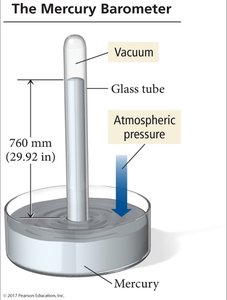
Units of Pressure
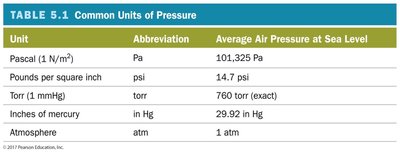
Common units of pressure include:
Pascal (Pa): SI unit, 1 Pa = 1 N/m2
Atmosphere (atm): 1 atm = 101,325 Pa
Millimeter of mercury (mmHg) or Torr: 1 atm = 760 mmHg = 760 torr
Pounds per square inch (psi): 1 atm = 14.7 psi
Inches of mercury (in Hg): 1 atm = 29.92 in Hg
Unit | Abbreviation | Average Air Pressure at Sea Level |
|---|---|---|
Pascal (1 N/m2) | Pa | 101,325 Pa |
Pounds per square inch | psi | 14.7 psi |
Torr (1 mmHg) | torr | 760 torr (exact) |
Inches of mercury | in Hg | 29.92 in Hg |
Atmosphere | atm | 1 atm |

Simple Gas Laws
Boyle’s Law (Pressure-Volume Relationship)
At constant temperature and amount of gas, the pressure of a gas is inversely proportional to its volume:
$ P_1 V_1 = P_2 V_2 $
As volume decreases, pressure increases, and vice versa.
Important in applications such as scuba diving, where pressure changes with depth.
Charles’s Law (Volume-Temperature Relationship)
At constant pressure and amount of gas, the volume of a gas is directly proportional to its temperature (in Kelvin):
$ \frac{V_1}{T_1} = \frac{V_2}{T_2} $
As temperature increases, volume increases.
Temperature must be in Kelvin: $T(K) = T(°C) + 273.15$
Avogadro’s Law (Volume-Mole Relationship)
At constant temperature and pressure, the volume of a gas is directly proportional to the number of moles:
$ \frac{V_1}{n_1} = \frac{V_2}{n_2} $
Equal volumes of gases at the same temperature and pressure contain equal numbers of molecules.
Gay-Lussac’s Law (Pressure-Temperature Relationship)
At constant volume and amount of gas, the pressure of a gas is directly proportional to its temperature (in Kelvin):
$ \frac{P_1}{T_1} = \frac{P_2}{T_2} $
The Ideal Gas Law
General Equation
The ideal gas law combines the simple gas laws into one equation:
$ PV = nRT $
P: Pressure (atm)
V: Volume (L)
n: Amount (mol)
R: Gas constant (0.08206 L·atm·mol−1·K−1)
T: Temperature (K)
The ideal gas law allows calculation of any one variable if the other three are known.
Standard Temperature and Pressure (STP)
Standard temperature: 273 K (0°C)
Standard pressure: 1 atm
At STP, 1 mole of an ideal gas occupies 22.4 L (molar volume).
Gas Density and Molar Mass
Density of a Gas
Density ($d$) is the ratio of mass to volume. For gases at STP:
$ d = \frac{\text{molar mass}}{22.4\ \text{L}} $
Density is usually expressed in g/L and is directly proportional to molar mass.
Mixtures of Gases and Partial Pressures
Dalton’s Law of Partial Pressures
In a mixture of gases, each gas exerts a pressure independently of the others. The total pressure is the sum of the partial pressures:
$ P_{\text{total}} = P_1 + P_2 + P_3 + \ldots $
The partial pressure of a component can be calculated using the ideal gas law or from its mole fraction:
$ P_a = \chi_a P_{\text{total}} $
where $\chi_a$ is the mole fraction of component a.
Gas Stoichiometry
Stoichiometry with Gases
Gas volumes can be related to moles using the ideal gas law or molar volume at STP.
In reactions, use balanced equations to relate moles of gases to each other and to other reactants or products.
Kinetic Molecular Theory
Postulates and Implications
Gases consist of particles in constant, random motion.
Collisions between particles and with container walls are perfectly elastic.
There are negligible attractive or repulsive forces between particles.
The average kinetic energy of gas particles is proportional to the absolute temperature:
$ KE_{\text{avg}} = \frac{3}{2}RT $
where $R = 8.314\ \text{J}\cdot\text{mol}^{-1}\cdot\text{K}^{-1}$.
Temperature, Molecular Speed, and Mass
At a given temperature, lighter molecules move faster than heavier ones.
As temperature increases, the distribution of molecular speeds broadens and shifts to higher values.
Diffusion and Effusion
Definitions
Diffusion: The mixing of gas molecules by random motion.
Effusion: The escape of gas molecules through a small hole into a vacuum.
The rate of effusion is inversely proportional to the square root of the molar mass (Graham’s law):
$ \text{Rate} \propto \frac{1}{\sqrt{M}} $
Real Gases and Deviations from Ideal Behavior
Limitations of the Ideal Gas Law
Ideal gas law assumes no intermolecular attractions and negligible molecular volume.
Real gases deviate from ideal behavior at high pressures (molecular volume significant) and low temperatures (intermolecular attractions significant).
Van der Waals Equation
The Van der Waals equation modifies the ideal gas law to account for real gas behavior:
$ \left(P + a\frac{n^2}{V^2}\right)(V - nb) = nRT $
where $a$ and $b$ are constants specific to each gas.
Additional info: This guide covers all major concepts from Chapter 5: Gases, including physical properties, measurement, gas laws, kinetic molecular theory, and real gas behavior, with relevant examples and equations for General Chemistry students.
