 뒤로
뒤로Chapter 5: Thermochemistry – Energy Changes in Chemical Reactions
스터디 가이드 - 스마트 노트
 자료에 맞춘 맞춤형 노트, 핵심 정의, 예시, 맥락을 확장해 제공합니다.
Thermochemistry: The Study of Energy in Chemical Reactions
Types of Chemistry Based on Energy Interaction
Chemistry investigates how matter interacts with various forms of energy. Thermochemistry focuses on heat, photochemistry on light, and electrochemistry on electricity. All chemical phenomena can be understood as transformations of energy.
5.1 The Nature of Chemical Energy
Energy: Capacity to Do Work or Transfer Heat
Energy is defined as the ability to do work or transfer heat. In chemistry, energy is central to understanding reactions and changes in matter.
Mechanical Work: (force times distance). SI unit: Joule (J).
Heat Energy: Energy used to increase temperature. 1 calorie (cal) is the energy needed to raise 1 g of water by 1°C. .
The Four Fundamental Forces in Nature
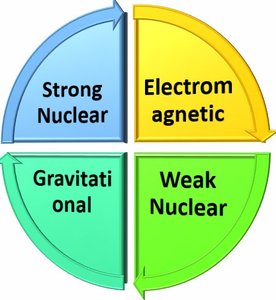
All physical and chemical phenomena arise from four fundamental forces. Their roles in chemistry and thermochemistry are summarized below:
Force | Role in Chemistry | Importance in Thermochemistry |
|---|---|---|
Electromagnetic | Holds electrons and nuclei together; responsible for chemical bonds. | Most important – bond breaking and formation determine enthalpy (ΔH). |
Strong Nuclear | Holds protons and neutrons together inside the nucleus. | Important in nuclear reactions. |
Weak Nuclear | Responsible for radioactive decay. | Relevant to radioactivity and nuclear chemistry. |
Gravitational | Attraction between masses. | Negligible at molecular level. |
Kinetic and Potential Energy
Energy can be classified as:
Kinetic Energy (KE): Energy due to motion.
Potential Energy (PE): Energy stored by virtue of position or composition. Chemical energy is mainly potential energy, especially electrostatic potential energy in molecules.
Electrostatic Potential Energy:


5.2 The First Law of Thermodynamics
Law of Conservation of Energy
The First Law of Thermodynamics states that energy cannot be created or destroyed, only transformed or transferred. The universe is divided into a system (the part studied) and surroundings (everything else).
Open System: Exchanges heat and mass with surroundings.
Closed System: Exchanges heat but not mass.
Isolated System: Exchanges neither heat nor mass.

Internal Energy (U or E)
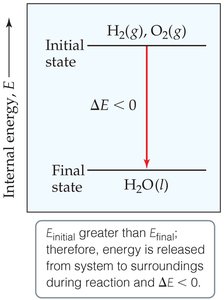
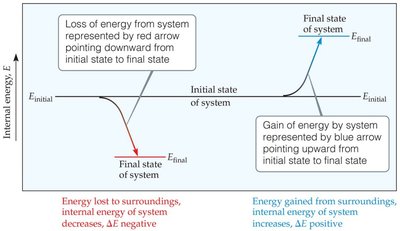
The internal energy of a system is the sum of all kinetic and potential energies. Only changes in internal energy (ΔE) are measurable.
ΔE & Sign Convention: ΔE > 0: system gains energy; ΔE < 0: system loses energy.
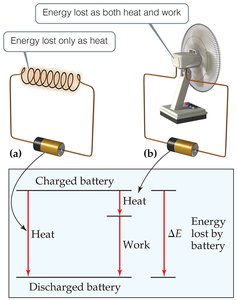
Energy Transfer: Energy lost by the system = energy gained by surroundings.
Relating ΔE to Heat and Work
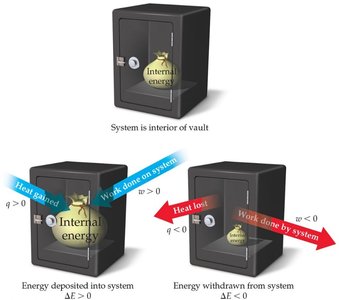
Energy exchange occurs as heat (q) or work (w):
Sign conventions: +q (heat absorbed), -q (heat released), +w (work done on system), -w (work done by system).

Quantity | Positive (+) | Negative (-) |
|---|---|---|
q | System gains heat | System loses heat |
w | Work done on system | Work done by system |
ΔE | Net gain of energy | Net loss of energy |

5.3 Enthalpy (H)
Definition and Properties
Enthalpy is the energy a system contains plus the energy required to push aside the surroundings at constant pressure:
Change in enthalpy:
At constant pressure:
Enthalpy is a state function and extensive property.
5.4 Enthalpy of Reaction
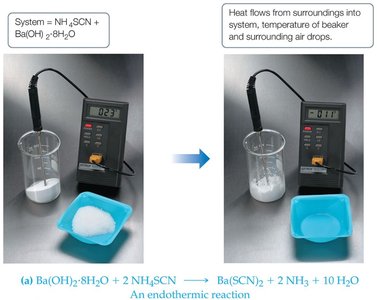
Exothermic and Endothermic Reactions
Reactions are classified by the sign of ΔH:
Exothermic: Heat is released, ΔH < 0.
Endothermic: Heat is absorbed, ΔH > 0.

5.5 Calorimetry
Measuring Heat Flow
Calorimetry is the measurement of heat flow by observing temperature changes. The instrument used is a calorimeter.
Heat Capacity (C): Energy required to raise temperature by 1 K.
Specific Heat (Cs): Energy required to raise 1 g of substance by 1 K.
Molar Heat Capacity (Cm): Energy required to raise 1 mol by 1 K.
5.6 Hess’s Law
Calculating Enthalpy Changes
Hess’s Law states that the enthalpy change for a reaction is the sum of the enthalpy changes for individual steps. This is possible because enthalpy is a state function.
If an equation is multiplied by a factor, ΔH is multiplied by the same factor.
If an equation is reversed, the sign of ΔH changes.
All substances not appearing in the desired equation must cancel.
5.7 Enthalpies of Formation
Standard Enthalpy of Formation (ΔHf°)
The standard enthalpy of formation is the enthalpy change for forming 1 mole of a compound from its elements in their standard states (usually 25°C, 1 atm).
ΔHf° = 0 for elements in their most stable form.
ΔH°rxn can be calculated using tabulated ΔHf° values:
5.8 Bond Enthalpy
Bond Dissociation Energy (BDE)
Bond enthalpy is the energy required to break 1 mole of a bond in the gas phase. It is always positive. Average bond enthalpies are used for polyatomic molecules.
Stronger bonds have higher bond enthalpies.
Reaction enthalpy can be estimated from bond enthalpies:
5.9 Foods and Fuels
Fuel Value of Foods and Fuels
The energy released when one gram of food or fuel is combusted is its fuel value. Most energy in foods comes from carbohydrates, fats, and proteins. Fossil fuels are hydrocarbons with high fuel values but environmental impacts.
Carbohydrate: 4 kcal/g (17 kJ/g)
Fat: 9 kcal/g (38 kJ/g)
Protein: 4 kcal/g (17 kJ/g)
Natural gas: 49 kJ/g; Oil: 45 kJ/g; Coal: 32 kJ/g
Combustion releases CO₂, SO₂, and NOₓ, contributing to climate change and acid rain.
