 뒤로
뒤로CHEM 131 Chapter 1: Matter, Measurement, and Problem Solving
스터디 가이드 - 스마트 노트
 자료에 맞춘 맞춤형 노트, 핵심 정의, 예시, 맥락을 확장해 제공합니다.
Chapter 1: Matter, Measurement, and Problem Solving
Introduction to Matter
Matter is anything that occupies space, has mass, and possesses energy. Understanding the nature and classification of matter is foundational to chemistry, as it determines how substances interact and change.
Matter: Anything that has mass and takes up space.
Particulate Nature: Matter is composed of particles such as atoms and molecules.
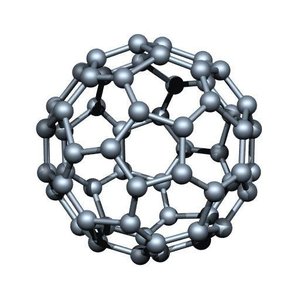
Atoms: The basic submicroscopic particles that constitute the fundamental building blocks of ordinary matter.
Molecules: Substances formed when two or more atoms bond in specific geometric arrangements.
Classification of Matter
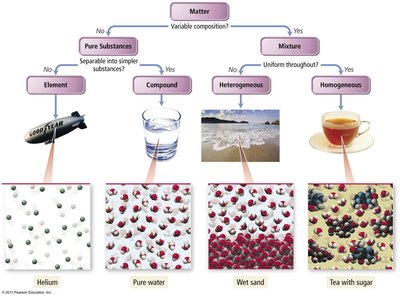
Matter can be classified by its physical state and by its composition. These classifications help chemists understand and predict the properties and behaviors of substances.
By State: Solid, liquid, gas.
By Composition:
Pure Substances: Composed of only one type of particle; invariant composition.
Mixtures: Composed of two or more types of particles; variable composition.
Elements and Compounds
Pure substances are further classified as elements or compounds. Elements cannot be broken down into simpler substances, while compounds are composed of two or more elements in fixed proportions.
Element: A substance that cannot be decomposed into simpler substances.
Compound: A substance composed of two or more elements chemically combined in a fixed ratio.
Mixtures: Homogeneous and Heterogeneous
Mixtures can be homogeneous (uniform throughout) or heterogeneous (not uniform throughout). The method of separation depends on the type of mixture.
Homogeneous Mixture: Uniform composition (e.g., tea with sugar).
Heterogeneous Mixture: Non-uniform composition (e.g., wet sand).
Separation of Mixtures
Mixtures can be separated by physical means based on differences in their physical properties.
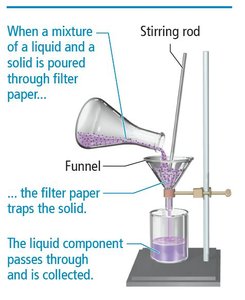
Filtration: Separates an insoluble solid from a liquid using filter paper.
Decanting: Separates a liquid from a solid by carefully pouring off the liquid.
Properties of Matter
Properties of matter are categorized as physical or chemical, and as extensive or intensive.
Physical Properties: Characteristics that can be observed without changing the substance's composition (e.g., mass, volume, density).
Chemical Properties: Characteristics that describe a substance's ability to change into different substances (e.g., flammability, reactivity).
Extensive Properties: Depend on the amount of matter (e.g., mass, volume).
Intensive Properties: Independent of the amount of matter (e.g., density, boiling point).
Physical and Chemical Changes
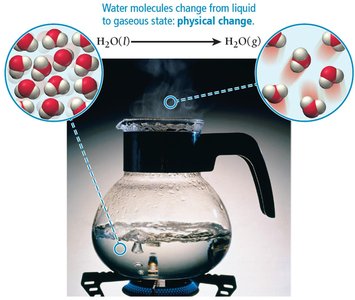
Changes in matter are classified as physical or chemical. Physical changes do not alter the composition, while chemical changes result in new substances.
Physical Change: Alters state or appearance without changing composition (e.g., melting, boiling, sublimation).
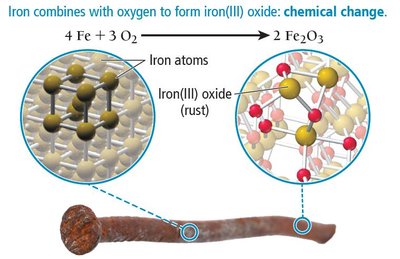
Chemical Change: Alters the composition, forming new substances (e.g., rusting, burning).
Energy in Chemistry
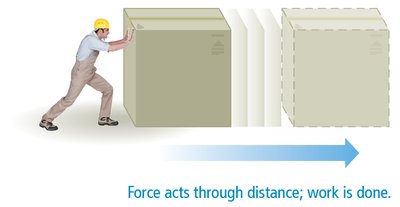
Energy is the capacity to do work or transfer heat. It is a fundamental aspect of both physical and chemical changes.
Kinetic Energy: Energy of motion.
Potential Energy: Stored energy due to position or composition (e.g., chemical energy).
Law of Conservation of Energy: Energy cannot be created or destroyed, only converted from one form to another.
Units of Measurement
Chemistry relies on the International System of Units (SI) for consistency in measurements. Prefix multipliers are used to express very large or small quantities.
SI Base Units: Meter (m), kilogram (kg), second (s), kelvin (K), mole (mol), ampere (A), candela (cd).
Metric System: Uses prefixes such as kilo- (103), centi- (10-2), milli- (10-3).

Temperature Scales
Temperature is measured in Celsius (°C), Kelvin (K), and Fahrenheit (°F). The Celsius and Kelvin scales have the same degree size, while Fahrenheit is different.
Conversion Formulas:
Derived Units: Volume and Density
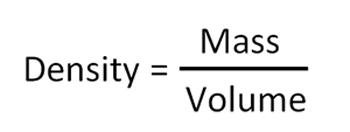
Some quantities, such as volume and density, are derived from base units. Density is a key property for identifying substances and is defined as mass per unit volume.
Volume:
Density:
Density of solids > liquids >>> gases (with some exceptions).
Density changes with temperature.
Precision, Accuracy, and Significant Figures
Measurements in chemistry must be both precise and accurate. Significant figures reflect the certainty of measurements and must be preserved in calculations.
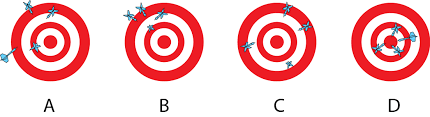
Accuracy: How close a measurement is to the true value.
Precision: How close repeated measurements are to each other.
Significant Figures: Digits in a measurement that are known with certainty plus one estimated digit.
Rules for Significant Figures:
All nonzero digits are significant.
Interior zeros are significant.
Leading zeros are not significant.
Trailing zeros are significant only if a decimal point is present.
Exact Numbers: Have an unlimited number of significant figures (e.g., defined quantities, counted objects).
Significant Figures in Calculations
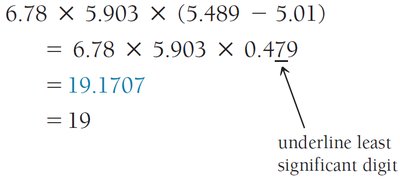
When performing calculations, the number of significant figures in the result must reflect the precision of the input values.
Multiplication/Division: Result has the same number of significant figures as the factor with the fewest significant figures.
Addition/Subtraction: Result has the same number of decimal places as the quantity with the fewest decimal places.
Rounding: Round down if the digit dropped is four or less; round up if five or more.
Multistep Calculations: Only round the final answer.
Dimensional Analysis (Unit Conversion)
Dimensional analysis is a systematic approach to problem solving that uses conversion factors to move from one unit to another.
Always include units in calculations; they are treated algebraically.
General formula:
Steps: Identify starting point, end point, and devise a conceptual plan using known relationships.
Interpreting Experimental Data and Graphs
Analyzing and interpreting data is essential for understanding chemical phenomena. Data can be presented in tables or graphs for clarity.
Example: Mass relationships in the decomposition of water show the law of conservation of mass.
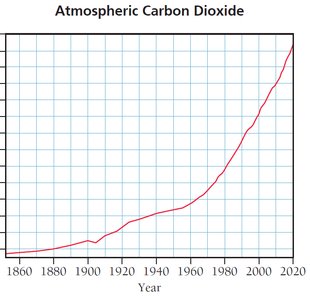
Graphs are used to visualize trends, such as the increase in atmospheric carbon dioxide over time.
Summary Table: Classification of Matter
Type | Description | Example |
|---|---|---|
Element | Cannot be broken down into simpler substances | Helium |
Compound | Composed of two or more elements in fixed proportions | Water (H2O) |
Homogeneous Mixture | Uniform composition throughout | Tea with sugar |
Heterogeneous Mixture | Non-uniform composition | Wet sand |
Key Equations
Density:
Temperature:
Temperature:
