 뒤로
뒤로Chemical Equations, Reactions, and Equilibrium: Study Notes
스터디 가이드 - 스마트 노트
 자료에 맞춘 맞춤형 노트, 핵심 정의, 예시, 맥락을 확장해 제공합니다.
Chemical Equations and Reactions
Components of a Chemical Equation
Chemical equations are symbolic representations of chemical reactions, showing the reactants and products, their physical states, and reaction conditions. Understanding the notation is essential for interpreting and writing equations.
Reactants: Substances present at the start of the reaction, written on the left side of the arrow.
Products: Substances formed as a result of the reaction, written on the right side of the arrow.
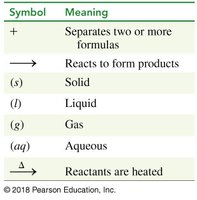
Symbols: Indicate physical states and reaction conditions.
Writing Chemical Equations
A chemical equation must clearly indicate the reactants, products, and their states. The arrow (→) shows the direction of the reaction, and plus signs (+) separate multiple substances.
Example:
State symbols: (s) for solid, (l) for liquid, (g) for gas, (aq) for aqueous.
Reaction conditions: Δ indicates heating.
Balanced Chemical Equations
Balancing chemical equations ensures the conservation of mass: the number of atoms for each element is the same on both sides. Coefficients are used to adjust quantities without changing the chemical formulas.
Law of Conservation of Mass: No atoms are lost, gained, or changed into other types during a reaction.
Balancing: Use whole-number coefficients to equalize atom counts.
Example:
Steps for Balancing Equations
Follow these steps to balance a chemical equation:
Write the correct formulas for reactants and products.
Count the atoms of each element on both sides.
Use coefficients to balance each element.
Check the final equation for balance.
Balancing with Polyatomic Ions
When polyatomic ions appear unchanged on both sides, balance them as a group. Start with the formula with the highest subscript values and use coefficients accordingly.
Example:
Types of Chemical Reactions
Overview of Reaction Types
Chemical reactions are classified into five main types based on the nature of reactants and products:
Combination (Synthesis)
Decomposition
Single Replacement
Double Replacement
Combustion
Combination Reactions
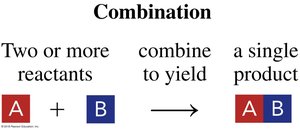
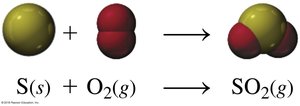
In combination reactions, two or more reactants combine to form a single product. This type is common in the formation of compounds from elements.
General form:
Example:
Decomposition Reactions
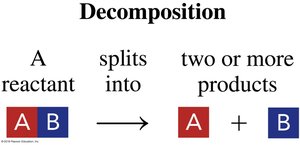
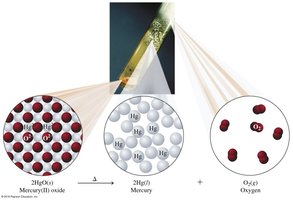
Decomposition reactions involve a single reactant breaking down into two or more products. These reactions often require energy input, such as heat.
General form:
Example:
Single Replacement Reactions
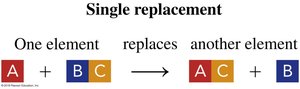
In single replacement reactions, one element replaces another in a compound, forming a new compound and releasing the replaced element.
General form:
Example: Zinc replaces hydrogen in hydrochloric acid:
Double Replacement Reactions
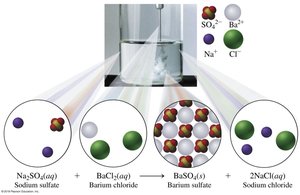
Double replacement reactions involve the exchange of ions between two compounds, resulting in the formation of two new compounds.
General form:
Example:
Combustion Reactions
Combustion reactions occur when a carbon-containing compound reacts with oxygen to produce carbon dioxide, water, and energy. These reactions are highly exothermic.
General form:
Example:
Summary Table: Types of Chemical Reactions
Type | General Equation | Description |
|---|---|---|
Combination | Two or more reactants form one product | |
Decomposition | One reactant splits into two or more products | |
Single Replacement | One element replaces another in a compound | |
Double Replacement | Ions in two compounds exchange places | |
Combustion | Carbon compound burns in oxygen |
Practice: Identifying Reaction Types
Combination:
Single Replacement:
Combustion:
References
Timberlake, K. (2018). Chemistry: An Introduction to General, Organic, and Biological Chemistry (13th ed). Pearson Education.
