 뒤로
뒤로Chemical Equilibrium: Calculating Equilibrium Constants and Concentrations
스터디 가이드 - 스마트 노트
 자료에 맞춘 맞춤형 노트, 핵심 정의, 예시, 맥락을 확장해 제공합니다.
Chemical Equilibrium
Introduction to Chemical Equilibrium
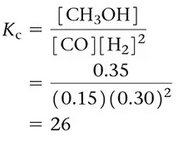
Chemical equilibrium occurs when the rates of the forward and reverse reactions are equal, resulting in constant concentrations of reactants and products. The equilibrium constant (K) quantifies the ratio of product and reactant concentrations at equilibrium for a given reaction at a specific temperature.
Calculating Equilibrium Constants from Measured Equilibrium Concentrations
The equilibrium constant can be determined by measuring the concentrations of reactants and products at equilibrium. The value of K is independent of the initial concentrations and depends only on temperature.
Equilibrium Constant Expression: For a reaction such as H2(g) + I2(g) → 2HI(g), the equilibrium constant is given by:
Example: Multiple sets of initial concentrations for H2, I2, and HI yield the same value of K at constant temperature, demonstrating the independence of K from initial conditions.
Calculating Equilibrium Concentration of One Substance
Given the equilibrium constant and equilibrium concentrations of other substances, the unknown concentration can be calculated by rearranging the equilibrium expression.
Example: If [H2] = 0.33 M, [I2] = 0.165 M, and K = 50, then:
ICE Tables: Finding Equilibrium Constant from Experimental Measurements
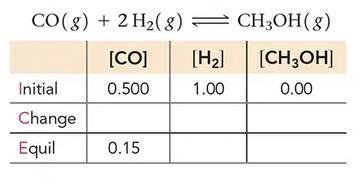
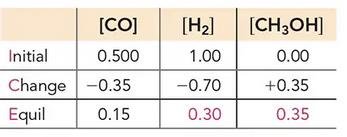
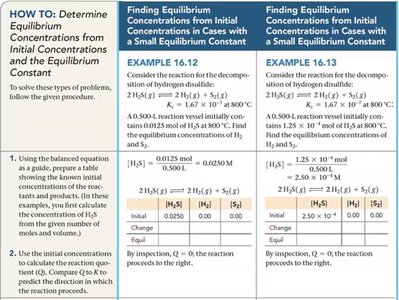
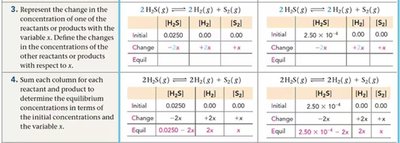
An ICE (Initial, Change, Equilibrium) table is a systematic way to track concentration changes and determine equilibrium values.
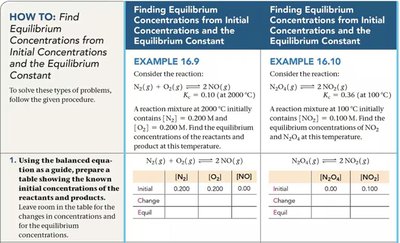
Step 1: Write the balanced equation and fill in initial concentrations.
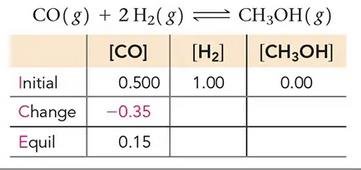
Step 2: Calculate the change in concentration for a known reactant or product.
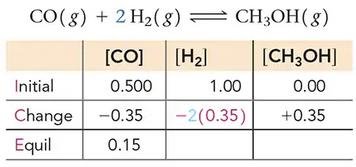
Step 3: Use stoichiometry to determine changes for all substances.
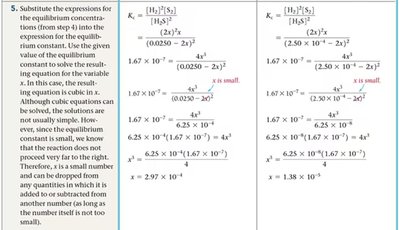
Step 4: Substitute equilibrium concentrations into the equilibrium constant expression and solve for K.
The Reaction Quotient (Q) and Predicting Direction of Change
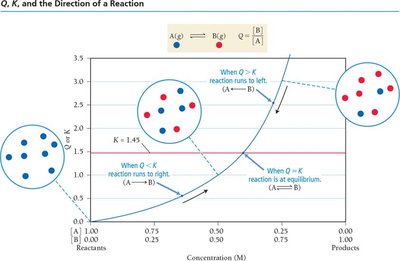
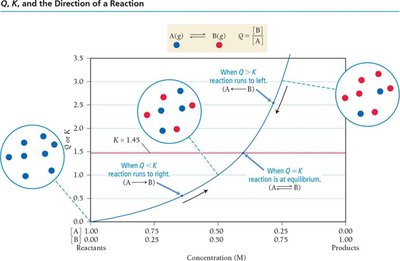
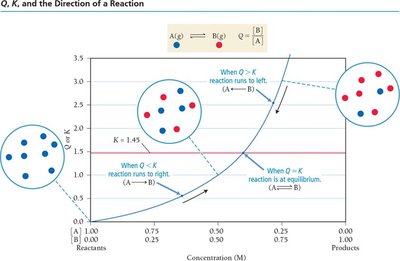
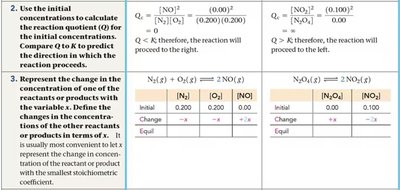
The reaction quotient (Q) is calculated using the same form as the equilibrium constant, but with current (not necessarily equilibrium) concentrations. Comparing Q to K predicts the direction the reaction will proceed:
If Q > K: The reaction shifts left (toward reactants).
If Q < K: The reaction shifts right (toward products).
If Q = K: The system is at equilibrium.
Finding Equilibrium Concentrations Given K and Initial Conditions
To determine equilibrium concentrations:
Step 1: Write the reaction and prepare an ICE table.
Step 2: Compare Q to K to determine direction.
Step 3: Define changes in terms of x, using stoichiometric coefficients.
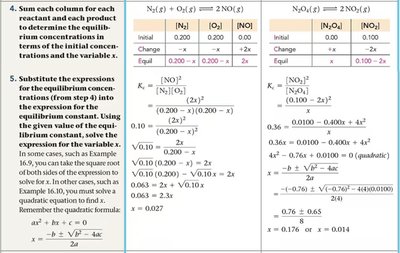
Step 4: Solve for x using algebraic or quadratic methods.
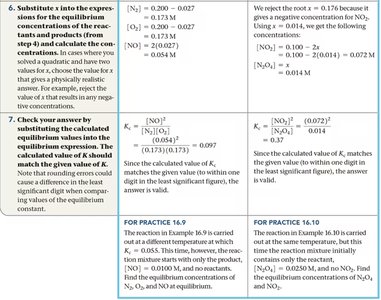
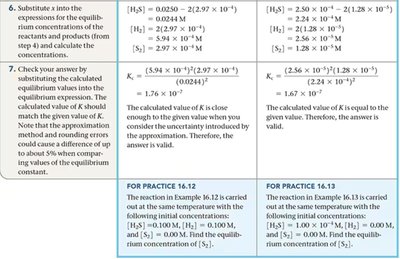
Step 5: Substitute x to find equilibrium concentrations.
Approximations to Simplify Equilibrium Calculations
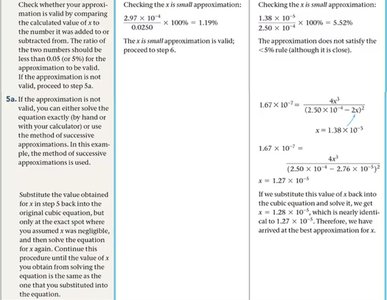
When the equilibrium constant is very small and initial concentrations are large, the change in concentration (x) is often negligible. This allows for the x is small approximation:
Approximation Validity: If x is less than 5% of the initial concentration, the approximation is valid.
Checking: Calculate ; if < 5%, proceed with the approximation.
Summary Table: Steps for Equilibrium Calculations
Step | Description |
|---|---|
1 | Write balanced equation and prepare ICE table |
2 | Calculate Q and compare to K |
3 | Define changes in terms of x |
4 | Solve for x (algebraic/quadratic) |
5 | Substitute x to find equilibrium concentrations |
6 | Check approximation validity (if used) |
7 | Verify calculated values with K |
Key Terms: Equilibrium constant (K), reaction quotient (Q), ICE table, x is small approximation, quadratic formula.
Applications: These methods are essential for predicting the outcome of chemical reactions, optimizing industrial processes, and understanding dynamic chemical systems.
