 뒤로
뒤로Chemical Equilibrium: Principles, Calculations, and Applications
스터디 가이드 - 스마트 노트
 자료에 맞춘 맞춤형 노트, 핵심 정의, 예시, 맥락을 확장해 제공합니다.
Chemical Equilibrium
The Concept of Equilibrium
Chemical equilibrium is a fundamental concept in chemistry describing the state in which the concentrations of reactants and products remain constant over time. Unlike reactions that proceed to completion, most chemical reactions are reversible and reach a point where the forward and reverse reactions occur at equal rates. At this stage, the system is said to be in dynamic equilibrium.
Dynamic equilibrium: Both forward and reverse reactions continue, but there is no net change in concentrations.
Equilibrium can be established from only reactants, only products, or any mixture of both.
Example: The decomposition of dinitrogen tetroxide (N2O4) to nitrogen dioxide (NO2):
N2O4 (g) ↔ 2 NO2 (g)
N2O4 is colorless; NO2 is brown.
At equilibrium, both species are present and their concentrations remain constant.
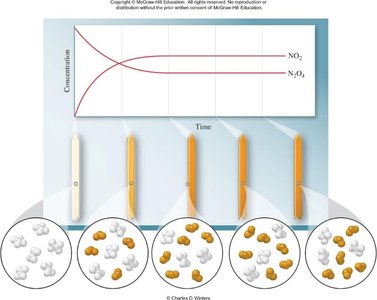
Additional info: The image above illustrates how, over time, the concentrations of reactants and products change until equilibrium is reached, with both species present in the system.
The Equilibrium Constant
The equilibrium constant (K_c) quantifies the ratio of product to reactant concentrations at equilibrium for a given reaction at a specific temperature. The equilibrium expression is derived from the balanced chemical equation, with each concentration raised to the power of its stoichiometric coefficient.
Law of mass action: For a general reaction: aA + bB ↔ cC + dD, the equilibrium constant expression is:
Kc is constant at a given temperature.
A large Kc (>1): Products are favored at equilibrium.
A small Kc (<1): Reactants are favored at equilibrium.
Calculating Equilibrium Constants and the Reaction Quotient
The reaction quotient (Q_c) has the same form as the equilibrium constant expression but uses initial (or non-equilibrium) concentrations. As the reaction progresses, Q_c changes until it equals K_c at equilibrium.
If Q_c < K_c: The reaction proceeds forward (toward products).
If Q_c = K_c: The system is at equilibrium.
If Q_c > K_c: The reaction proceeds in reverse (toward reactants).
Equilibrium Expressions: Homogeneous and Heterogeneous Equilibria
Equilibrium systems can be classified as homogeneous (all species in the same phase) or heterogeneous (species in different phases). For heterogeneous equilibria, only gaseous and aqueous species appear in the equilibrium expression; pure solids and liquids are omitted.
Example: CO2 (g) + C (s) ↔ 2 CO (g)
Solids (C) do not appear in the equilibrium expression.
Manipulating Equilibrium Expressions
Equilibrium constant expressions can be manipulated based on changes to the chemical equation:
Reversing the equation: Take the reciprocal of K_c.
Multiplying the equation by a factor: Raise K_c to that power.
Adding equations: Multiply the corresponding K_c values.
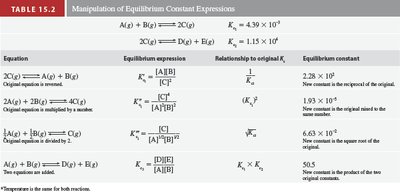
Additional info: The table above summarizes how to adjust the equilibrium constant when the chemical equation is reversed, multiplied, divided, or added to another equation.
Gaseous Equilibrium and Kp
For reactions involving gases, equilibrium can also be expressed in terms of partial pressures (K_p):
R = 0.0821 L·atm/(mol·K) (gas constant)
T = temperature in Kelvin
Δn = (sum of coefficients of gaseous products) – (sum of coefficients of gaseous reactants)
Using Equilibrium Expressions to Solve Problems
To determine the direction a reaction will proceed, compare Q and K using initial concentrations. To calculate equilibrium concentrations, follow these steps:
Write the K_c expression.
Determine the direction of shift (using Q_c).
Set up a RICE table (Reaction, Initial, Change, Equilibrium).
Insert equilibrium values into the K_c expression.
Solve for the unknown (usually x).
Calculate equilibrium concentrations.
Factors Affecting Chemical Equilibrium (Le Châtelier’s Principle)
Le Châtelier’s principle states that if a system at equilibrium is disturbed, it will shift in the direction that minimizes the disturbance.
Change in concentration: Increasing a reactant shifts equilibrium toward products; increasing a product shifts toward reactants.
Change in temperature: For exothermic reactions, increasing temperature shifts equilibrium left; for endothermic, shifts right.
Change in pressure: Affects only gaseous equilibria. Increasing pressure shifts equilibrium toward the side with fewer moles of gas.
Addition of a catalyst: Does not affect the position of equilibrium; only increases the rate at which equilibrium is achieved.
Summary Table: Effects on Equilibrium
Change | Effect on Equilibrium |
|---|---|
Increase [Reactant] | Shifts right (toward products) |
Increase [Product] | Shifts left (toward reactants) |
Increase Temperature (Exothermic) | Shifts left |
Increase Temperature (Endothermic) | Shifts right |
Increase Pressure | Shifts to side with fewer gas moles |
Add Catalyst | No effect on equilibrium position |
Practice Problems
Suggested Problems: Ch 13: 1–9, 13–15, 17–18, 36–39, 52–68
