 뒤로
뒤로Chemical Equilibrium: Principles, Calculations, and Applications
스터디 가이드 - 스마트 노트
 자료에 맞춘 맞춤형 노트, 핵심 정의, 예시, 맥락을 확장해 제공합니다.
Chemical Equilibrium
The Concept of Equilibrium
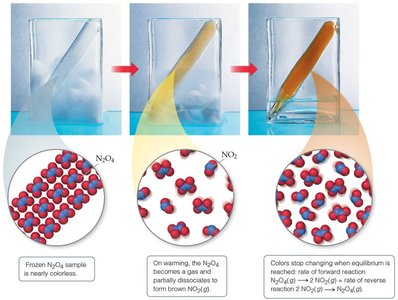
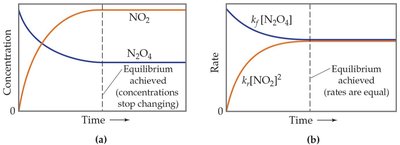
Chemical equilibrium is a dynamic state in which the rates of the forward and reverse reactions are equal, resulting in constant concentrations of reactants and products. This does not mean the amounts are equal, but that their ratios remain unchanged over time.
Dynamic Equilibrium: Both forward and reverse reactions continue to occur, but there is no net change in the concentrations of reactants and products.
Constant Concentrations: Once equilibrium is achieved, the amounts of all species remain constant as long as the system is undisturbed.
Closed System: Neither reactants nor products can escape; the system must be closed for equilibrium to be established.
Writing Equilibrium Equations
Equilibrium reactions are represented with a double arrow to indicate that both forward and reverse reactions occur:
Example:
Equilibrium Constant Expressions
The equilibrium constant, K, quantifies the ratio of product and reactant concentrations at equilibrium. For a general reaction:
The equilibrium expression is:
For gaseous reactions, the equilibrium constant can also be expressed in terms of partial pressures:
The relationship between and is:
where is the change in moles of gas ().
Magnitude and Direction of K
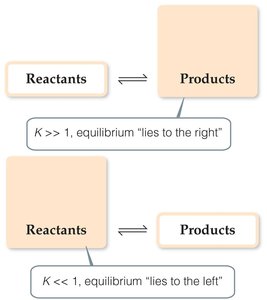
The value of the equilibrium constant indicates the extent of a reaction:
If , products are favored ("lies to the right").
If , reactants are favored ("lies to the left").
Manipulating Equilibrium Equations
Reversing the Equation: The equilibrium constant for the reverse reaction is the reciprocal of the forward reaction's constant.
Multiplying the Equation: If the coefficients in a balanced equation are multiplied by n, the equilibrium constant is raised to the nth power.
Adding Equations: When adding two or more equations, the overall equilibrium constant is the product of the individual constants.
Homogeneous vs. Heterogeneous Equilibria
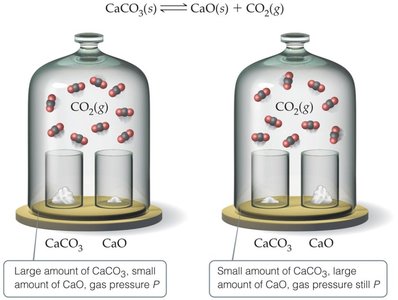
Homogeneous equilibria involve all reactants and products in the same phase, while heterogeneous equilibria involve different phases. The concentration of pure solids and liquids is taken as 1 and does not appear in the equilibrium expression.
Calculating Equilibrium Concentrations
ICE Tables (Initial, Change, Equilibrium)
To solve equilibrium problems, use an ICE table to organize initial concentrations, changes during the reaction, and equilibrium concentrations.
Tabulate all known initial and equilibrium concentrations.
Calculate the change for known species.
Use stoichiometry to find changes for all other species.
Calculate equilibrium concentrations.
Substitute equilibrium values into the equilibrium expression to solve for K or unknown concentrations.
Reaction Quotient (Q) and Predicting Direction
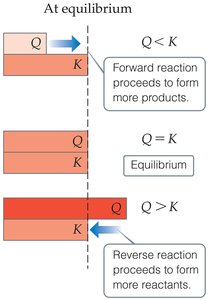
The reaction quotient, Q, is calculated like K but with current (not necessarily equilibrium) concentrations. Comparing Q to K predicts the direction the reaction will proceed:
If , the reaction proceeds forward (toward products).
If , the system is at equilibrium.
If , the reaction proceeds in reverse (toward reactants).
Le Châtelier’s Principle
Principle Statement
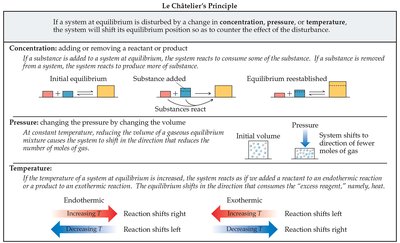
If a system at equilibrium is disturbed by a change in temperature, pressure, or concentration, the system will shift its equilibrium position to counteract the disturbance.
Effects of Changing Conditions
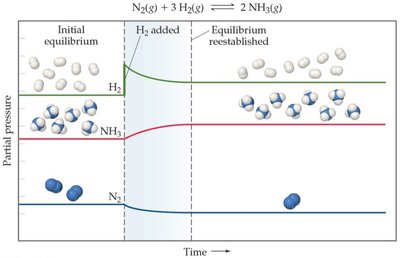
Concentration: Adding a reactant or product shifts equilibrium to consume the added substance; removing shifts to produce more.
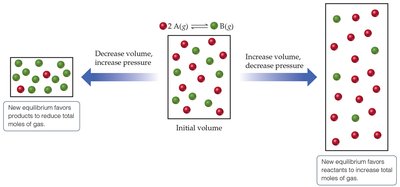
Volume/Pressure (for gases): Increasing volume (decreasing pressure) favors the side with more moles of gas; decreasing volume (increasing pressure) favors the side with fewer moles.
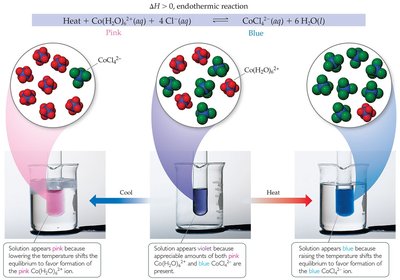
Temperature: For endothermic reactions, heat is a reactant; for exothermic, heat is a product. Increasing temperature favors the endothermic direction; decreasing favors exothermic.
Catalysts and Equilibrium
Effect of Catalysts
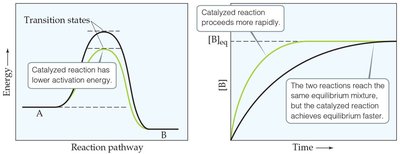
Catalysts increase the rate at which equilibrium is achieved by lowering the activation energy for both forward and reverse reactions. However, they do not affect the equilibrium composition or the value of K.
Summary Table: Key Steps in Equilibrium Calculations
Step | Description |
|---|---|
1 | Write the balanced equation and equilibrium expression. |
2 | Set up an ICE table with initial concentrations, changes, and equilibrium values. |
3 | Express equilibrium concentrations in terms of a variable (x). |
4 | Substitute equilibrium values into the equilibrium expression and solve for x. |
5 | Calculate all equilibrium concentrations and check your work. |
Additional info: For more complex systems, quadratic or higher-order equations may be required to solve for equilibrium concentrations. Approximations can sometimes be used if K is very large or small.
