 뒤로
뒤로Chemical Kinetics: Rates and Mechanisms of Chemical Reactions
스터디 가이드 - 스마트 노트
 자료에 맞춘 맞춤형 노트, 핵심 정의, 예시, 맥락을 확장해 제공합니다.
Chemical Kinetics: The Rates and Mechanisms of Chemical Reactions
Introduction to Chemical Kinetics
Chemical kinetics is the branch of chemistry that studies the speed (rate) of chemical reactions and the factors that affect these rates. It is important to distinguish between spontaneity and reaction rate: a reaction may be thermodynamically spontaneous but proceed extremely slowly.
Reaction Rate: The change in concentration of a reactant or product per unit time.
Mechanism: The sequence of molecular events (elementary steps) that leads to product formation.
Factors Affecting Reaction Rates
Main Factors
Nature of Reactants: Physical state, chemical identity, and bond strengths affect rates. For example, ionic reactions are typically faster than covalent reactions.
Concentration: Higher concentrations lead to more frequent collisions and generally faster reactions.
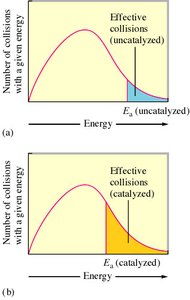
Temperature: Increasing temperature increases reaction rate, often doubling the rate for every 10°C rise, due to more molecules having sufficient energy to overcome the activation energy barrier.
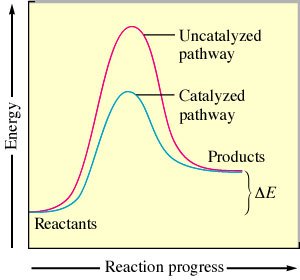
Catalysts: Substances that increase reaction rate by providing an alternative pathway with lower activation energy. Catalysts are not consumed in the reaction.
Surface Area: For heterogeneous reactions, greater surface area increases the rate by exposing more reactant particles to collisions.
The Collision Theory of Reaction Rates
Basic Principles
Collision theory explains that molecules must collide with sufficient energy and proper orientation to react. Only a fraction of collisions are effective in producing products.
Only two particles can collide at a time (bimolecular collisions are most common).
Collisions must have enough energy to overcome electron repulsion and allow bond rearrangement.
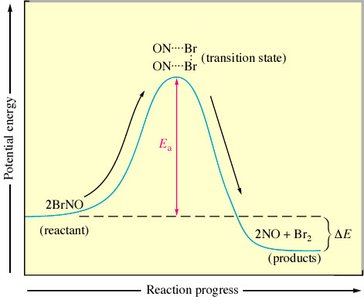
The activated complex (or transition state) is formed at the peak of the energy barrier.
Chemical Reaction Rates
Measuring Reaction Rates
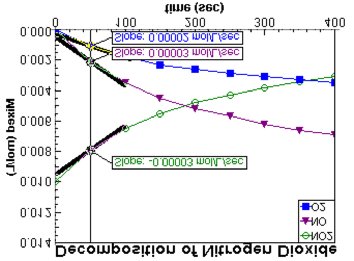
The rate of a chemical reaction is measured by the change in concentration of a reactant or product over time:
Rates are typically expressed as the disappearance of reactants (negative) or appearance of products (positive).
Rates are not constant; they generally decrease as the reaction proceeds.
Instantaneous rate is the slope of the tangent to the concentration vs. time curve at a specific time.
Relative Rates and Stoichiometry
Relative rates are determined by the stoichiometry of the balanced equation. For example, for the reaction:
The rate expressions are:
Rate Laws and Reaction Order
Rate Law Expressions
The rate law relates the reaction rate to the concentrations of reactants (and sometimes catalysts):
k: Rate constant (depends on temperature).
m, n, p: Reaction orders (determined experimentally).
The overall order is the sum of the exponents.
Common Reaction Orders
Zero Order: Rate is independent of concentration.
First Order: Rate is directly proportional to concentration.
Second Order: Rate is proportional to the square of concentration.
Experimental Determination of Rate Laws
Reaction orders are determined by varying concentrations and measuring initial rates. The method of initial rates involves comparing how changes in concentration affect the rate.
Integrated Rate Laws
Concentration-Time Relationships
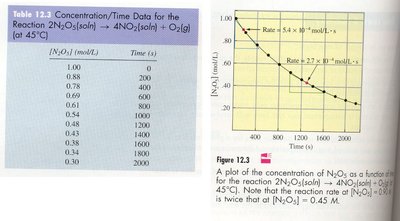
Integrated rate laws relate reactant concentration to time and are used to determine how long a reaction must proceed to reach a certain concentration.
Zero Order:
First Order:
Second Order:
Graphical Methods for Determining Reaction Order
Plot vs. time: Zero order yields a straight line.
Plot vs. time: First order yields a straight line.
Plot vs. time: Second order yields a straight line.
Half-Life of Reactions
Definitions and Equations
First Order: (independent of initial concentration)
Second Order:
Zero Order:
Reaction Mechanisms
Elementary Steps and Molecularity
The mechanism of a reaction is the sequence of elementary steps by which overall chemical change occurs. Each step can be unimolecular, bimolecular, or termolecular (rare).
Unimolecular: Involves one molecule.
Bimolecular: Involves two molecules. or
Termolecular: Involves three molecules.
Rate-Determining Step
The slowest step in a reaction mechanism determines the overall reaction rate. Intermediates are produced in one step and consumed in another; catalysts appear in the mechanism but are regenerated.
Temperature and the Arrhenius Equation
Effect of Temperature on Rate
Reaction rates increase with temperature due to more molecules having energy greater than the activation energy (). The Arrhenius equation quantifies this relationship:
Taking the natural logarithm:
Plotting vs. yields a straight line with slope .
Catalysis
Types and Mechanisms
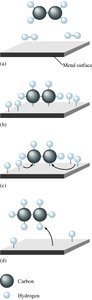
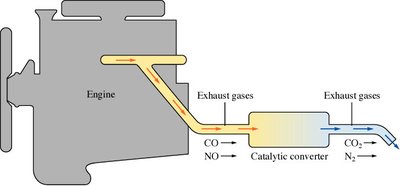
Heterogeneous Catalysis: Catalyst is in a different phase than reactants (e.g., solid catalyst with gaseous reactants). Involves adsorption, reaction, and desorption steps.
Homogeneous Catalysis: Catalyst is in the same phase as reactants.
Enzymes: Biological catalysts, typically proteins, that speed up biochemical reactions.
Key Points about Catalysts
Catalysts lower the activation energy but do not change the overall energy change () of the reaction.
Catalysts are not consumed in the reaction and can be used repeatedly.
They provide an alternative reaction pathway with a lower activation energy.
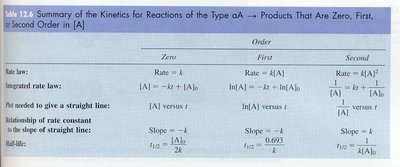
Summary Table: Kinetics for Zero, First, and Second Order Reactions
Order | Rate Law | Integrated Rate Law | Straight Line Plot | Slope | Half-life |
|---|---|---|---|---|---|
Zero | Rate = k | [A] = -kt + [A]_0 | [A] vs. t | -k | t1/2 = [A]_0 / 2k |
First | Rate = k[A] | ln[A] = -kt + ln[A]_0 | ln[A] vs. t | -k | t1/2 = 0.693 / k |
Second | Rate = k[A]^2 | 1/[A] = kt + 1/[A]_0 | 1/[A] vs. t | k | t1/2 = 1 / (k[A]_0) |
