 뒤로
뒤로Chemical Kinetics: Rates and Mechanisms of Chemical Reactions
스터디 가이드 - 스마트 노트
 자료에 맞춘 맞춤형 노트, 핵심 정의, 예시, 맥락을 확장해 제공합니다.
Chemical Kinetics: The Rates and Mechanisms of Chemical Reactions
Introduction to Chemical Kinetics
Chemical kinetics is the study of the speed (rate) of chemical reactions and the mechanisms by which they occur. It is important to note that a reaction can be spontaneous but still proceed very slowly. The mechanism of a reaction refers to the sequence of molecular events that dictate the reaction's speed and outcome.
Factors Affecting Reaction Rates
Nature of Reactants
Physical State: Reactions occur faster when reactants are in the same phase or in solution, as particles can collide more easily.
Chemical Identity: Ions of opposite charge react rapidly, while substances with strong bonds (high bond energies) react more slowly. For example, metallic sodium reacts faster with water than metallic calcium.
Concentration of Reactants
Increasing the concentration of reactants increases the number of collisions, thus increasing the reaction rate.
Temperature
Raising the temperature increases the kinetic energy of molecules, leading to more frequent and energetic collisions. A general rule is that a 10°C increase doubles the reaction rate, though this depends on the activation energy and temperature range.
Catalysts
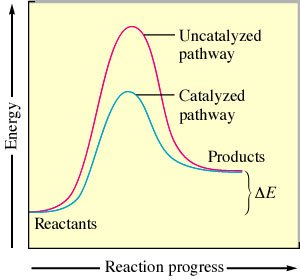
Catalysts accelerate reactions by lowering the activation energy, providing an alternative pathway. They are not consumed in the reaction. Biological catalysts are called enzymes.
Surface Area
For heterogeneous reactions, increasing the surface area of a reactant increases the reaction rate by exposing more particles to collisions.
The Collision Theory of Reaction Rates
Key Concepts
Reactant particles must collide to react.
Only two particles can collide at a time (bimolecular collisions are most common).
Collisions must have proper orientation and sufficient energy to overcome electron repulsion and allow bond rearrangement.
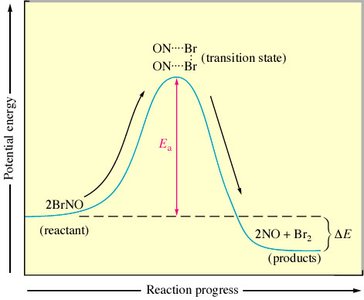
The activated complex (or transition state) is formed at the peak of the activation energy barrier and can proceed to products or revert to reactants.
Chemical Reaction Rates
Measuring Reaction Rates
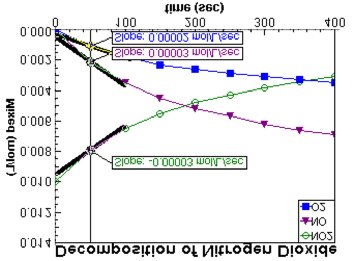
The rate of a chemical reaction is measured as the change in concentration of a reactant or product per unit time:
Rates can be expressed in terms of the disappearance of reactants (negative) or appearance of products (positive).
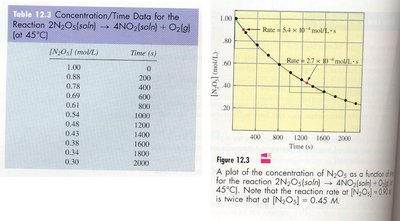
Rates are not constant; they typically decrease as the reaction proceeds.
The instantaneous rate is the slope of the tangent to the concentration vs. time curve at a specific time.
Relative Rates and Stoichiometry
Relative rates are determined by the stoichiometry of the balanced equation. For example, for the reaction:
The rate expressions are:
Rate Laws: An Introduction
Rate Law Expressions
The rate law relates the reaction rate to the concentrations of reactants (and sometimes catalysts):
k is the rate constant (temperature dependent).
m, n, p are the reaction orders with respect to each species, determined experimentally.
The overall order is the sum of the exponents.
Common Reaction Orders
Zero Order: Rate does not depend on concentration.
First Order: Rate is directly proportional to concentration.
Second Order: Rate is proportional to the square of concentration.
Determining Rate Laws from Experimental Data
By comparing initial rates with varying concentrations, the order with respect to each reactant can be deduced. For example, if doubling [A] doubles the rate, the reaction is first order in A.
Integrated Rate Laws: Concentration/Time Relationships
Zero, First, and Second Order Integrated Rate Laws
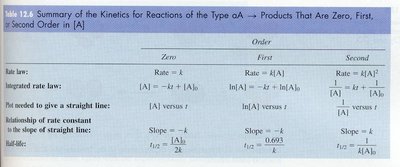
Order | Integrated Rate Law | Straight Line Plot | Slope | Half-life () |
|---|---|---|---|---|
Zero | vs. | |||
First | vs. | |||
Second | vs. |
Graphical Methods for Determining Reaction Order
Plot vs. (zero order), vs. $t$ (first order), and vs. $t$ (second order). The plot that yields a straight line indicates the reaction order.
Half-Life of Reactions
First Order
The half-life is independent of the initial concentration:
Second Order
The half-life depends on the initial concentration:
Zero Order
The half-life is:
Reaction Mechanisms
Elementary Steps and Molecularity
Unimolecular: Involves one reactant molecule. Rate =
Bimolecular: Involves two reactant molecules. Rate = or
Termolecular: Involves three molecules (rare). Rate =
The overall reaction rate is determined by the slowest (rate-determining) step in the mechanism.
Transition State Theory and Activation Energy
Energy Profile of a Reaction
The activation energy () is the minimum energy required for a reaction to occur.
The transition state is the highest energy point along the reaction path.
Endothermic reactions absorb heat; exothermic reactions release heat.
The Arrhenius Equation
Temperature Dependence of Rate Constants
The Arrhenius equation relates the rate constant to temperature and activation energy:
Taking the natural logarithm:
Plotting vs. yields a straight line with slope .
Catalysis
Role of Catalysts
Catalysts lower the activation energy, increasing the reaction rate without being consumed.
They do not affect the overall energy change () of the reaction.
Heterogeneous Catalysis
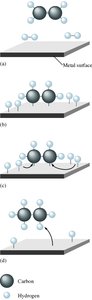
The catalyst is in a different phase than the reactants (e.g., solid catalyst with gaseous reactants).
Involves adsorption of reactants on the catalyst surface, reaction, and desorption of products.
Homogeneous Catalysis
The catalyst is in the same phase as the reactants (e.g., all in solution).
Example: Chlorine atoms catalyzing ozone decomposition in the atmosphere.
Catalytic Converters
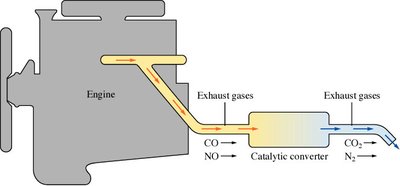
Devices in automobiles that use heterogeneous catalysts to convert toxic gases (CO, NO) into less harmful substances (CO2, N2).
Summary Table: Kinetics of Zero, First, and Second Order Reactions
Order | Rate Law | Integrated Rate Law | Straight Line Plot | Slope | Half-life |
|---|---|---|---|---|---|
Zero | Rate = k | vs. | |||
First | Rate = k[A] | vs. | |||
Second | Rate = k[A]2 | vs. |
Additional info: This guide covers the essential concepts, equations, and graphical methods for understanding chemical kinetics, including the effects of catalysts, reaction mechanisms, and the Arrhenius equation. Practice problems and exercises are recommended for mastery.
