 뒤로
뒤로CHEM 131 Chapter 4: Chemical Reactions and Chemical Quantities: Study Notes
스터디 가이드 - 스마트 노트
 자료에 맞춘 맞춤형 노트, 핵심 정의, 예시, 맥락을 확장해 제공합니다.
Chapter 4: Chemical Reactions and Chemical Quantities
Introduction to Chemical Reactions and Equations
Chemical reactions involve the transformation of substances (reactants) into new substances (products) through the breaking and forming of chemical bonds. These changes are represented using chemical equations, which provide information about the identities, states, and relative quantities of the substances involved.
Chemical Reaction: A process in which one or more substances are converted into one or more different substances, often accompanied by energy changes such as heat emission.
Chemical Equation: A symbolic representation of a chemical reaction, showing the formulas of reactants and products, their physical states, and their relative quantities.
States of Matter in Equations: Indicated by (s) for solid, (l) for liquid, (g) for gas, and (aq) for aqueous solution.
Abbreviation | State |
|---|---|
(g) | Gas |
(l) | Liquid |
(s) | Solid |
(aq) | Aqueous (water solution) |
Law of Conservation of Mass and Balancing Equations
The Law of Conservation of Mass states that matter is neither created nor destroyed in a chemical reaction. Therefore, chemical equations must be balanced so that the number of atoms of each element is the same on both sides of the equation.
Balancing Steps:
Write the unbalanced (skeletal) equation with correct formulas for all reactants and products.
Balance atoms in complex substances first, then balance free elements.
If fractional coefficients are present, multiply all coefficients by the denominator to obtain whole numbers.
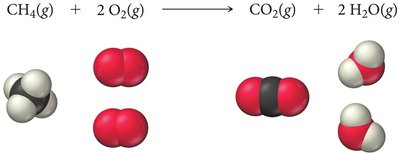
Example: The combustion of methane:
Combustion Reactions
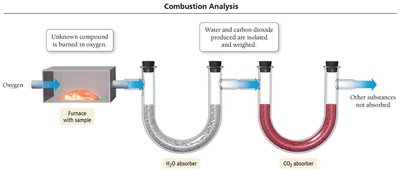
Combustion reactions are a type of chemical reaction where a substance reacts rapidly with oxygen, releasing energy in the form of heat and light. Organic compounds containing carbon and hydrogen (and sometimes oxygen) are commonly analyzed by combustion.
All carbon in the compound forms CO2, all hydrogen forms H2O, and oxygen is determined by subtraction.
Used to determine empirical formulas of unknown compounds.
Reaction Stoichiometry
Stoichiometry is the quantitative relationship between reactants and products in a chemical reaction, based on the balanced equation. The coefficients indicate the relative number of moles of each substance involved.
Mole Ratios: Used to convert between amounts of reactants and products.
Example: For the combustion of octane: 2 mol C8H18 : 25 mol O2 : 16 mol CO2 : 18 mol H2O
Mass-to-Mass Conversions
To determine the mass of a product formed from a given mass of reactant, use the following steps:
Convert mass of reactant to moles using molar mass.
Use the stoichiometric ratio from the balanced equation to find moles of product.
Convert moles of product to mass using its molar mass.

Limiting Reactant, Theoretical Yield, and Percent Yield
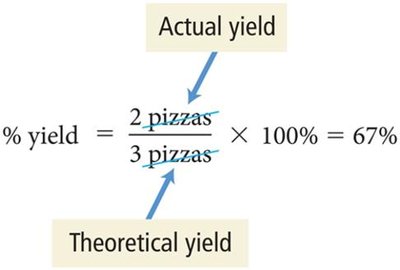
In reactions with more than one reactant, the limiting reactant is the one that is completely consumed first, thus limiting the amount of product formed. The theoretical yield is the maximum amount of product that can be formed, while the actual yield is the amount actually obtained. Percent yield measures the efficiency of a reaction.
Percent Yield Formula:
Example: If you can make 3 pizzas (theoretical yield) but only make 2 (actual yield):
Visualizing Limiting and Excess Reactants
Visual models can help illustrate the concept of limiting and excess reactants. The reactant that produces the least amount of product is the limiting reactant; any remaining reactant is in excess.
Example: In the reaction 2H2 + O2 → 2H2O, if you have more H2 than needed, O2 is the limiting reactant.
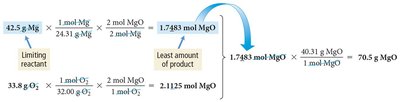
Calculating Limiting Reactant and Theoretical Yield from Masses
To determine the limiting reactant and theoretical yield when given masses of reactants:
Convert each reactant mass to moles.
Use stoichiometry to calculate the amount of product each reactant can produce.
The reactant that produces the least product is the limiting reactant; this amount is the theoretical yield.
Reactions of Alkali Metals and Halogens
Alkali metals react vigorously with nonmetals and water, forming ionic compounds and releasing hydrogen gas. Halogens react with metals to form metal halides, with hydrogen to form hydrogen halides, and with each other to form interhalogen compounds.
Example: Sodium reacts with chlorine to form sodium chloride:
Alkali metals with water:
Halogens with hydrogen:
Summary Table: Key Terms and Concepts
Term | Definition |
|---|---|
Chemical Equation | Symbolic representation of a chemical reaction |
Stoichiometry | Quantitative relationship between reactants and products |
Limiting Reactant | Reactant that is completely consumed first |
Theoretical Yield | Maximum possible amount of product |
Actual Yield | Amount of product actually obtained |
Percent Yield | Efficiency of a reaction, actual yield divided by theoretical yield |
Additional info: These notes provide a comprehensive overview of chemical reactions, stoichiometry, limiting reactants, and yields, as well as the reactivity of alkali metals and halogens, all of which are essential for mastering General Chemistry at the college level.
