 뒤로
뒤로Chemical Reactions: Double Replacement and Redox Reactions
스터디 가이드 - 스마트 노트
 자료에 맞춘 맞춤형 노트, 핵심 정의, 예시, 맥락을 확장해 제공합니다.
Double Replacement Reactions
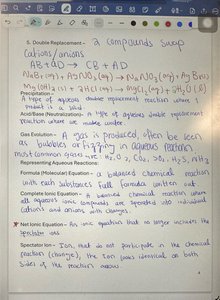
Definition and General Form
Double replacement reactions are a type of chemical reaction in which two compounds exchange their cations and anions to form two new compounds. This process is commonly observed in aqueous solutions.
General Equation:
Example:
Example:
Types of Double Replacement Reactions
Precipitation Reaction: Occurs when an insoluble product (precipitate) forms from the reaction of two soluble compounds in solution.
Gas Evolution Reaction: A gas is produced, often visible as bubbles, as a result of the reaction in aqueous solution.
Common gases: , , ,
Formula Representation
Molecular Equation: Shows the complete formulas of all reactants and products.
Complete Ionic Equation: Shows all strong electrolytes as ions.
Net Ionic Equation: Shows only the species that actually participate in the reaction, omitting spectator ions.
Example Table: Types of Double Replacement Reactions
Type | Description | Example |
|---|---|---|
Precipitation | Formation of insoluble solid | |
Gas Evolution | Formation of gas |
Oxidation-Reduction (Redox) Reactions
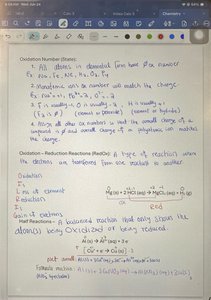
Oxidation Number (States)
Oxidation numbers are assigned to atoms in compounds to track electron transfer during chemical reactions. They help identify which atoms are oxidized and which are reduced.
Rules for Assigning Oxidation Numbers:
Atoms in elemental form have oxidation number 0 (e.g., , ).
Monatomic ions: Oxidation number equals the ion charge (e.g., is +1).
Fluorine is always -1 in compounds.
Oxygen is usually -2 (except in peroxides, where it is -1).
Hydrogen is +1 when bonded to nonmetals, -1 when bonded to metals.
Other halogens (Cl, Br, I) are usually -1 unless combined with oxygen or fluorine.
The sum of oxidation numbers in a neutral compound is 0; in a polyatomic ion, it equals the ion charge.
Redox Reactions
Redox reactions involve the transfer of electrons between atoms, resulting in changes in oxidation numbers. One atom is oxidized (loses electrons), and another is reduced (gains electrons).
Oxidation: Increase in oxidation number (loss of electrons).
Reduction: Decrease in oxidation number (gain of electrons).
Example:
is oxidized from 0 to +1.
is reduced from 0 to -1.
Identifying Redox Reactions
Compare oxidation numbers of atoms before and after the reaction.
Redox reactions are balanced to show the atoms being oxidized and reduced.
Example Table: Oxidation Number Assignments
Element/Compound | Oxidation Number |
|---|---|
Na (elemental) | 0 |
Na+ (ion) | +1 |
Cl2 (elemental) | 0 |
Cl- (ion) | -1 |
O in H2O | -2 |
O in H2O2 | -1 |
Additional info:
Redox reactions are fundamental in processes such as metabolism, corrosion, and energy production in batteries.
Double replacement reactions are commonly used in qualitative analysis to identify ions in solution.
