 뒤로
뒤로Covalent Bonding, Molecular Structure, and VSEPR Theory: A General Chemistry Study Guide
스터디 가이드 - 스마트 노트
 자료에 맞춘 맞춤형 노트, 핵심 정의, 예시, 맥락을 확장해 제공합니다.
Covalent Bonding and Molecular Structure
Atomic Structure and Electron Configuration
Atoms are composed of a nucleus containing protons and neutrons, surrounded by electrons arranged in orbitals. The arrangement of electrons determines how atoms interact and bond with each other.
Orbitals describe regions in space where electrons are likely to be found, designated by quantum numbers (n = 1, 2, 3, ...; types: s, p, d, f).
Each orbital can hold a maximum of 2 electrons.
Electron shells (energy levels) contain increasing numbers of orbitals as n increases.
Valence electrons are the electrons in the outermost s and p orbitals and are most important for bonding.
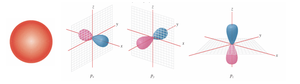
Electron configuration is specified by listing each orbital type with a superscript for the number of electrons (e.g., 1s22s1 for lithium).
Fundamentals of Chemical Bonding
Chemical bonds form due to the balance of attractive and repulsive forces between electrons and nuclei of atoms. The most stable arrangement is achieved when electron density is shared between nuclei, forming a covalent bond.
Bond length: The distance at which the molecule is most stable (attractive and repulsive forces are balanced).
Bond energy: The energy required to break a bond (always positive).
Covalent Bonding
A covalent bond is formed by sharing one or more pairs of electrons between atoms, allowing non-metals to achieve a stable electron configuration (octet rule).
Single bond: One pair of shared electrons (e.g., H–H).
Double bond: Two pairs of shared electrons (e.g., O=O).
Triple bond: Three pairs of shared electrons (e.g., N≡N).
Bond Polarity and Electronegativity
Polar Covalent Bonds and Electronegativity
When two different atoms share electrons unequally, a polar covalent bond forms. Electronegativity (𝜒) quantifies an atom's ability to attract electrons in a bond.
Electronegativity increases across a period and decreases down a group in the periodic table.
If Δ𝜒 > 2.0: Ionic bond; if Δ𝜒 < 0.5: Nonpolar covalent; if 0.5 < Δ𝜒 < 2.0: Polar covalent.
Properties of Covalent Bonds
Dipole moment (μ): A measure of bond polarity, depends on Δ𝜒 and molecular geometry.
Bond length: Increases with atomic size; multiple bonds are shorter than single bonds between the same atoms.
Bond energy: Increases with more shared electrons and greater Δ𝜒; decreases with longer bonds.

Polar and Nonpolar Molecules
A molecule is polar if it has a net dipole moment due to bond polarities and molecular shape. Symmetrical molecules with polar bonds may be nonpolar overall if the dipoles cancel.
Polarity affects melting/boiling points and solubility (e.g., water's high boiling point).
Ionic Bonds and Lattice Energy
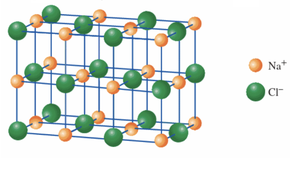
Ionic bonds form between elements with large differences in electronegativity, resulting in the transfer of electrons and formation of cations and anions. Ionic compounds are typically solid with high melting points, held together by electrostatic attraction.
Lattice energy: Energy required to separate an ionic lattice into gaseous ions; decreases with increasing ion size.
Lewis Structures and Resonance
Lewis Structures
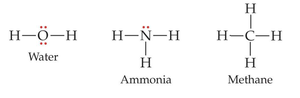
Lewis structures represent the bonding and lone pairs of electrons in a molecule. They are essential for predicting molecular geometry and reactivity.
Atoms are shown by their symbols; lines represent shared pairs (bonds); dots represent lone pairs.
Follow a systematic approach: count valence electrons, assemble the bonding framework, assign lone pairs, distribute remaining electrons, and minimize formal charges.
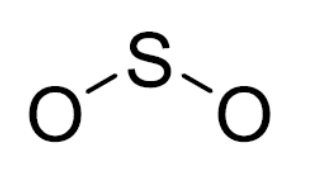
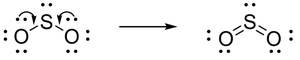
Example: Lewis Structure for SO2
Step 1: Count valence electrons (S = 6, O = 6 each; total = 18).
Step 2: Assemble bonding framework with single bonds.
Step 3: Place lone pairs on outer atoms.
Step 4: Assign remaining electrons to the central atom.
Step 5: Minimize formal charges by converting lone pairs to bonds if needed.

Resonance Structures
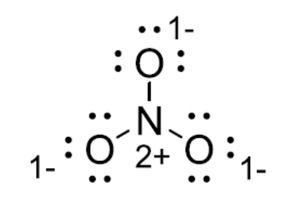
When more than one valid Lewis structure exists, the actual structure is a resonance hybrid. Resonance structures differ only in the arrangement of electrons, not atom positions.
Example: Nitrate ion (NO3–) has three resonance structures, each with different N=O and N–O bonds, but experimentally all N–O bonds are equivalent.
Valence Shell Electron Pair Repulsion (VSEPR) Theory
VSEPR Theory and Molecular Geometry
VSEPR theory predicts the three-dimensional arrangement of atoms in a molecule based on the repulsions between electron pairs (bonding and lone pairs) around a central atom. Electron pairs arrange themselves as far apart as possible to minimize repulsion.
Molecular geometry: Arrangement of all electron sets (bonding and lone pairs).
Molecular shape: Arrangement of atoms only (ignoring lone pairs).
Repulsion order: Lone pair–lone pair > lone pair–bonding pair > bonding pair–bonding pair.
Common Molecular Geometries and Shapes
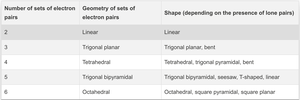
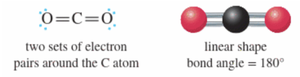
Linear (2 sets): 180° bond angle (e.g., BeH2, CO2).
Trigonal planar (3 sets): 120° bond angle (e.g., BF3); with one lone pair, shape is 'bent' (e.g., NO2–).
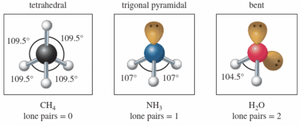
Tetrahedral (4 sets): 109.5° bond angle (e.g., CH4); with one lone pair, trigonal pyramidal (e.g., NH3); with two lone pairs, bent (e.g., H2O).
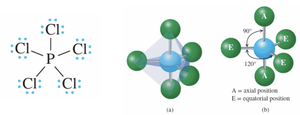
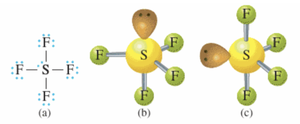
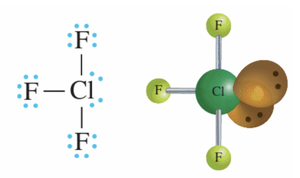
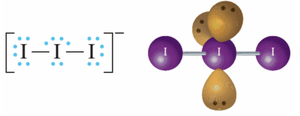
Trigonal bipyramidal (5 sets): 90°, 120° bond angles (e.g., PCl5); with lone pairs, shapes include seesaw, T-shaped, and linear.
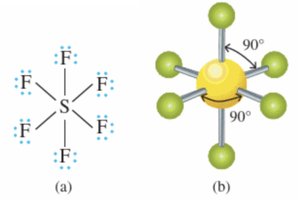
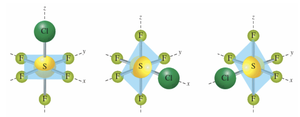
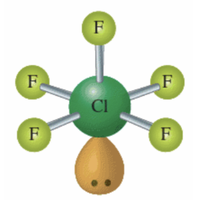
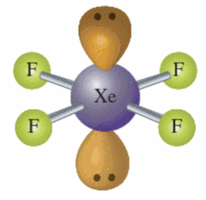
Octahedral (6 sets): 90° bond angles (e.g., SF6); with lone pairs, shapes include square pyramidal (e.g., ClF5) and square planar (e.g., XeF4).
Representing 3D Structures
Three-dimensional molecular structures can be represented in two dimensions using solid wedges (bonds coming out of the page) and dashed wedges (bonds going into the page). Lone pairs are often shown to clarify geometry and shape.
