 뒤로
뒤로Electrolytes, Ionic Equations, and Chemical Reactions in Aqueous Solution
스터디 가이드 - 스마트 노트
 자료에 맞춘 맞춤형 노트, 핵심 정의, 예시, 맥락을 확장해 제공합니다.
Electrolytes and Nonelectrolytes
Types of Solutions and Their Conductivity
When substances dissolve in water, they can either dissociate into ions or remain as intact molecules. This distinction determines whether the solution conducts electricity and is classified as an electrolyte or nonelectrolyte.
Electrolytes: Substances that dissolve in water to produce ions, allowing the solution to conduct electricity. Examples include ionic compounds like NaCl and strong acids.
Nonelectrolytes: Substances that dissolve in water as molecules and do not produce ions, so the solution does not conduct electricity. Examples include sugar and ethanol.
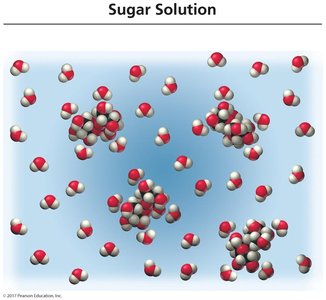
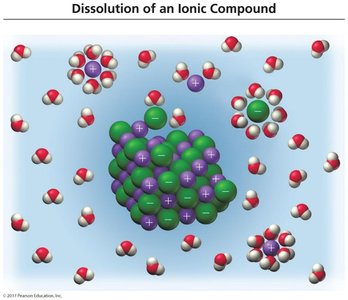
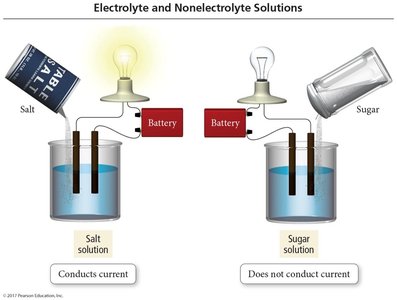
Dissociation and Ionization in Aqueous Solution
Behavior of Ionic and Molecular Compounds
When ionic compounds dissolve in water, they dissociate into their constituent ions. Molecular compounds may ionize to varying degrees depending on their chemical nature.
Dissociation: The process by which an ionic compound separates into ions when dissolved in water. For example: $\mathrm{Na_2S(aq) \rightarrow 2\ Na^+(aq) + S^{2-}(aq)}$
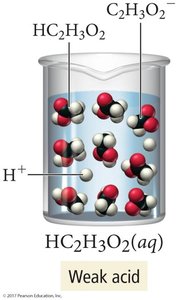
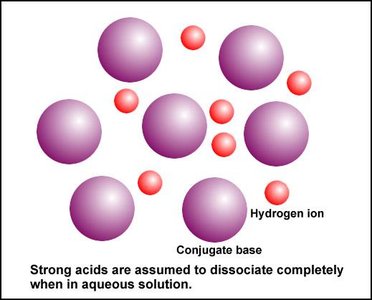
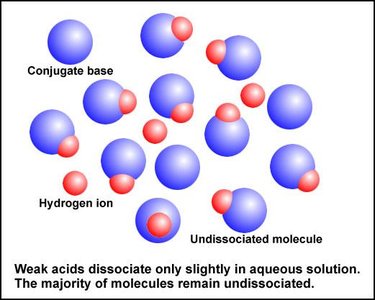
Ionization: The process by which a molecular compound forms ions in solution, as seen with acids. Strong acids ionize completely, while weak acids only partially ionize.
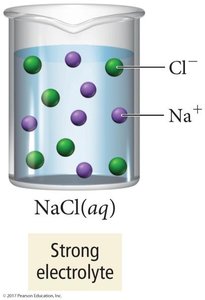
Strong and Weak Acids
Degree of Ionization
Acids are molecular compounds that ionize in water to produce hydrogen ions (H+) and anions. The extent of ionization distinguishes strong acids from weak acids.
Strong acids: Ionize completely in water, producing a high concentration of H+ ions. Example: $\mathrm{HCl(aq) \rightarrow H^+(aq) + Cl^-(aq)}$
Weak acids: Only partially ionize in water, resulting in an equilibrium between the undissociated acid and its ions. Example: $\mathrm{HF(aq) \rightleftharpoons H^+(aq) + F^-(aq)}$
Classification of Chemical Reactions in Aqueous Solution
Main Types of Reactions
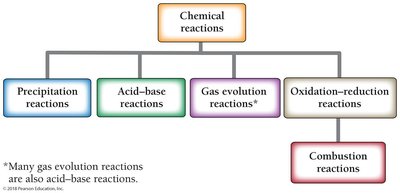
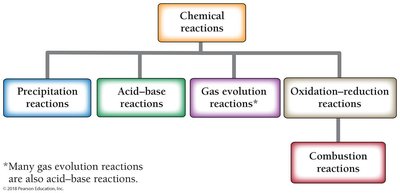
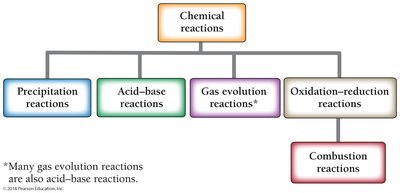
Chemical reactions in aqueous solution can be classified into several main types based on the nature of the reactants and products:
Precipitation reactions: Formation of an insoluble solid (precipitate) when two solutions are mixed.
Acid–base reactions: Transfer of protons (H+) between reactants, often producing water and a salt.
Gas evolution reactions: Formation of a gas as a product of the reaction.
Oxidation–reduction (redox) reactions: Transfer of electrons between reactants, changing their oxidation states.
Precipitation Reactions
Formation of Insoluble Products
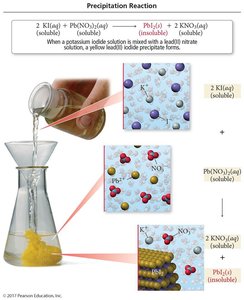
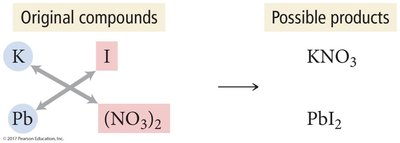
Precipitation reactions occur when two aqueous solutions of ionic compounds are mixed and an insoluble product forms. The insoluble product is called a precipitate.
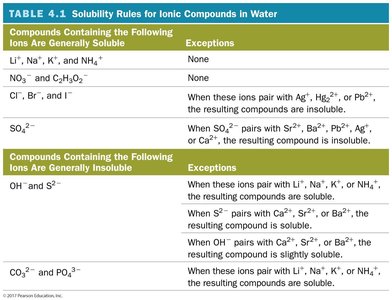
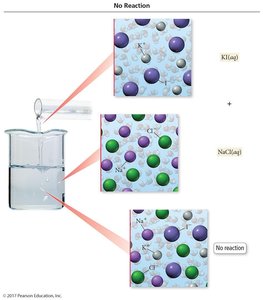
Solubility rules are used to predict whether a precipitate will form. These rules are based on experimental observations and help determine if a compound is soluble or insoluble in water.
Empirical method: Solubility is determined by experiment, and general rules are developed from these results.
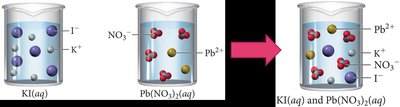
Solubility Rules Table
The following table summarizes the solubility rules for common ionic compounds in water:
Compounds Containing the Following Ions Are Generally Soluble | Exceptions |
|---|---|
Li+, Na+, K+, NH4+ | None |
NO3−, C2H3O2− | None |
Cl−, Br−, I− | When paired with Ag+, Hg22+, or Pb2+, insoluble |
SO42− | When paired with Sr2+, Ba2+, Pb2+, Ag+, or Ca2+, insoluble |
Compounds Containing the Following Ions Are Generally Insoluble | Exceptions |
OH−, S2− | When paired with Li+, Na+, K+, or NH4+, soluble; S2− with Ca2+, Sr2+, Ba2+, soluble; OH− with Ca2+, Sr2+, Ba2+, slightly soluble |
CO32−, PO43− | When paired with Li+, Na+, K+, or NH4+, soluble |
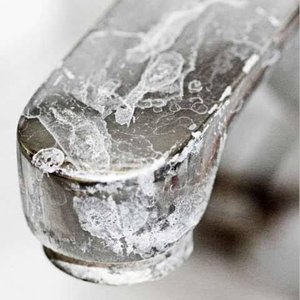
Representing Aqueous Reactions: Molecular, Complete Ionic, and Net Ionic Equations
Types of Chemical Equations
Chemical reactions in aqueous solution can be represented in three main ways:
Molecular equation: Shows the complete, neutral formulas for every compound in the reaction.
Complete ionic equation: Shows all of the species as they are actually present in solution (dissociated ions for strong electrolytes).
Net ionic equation: Shows only the species that actually participate in the reaction, omitting spectator ions.
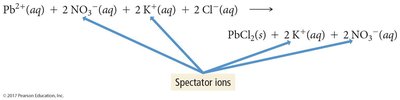
Acid–Base Reactions
Neutralization and Salt Formation
Acid–base reactions, also known as neutralization reactions, involve the reaction of an acid and a base to form water and an ionic compound (salt). The net ionic equation for many acid–base reactions is:
$\mathrm{H^+(aq) + OH^-(aq) \rightarrow H_2O(l)}$
Definitions of Acids and Bases
Acid: Substance that produces H+ in aqueous solution. Example: $\mathrm{HCl(aq) \rightarrow H^+(aq) + Cl^-(aq)}$
Base: Substance that produces OH− in aqueous solution. Example: $\mathrm{NaOH(aq) \rightarrow Na^+(aq) + OH^-(aq)}$
Polyprotic acids: Acids that contain more than one ionizable proton, releasing them sequentially (e.g., H2SO4).
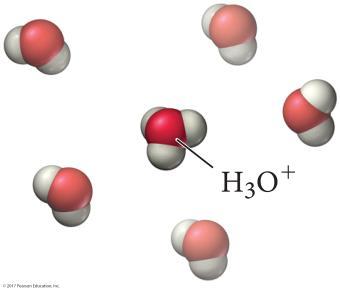
Common Acids and Bases
Name of Acid | Formula | Name of Base | Formula |
|---|---|---|---|
Hydrochloric acid | HCl | Sodium hydroxide | NaOH |
Hydrobromic acid | HBr | Lithium hydroxide | LiOH |
Hydroiodic acid | HI | Potassium hydroxide | KOH |
Nitric acid | HNO3 | Calcium hydroxide | Ca(OH)2 |
Sulfuric acid | H2SO4 | Barium hydroxide | Ba(OH)2 |
Perchloric acid | HClO4 | Ammonia (weak base) | NH3 |
Formic acid (weak acid) | HCO2H | ||
Acetic acid (weak acid) | HC2H3O2 | ||
Hydrofluoric acid (weak acid) | HF |
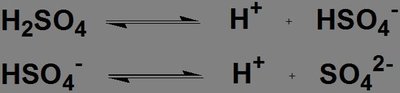
Acid–Base Titrations
Determining Concentration by Neutralization
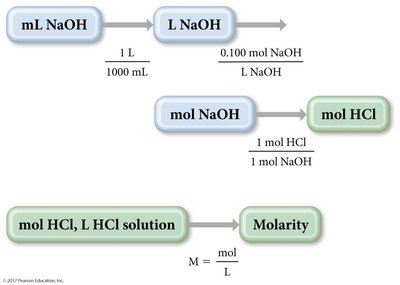
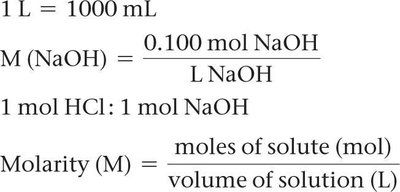
Titration is a laboratory technique used to determine the concentration of an unknown solution by reacting it with a solution of known concentration. The equivalence point is reached when the amount of acid equals the amount of base in the reaction.
Indicator: A dye that changes color depending on the acidity or basicity of the solution, used to detect the equivalence point.
Calculation: Use the stoichiometry of the reaction and the known volume and concentration of titrant to find the unknown concentration.
Gas Evolution Reactions
Formation of Gaseous Products
Gas evolution reactions produce a gas as a product, often resulting in bubbling. These reactions can occur directly or through the decomposition of an intermediate product.
Direct gas formation: $\mathrm{K_2S(aq) + H_2SO_4(aq) \rightarrow K_2SO_4(aq) + H_2S(g)}$
Formation via decomposition: $\mathrm{NaHCO_3(aq) + HCl(aq) \rightarrow NaCl(aq) + H_2CO_3(aq)}$ followed by $\mathrm{H_2CO_3(aq) \rightarrow H_2O(l) + CO_2(g)}$
Oxidation–Reduction (Redox) Reactions
Electron Transfer and Oxidation States
Redox reactions involve the transfer of electrons between substances, resulting in changes in oxidation states. These reactions are essential in processes such as corrosion, combustion, and metabolism.
Oxidation: Loss of electrons (increase in oxidation state).
Reduction: Gain of electrons (decrease in oxidation state).
Oxidizing agent: Substance that causes oxidation (is reduced).
Reducing agent: Substance that causes reduction (is oxidized).
Helpful mnemonics: OIL RIG (Oxidation Is Loss; Reduction Is Gain), LEO GER (Lose Electrons Oxidation; Gain Electrons Reduction).
Assigning Oxidation States
Free elements: Oxidation state = 0
Monatomic ions: Oxidation state = ion charge
Sum of oxidation states in a compound = 0
Sum of oxidation states in a polyatomic ion = ion charge
Group I metals: +1; Group II metals: +2
Nonmetals: Assign based on priority (e.g., F = –1, O = –2, H = +1, etc.)
Classification of Chemical Reactions by Atom Rearrangement
Synthesis, Decomposition, and Displacement Reactions
Synthesis reaction: Two or more simple substances combine to form a more complex substance.
Decomposition reaction: A complex substance breaks down into simpler substances.
Single-displacement reaction: One element displaces another in a compound.
Double-displacement reaction: Two elements or groups in different compounds exchange places.
Examples include precipitation, acid–base, and gas evolution reactions.
Summary Table: Types of Chemical Reactions
Type of Reaction | Description | Example |
|---|---|---|
Precipitation | Formation of an insoluble solid | $\mathrm{AgNO_3(aq) + NaCl(aq) \rightarrow AgCl(s) + NaNO_3(aq)}$ |
Acid–Base | Transfer of H+ between reactants | $\mathrm{HCl(aq) + NaOH(aq) \rightarrow H_2O(l) + NaCl(aq)}$ |
Gas Evolution | Formation of a gas | $\mathrm{Na_2CO_3(aq) + 2 HCl(aq) \rightarrow 2 NaCl(aq) + H_2O(l) + CO_2(g)}$ |
Redox | Transfer of electrons | $\mathrm{2 Na(s) + Cl_2(g) \rightarrow 2 NaCl(s)}$ |
