 뒤로
뒤로Entropy of the Surroundings & Gibbs Free Energy: Spontaneity and Temperature Dependence
스터디 가이드 - 스마트 노트
 자료에 맞춘 맞춤형 노트, 핵심 정의, 예시, 맥락을 확장해 제공합니다.
Entropy of the Surroundings
Heat Transfer and Entropy Change
The entropy change of the surroundings (ΔSsurr) is a key factor in determining the spontaneity of chemical reactions. It is directly related to the heat exchanged with the surroundings and the temperature at which the process occurs.
Formula: , where T is in Kelvins.
Exothermic reactions (ΔHsys < 0): Surroundings gain heat, so ΔSsurr > 0.
Endothermic reactions (ΔHsys > 0): Surroundings lose heat, so ΔSsurr < 0.
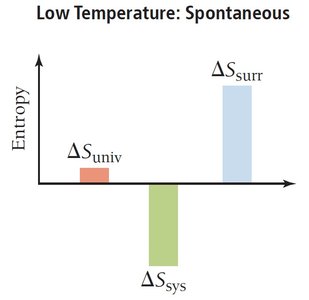
Temperature dependence: At low T, ΔSsurr is large; at high T, ΔSsurr is small for the same ΔH.
Example: When water freezes (liquid → solid), ΔSsys < 0 (system becomes more ordered), but the process is exothermic, so ΔSsurr > 0. At low temperatures, the positive ΔSsurr dominates, making the process spontaneous.
Temperature Dependence of Spontaneity
Why Phase Transitions Occur at Specific Temperatures
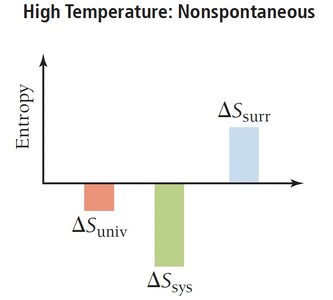
The spontaneity of a process depends on the balance between the entropy changes of the system and the surroundings. The sum, ΔSuniv = ΔSsys + ΔSsurr, determines whether a process is spontaneous (ΔSuniv > 0) or not.
At low temperature: ΔSsurr is large and can outweigh a negative ΔSsys, making ΔSuniv positive (spontaneous).
At high temperature: ΔSsurr is small, so a negative ΔSsys dominates, making ΔSuniv negative (nonspontaneous).
This explains why, for example, water freezes spontaneously below 0°C but not above.
Gibbs Free Energy: The Criterion for Spontaneity
Definition and Equation
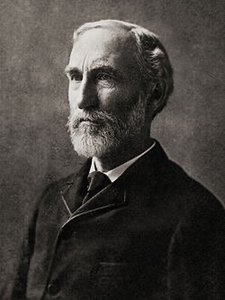
Gibbs free energy (G) is a thermodynamic function that combines enthalpy and entropy to predict the spontaneity of a process at constant temperature and pressure.
Equation:
Change in Gibbs free energy:
Relationship to the universe:
Spontaneity criterion:
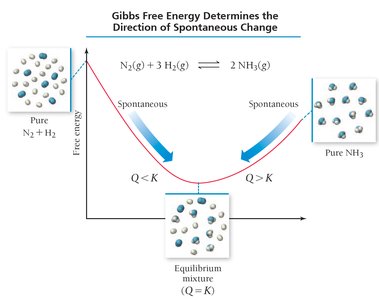
ΔG < 0: Process is spontaneous
ΔG = 0: System is at equilibrium
ΔG > 0: Process is nonspontaneous (reverse is spontaneous)
Physical meaning: |ΔG| is the maximum useful work obtainable from a process (if ΔG < 0), or the minimum work required to drive a nonspontaneous process (if ΔG > 0).
The Four Cases: How ΔH, ΔS, and T Determine Spontaneity
Classification of Reaction Spontaneity
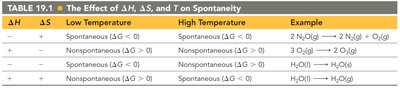
The sign of ΔH (enthalpy change) and ΔS (entropy change), along with temperature, determines whether a reaction is spontaneous.
Case 1: ΔH < 0, ΔS > 0 — Always spontaneous (ΔG < 0 at all T)
Case 2: ΔH > 0, ΔS < 0 — Never spontaneous (ΔG > 0 at all T)
Case 3: ΔH < 0, ΔS < 0 — Spontaneous at low T only
Case 4: ΔH > 0, ΔS > 0 — Spontaneous at high T only
Crossover temperature: The temperature at which ΔG changes sign is .
Practice Problems and Applications
Sample Calculations
Example 1: For the reaction 2 N2(g) + O2(g) → 2 N2O(g), ΔH°rxn = +163.2 kJ, ΔSsys = −109 J/K at 25°C.
Calculate ΔSsurr at 25°C (T = 298.15 K):
Calculate ΔSuniv:
Since ΔSuniv < 0, the reaction is NOT spontaneous at 25°C.
Example 2: For C2H4(g) + H2(g) → C2H6(g), ΔH = −137.5 kJ, ΔS = −120.5 J/K:
Case 3: Spontaneous at low T only (ΔH−, ΔS−)
Crossover T:
Example 3: Electrolysis of water (2H2O(l) → 2H2(g) + O2(g)): ΔH > 0, ΔS > 0 — Spontaneous only at high T, but requires electrical input at room temperature.
Summary Table: Effect of ΔH, ΔS, and T on Spontaneity
ΔH | ΔS | Low Temperature | High Temperature | Example |
|---|---|---|---|---|
− | + | Spontaneous (ΔG < 0) | Spontaneous (ΔG < 0) | 2 N2(g) + O2(g) → 2 N2O(g) |
+ | − | Nonspontaneous (ΔG > 0) | Nonspontaneous (ΔG > 0) | 3 O2(g) → 2 O3(g) |
− | − | Spontaneous (ΔG < 0) | Nonspontaneous (ΔG > 0) | H2O(g) → H2O(l) |
+ | + | Nonspontaneous (ΔG > 0) | Spontaneous (ΔG < 0) | H2O(l) → H2O(g) |
Key Takeaways
ΔSsurr = −ΔHsys/T: Exothermic reactions increase surroundings entropy; endothermic reactions decrease it.
ΔSsurr is larger at low T.
Gibbs free energy: ΔG = ΔH − TΔS = −TΔSuniverse; ΔG < 0 → spontaneous.
Four cases: (1) ΔH−, ΔS+: always spontaneous; (2) ΔH+, ΔS−: never spontaneous; (3) ΔH−, ΔS−: spontaneous at low T only; (4) ΔH+, ΔS+: spontaneous at high T only.
Crossover temperature: Tcrossover = ΔH/ΔS (where ΔG changes sign).
