 뒤로
뒤로Exam 4 Review: Electromagnetic Waves, Quantum Numbers, Electron Configuration, and Chemical Bonding
스터디 가이드 - 스마트 노트
 자료에 맞춘 맞춤형 노트, 핵심 정의, 예시, 맥락을 확장해 제공합니다.
Chapter 8: Electromagnetic Waves and Quantum Numbers
Electromagnetic Waves
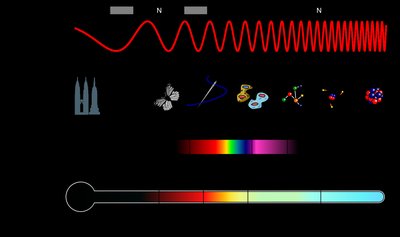
The electromagnetic (EM) spectrum encompasses all types of electromagnetic radiation, which differ in wavelength and frequency. Understanding the EM spectrum is essential for interpreting the behavior of light and energy in chemical systems.
EM Spectrum Diagram: The EM spectrum ranges from low-energy radio waves to high-energy gamma rays. Visible light occupies a small portion, with wavelengths from approximately 400 nm (violet, highest energy) to 700 nm (red, lowest energy).
Key Equations:
Speed of light: Where m/s, is wavelength (meters), is frequency (Hz or s-1).
Energy of a photon: Where Js (Planck's constant).
Energy-wavelength relation:
Units: Wavelength (meters), Frequency (Hz or s-1), Energy (Joules).
Visible Light: Ranges from 400 nm (violet) to 700 nm (red).
Quantum Numbers and Atomic Orbitals
Quantum numbers describe the properties of atomic orbitals and the electrons within them. Each electron in an atom is defined by a unique set of four quantum numbers.
Principal Quantum Number (n): Indicates the size and energy level of the orbital. Possible values: 1, 2, 3, ...
Azimuthal Quantum Number (l): Defines the shape of the orbital. Values: 0 to n-1. l = 0 (s orbital), l = 1 (p orbital), l = 2 (d orbital), l = 3 (f orbital).
Magnetic Quantum Number (ml): Specifies the orientation of the orbital. Values: -l to +l.
Spin Quantum Number (ms): Describes the spin of the electron. Values: +1/2 or -1/2.
Selection Rules:
n: 1, 2, 3, ...
l: 0, 1, ..., n-1
ml: -l, ..., 0, ..., +l
ms: ±1/2
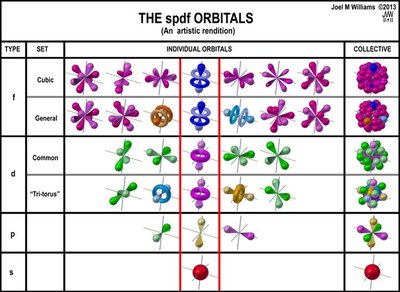
Example: For n = 2 (second energy level), possible l values are 0 and 1. For l = 1 (p orbital), ml can be -1, 0, or +1.
Chapter 9: Electron Configurations and Periodic Trends
Electron Configurations
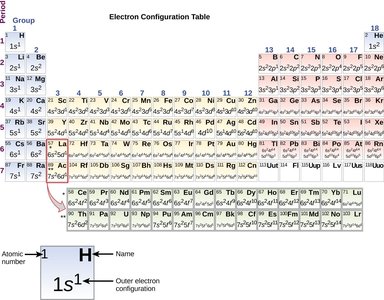
Electron configuration describes the arrangement of electrons in an atom's orbitals. The Aufbau principle, Pauli exclusion principle, and Hund's rule guide the filling order.
Noble Gas Configuration: Use the previous noble gas (Group 18) in brackets to simplify notation. Example: [Ne] 3s23p4 for sulfur.
Example: Copper (Cu): [Ar] 4s13d10
Periodic Trends
Periodic trends describe how properties of elements change across periods and groups in the periodic table.
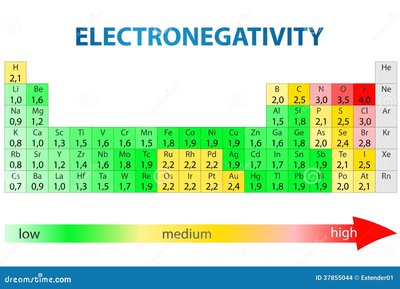
Electronegativity: Tendency of an atom to attract electrons. Increases across a period (left to right), decreases down a group. Fluorine is the most electronegative element.
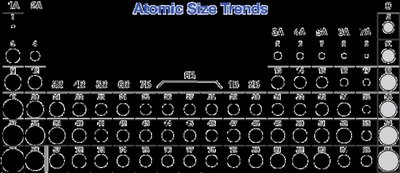
Atomic Size: Atomic radius decreases across a period and increases down a group.
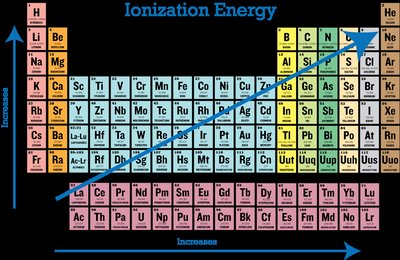
Ionization Energy: Energy required to remove an electron from an atom. Increases across a period, decreases down a group.
Chapter 10: Chemical Bonding and Molecular Structure
Types of Bonds
Chemical bonds form between atoms to achieve stability. The main types are covalent, ionic, and metallic bonds.
Covalent Bonds: Sharing of electrons between two nonmetals.
Ionic Bonds: Transfer of electrons from a metal to a nonmetal.
Metallic Bonds: Delocalized 'sea of electrons' among metal atoms.
Covalent Bond Polarity:
Nonpolar: Even or nearly even sharing (electronegativity difference 0.0–0.4).
Polar: Unequal sharing (difference 0.4–1.9).
Ionic: Difference ≥ 2.0.
Radical: A molecule with an odd number of electrons.
Bond Strength and Order
Single Bond: One sigma (σ) bond; weakest and longest.
Double Bond: One sigma and one pi (π) bond.
Triple Bond: One sigma and two pi bonds; strongest and shortest.
Sigma bonds are stronger than pi bonds.
Hybridization
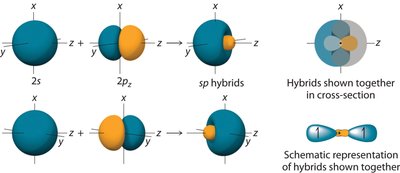
Hybridization explains the mixing of atomic orbitals to form new, equivalent hybrid orbitals for bonding.
Number of Hybrid Orbitals: Equals the number of sigma bonds plus lone pairs on the central atom.
Examples: sp2 hybridization has 3 hybrid orbitals.
VSEPR Theory and Molecular Geometry
Valence Shell Electron Pair Repulsion (VSEPR) theory predicts the shapes of molecules based on electron pair repulsion around the central atom.
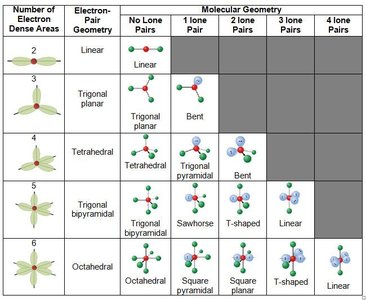
Electron Domains: Regions of electron density (bonds and lone pairs) around the central atom.
Common Geometries: Linear, trigonal planar, tetrahedral, trigonal bipyramidal, octahedral.
Effect of Lone Pairs: Lone pairs occupy more space and can alter bond angles and molecular shape.
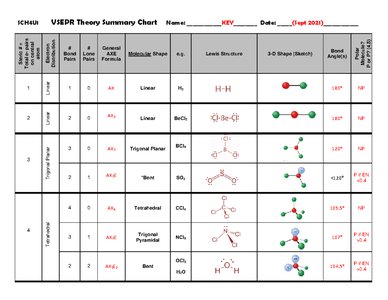
Lewis Structures and Formal Charge
Lewis structures represent the arrangement of valence electrons in molecules. The octet rule states that atoms tend to have eight electrons in their valence shell. Some elements can have expanded octets.
Formal Charge: Calculated as: Formal charge = (Valence electrons) – (Nonbonding electrons) – (Bonding electrons/2)
Application: Used to determine the most stable Lewis structure and identify atoms with unusual charges.
Example: In CHOO-, one oxygen has a negative formal charge (sp2, trigonal planar), the other is neutral (sp3, tetrahedral).
Practice Problems (Selected)
Calculate the frequency and energy of red light (676 nm).
Determine the energy of a microwave photon (2.45 GHz).
Assign quantum numbers for electrons in various orbitals.
Write electron configurations for elements (e.g., Cu, S).
Predict molecular geometry and hybridization for molecules (e.g., CH4, NH3, H2O).
Additional info: For full solutions, refer to the answer key provided in the original materials.
