 뒤로
뒤로Formal Charge Assignment and Resonance Structure Plausibility for HCNO
스터디 가이드 - 스마트 노트
 자료에 맞춘 맞춤형 노트, 핵심 정의, 예시, 맥락을 확장해 제공합니다.
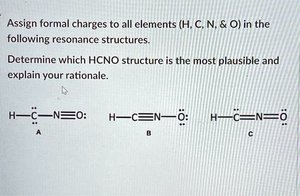
Q8. Assign formal charges to all elements (H, C, N, O) in the following resonance structures of HCNO. Determine which structure is most plausible and explain your rationale.
Background
Topic: Resonance Structures and Formal Charge
This question tests your understanding of how to assign formal charges to atoms in different resonance structures and how to evaluate which resonance form is most plausible based on formal charge distribution and chemical reasoning.
Key Terms and Formulas
Formal Charge: The charge assigned to an atom in a molecule, calculated as:
Resonance Structure: Different possible Lewis structures for a molecule that differ only in the arrangement of electrons.
Plausibility: Resonance forms are more plausible when formal charges are minimized and placed on atoms that can best accommodate them (e.g., negative charge on more electronegative atoms).
Step-by-Step Guidance
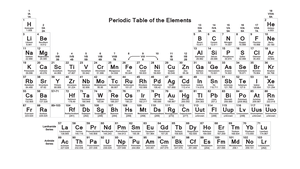
For each resonance structure (A, B, C), identify the number of valence electrons for H, C, N, and O using the periodic table. For example, H = 1, C = 4, N = 5, O = 6.
Count the number of nonbonding (lone pair) electrons and bonding electrons for each atom in each structure. Bonding electrons are shared in bonds; nonbonding electrons are lone pairs.
Apply the formal charge formula for each atom in each structure. For example, for carbon in structure A:
Repeat the calculation for all atoms (H, C, N, O) in each resonance structure (A, B, C). Write down the formal charges next to each atom.
Compare the formal charge distributions for each structure. Consider which structure has the lowest formal charges and places negative charges on the most electronegative atoms (like O).
Try solving on your own before revealing the answer!
